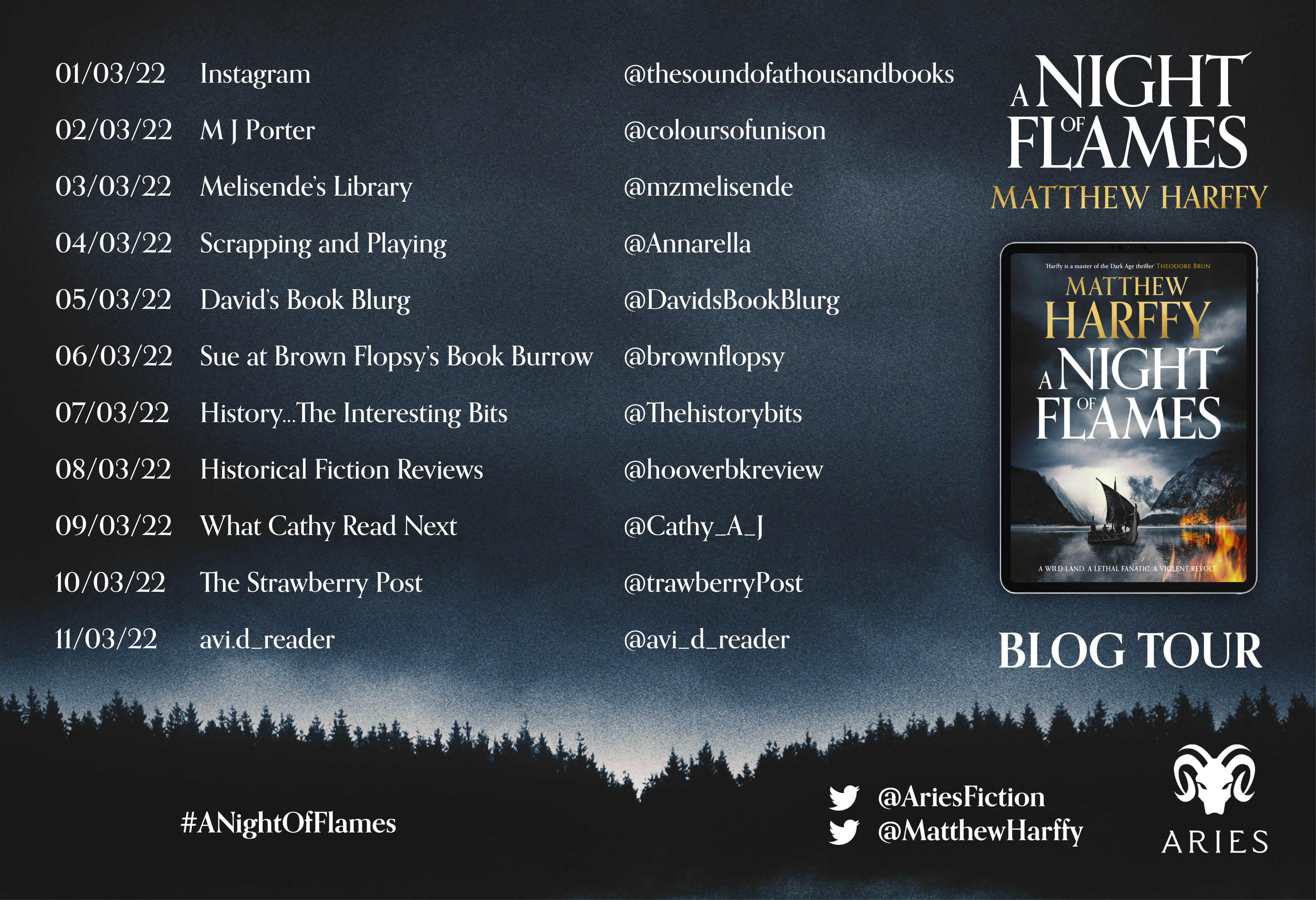
 Welcome to today’s stop on the blog tour for A Night of Flames by Matthew Harffy. My thanks to Andrew at Head of Zeus for inviting me to take part in the tour and for my review copy. Before I share my thoughts, let’s see what some of the other book bloggers taking part in the tour have been saying about A Night of Flames:
“Harffy’s narrative is such that the reader finds themselves not only drawn into Hunlaf’s world but posited into the warband itself.” Melisende
“It’s unreal how haunting amazing this book is.. how is it even possible to write something so disturbingly beautiful! There’s so many emotions that pass through you as you read this one and it’s something that will really stay with you.” David at David’s Book Blurg
“I cannot remember the last time I was so terrified reading a work of historical fiction – the way Harffy builds suspense, ramping up to a tense and heart-in-the-mouth climax is impressive in the extreme.” Sue at Brown Flopsy’s Book Burrow
“It is edge-of-the-seat drama that will keep the reader engrossed late into the night. The battles are vicious, the losses devastating and the outcome uncertain – this is Matthew Harffy at his best.” Sharon at History…The Interesting Bits
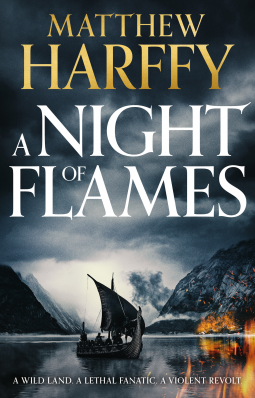 About the Book
A wild land. A lethal fanatic. A violent revolt.
Northumbria, AD 794. Those who rule the seas, rule the land. None know the truth of this more than the Vikings. To compete with the sea-faring, violent raiders, the king of Northumbria orders the construction of his own longships under the command of oath-sworn Norseman, Runolf.
When the Northern sea wolves attack for the second year, the king sends cleric turned warrior, Hunlaf, on a mission across the Whale Road to persuade the king of Rogaland into an alliance. But Runolf and Hunlaf have other plans; old scores to settle, kin to seek out, and a heretical tome to find in the wild lands of the Norse.
Their voyage takes them into the centre of a violent uprising. A slave has broken free of his captors, and, with religious fervour, he is leading his fanatical followers on a rampage – burning all in his path.
Hunlaf must brave the Norse wilderness, and overcome deadly foes to stop this madman. To fail would see too many die…
Format: Hardcover (544 pages) Publisher: Head of Zeus
Publication date: 3rd March 2022 Genre: Historical Fiction
Find A Night of Flames on Goodreads
Purchase links
Bookshop.org
Disclosure: If you buy a book via the above link, I may earn a commission from Bookshop.org, whose fees support independent bookshops
Hive | Amazon UK
Links provided for convenience only, not as part of an affiliate programme
My Review
A Night of Flames is the sequel to A Time For Swords which saw monk Hunlaf forced to take up arms to defend the minster of Werceworthe (modern day Warkworth in Northumberland) from a Viking raid. The book is structured as Hunlaf’s memoir in which he looks back in old age at events in his life. Alongside recounting his many adventures, he reflects on the decisions he has taken and his actions, not all of which had the consequences he wished for. As he reflects, ‘Many times in my life, my pride has led me into trouble’. And he remains conflicted about having giving up his priestly vows for the life of a warrior, even if the latter seems to be one he was born for. He also confesses to having succumbed to temptation in the past, admitting ‘I have ever been a fool for a pretty face and swaying hips’. Hunlaf – what would Leofstan say!
With support from King Aethelred, Hunlaf and Runolf who, as well as being a fearsome warrior is also a master-shipbuilder, undertake the construction of a huge ship that will withstand a voyage across the Whale Road. The price of Aethelred’s support for the task is that they negotiate a peace treaty and trade agreement with the King of Rogaland whose nickname (which I won’t divulge here) gives a clear idea of the sort of man they’re dealing with. With the ship completed, they gather together a crew made up of fisherman and warriors, some of whom take time to find their sea legs. Their journey is perilous with the ship and its largely untried crew being severely tested by vicious squalls.
However, the hazards they face at sea are nothing compared to what they encounter when they reach Rogaland. The fear of Leofstan, Hunlaf’s mentor, that the content of the book known as The Treasure of Life may be put to dangerous purposes is proved correct. Its heretical teachings have become embedded in the warped mind of a religious fanatic, a man calling himself Ljósberari, the Lightbringer. In fact what he brings is just the opposite – a reign of terror and unspeakable cruelty. Much of the book is taken up with the quest by Hunlaf and his companions to reach Ljósberari’s encampment. (The author’s note provides details of the literary and cinematic inspiration for their journey.) The wonderful maps at the beginning of the book make it easy to follow their progress even if you can’t pronounce the names of the places they pass along the way.
As always, comradeship is a strong theme with some of Hunlaf’s companions from the first book returning as well as new characters arriving. Whatever their background and whether lined up in a shieldwall or pulling on the oars in stormy seas, they are a band of brothers each of whom are prepared to risk their own life to save a comrade. Sadly, it’s not always successful. We know Hunlaf will not die – although of course at the time he doesn’t – but his comrades, well that’s a different story. Much of the tension in the book comes from knowing that not all of those who start out on the journey may make it back. Although as Runolf is fond of saying, ‘Anything is possible’.
At the beginning of the book Hunlaf recalls advice he was once given, ‘Never turn your back on adventure, for your tomorrow will come too soon’. A Night of Flames has adventure aplenty including the sort of thrilling action scenes readers have come to expect from the author, depicted in all their bone-crunching, bloody and visceral detail. You really are immersed in the heat of battle or one-on-one combat so you feel every thud of axe or sword upon shield.
The book gives some tantalising glimpses of exploits Hunlaf has yet to tell us about – such as drinking a potent concoction of fermented mare’s milk in the smoke-filled tent of a Kumyk leader – leaving me, and I’m sure many others, desperate for the next volume of the Annals of the life of Hunlaf of Ubbanford.
In his author’s note, Matthew Harffy writes that A Night of Flames ‘is historical fiction with a capital F’. If you ask me, that ‘F’ stands for fabulous.
In three words: Thrilling, action-packed, immersive
Try something similar: Blood Eye by Giles Kristian
Follow this blog via Bloglovin
 About the Author
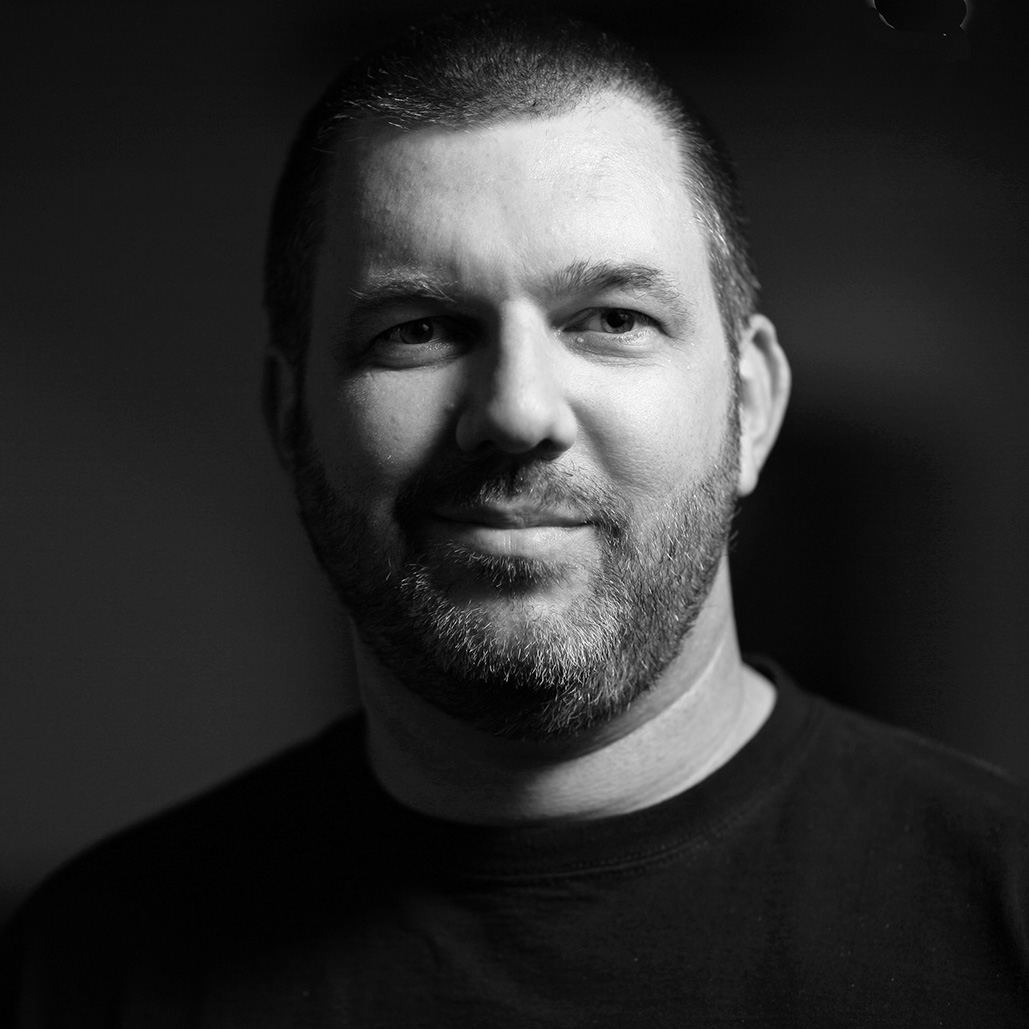
Matthew Harffy grew up in Northumberland where the rugged terrain, ruined castles and rocky coastline had a huge impact on him. Matthew is the author of Wolf of Wessex and the Bernicia Chronicles series. He now lives in Wiltshire with his wife and their two daughters.
Connect with Matthew
Website | Twitter | Facebook | Instagram


 Lean On Me by Serge Joncour, trans. by Louise Rogers Lalaurie and Jane Aitken (Gallic Books)
 The Marsh House by Zoë Somerville (Apollo via NetGalley)


 China Room by Sunjeev Sahota (Harvill Secker)

 What Cathy Read Next...