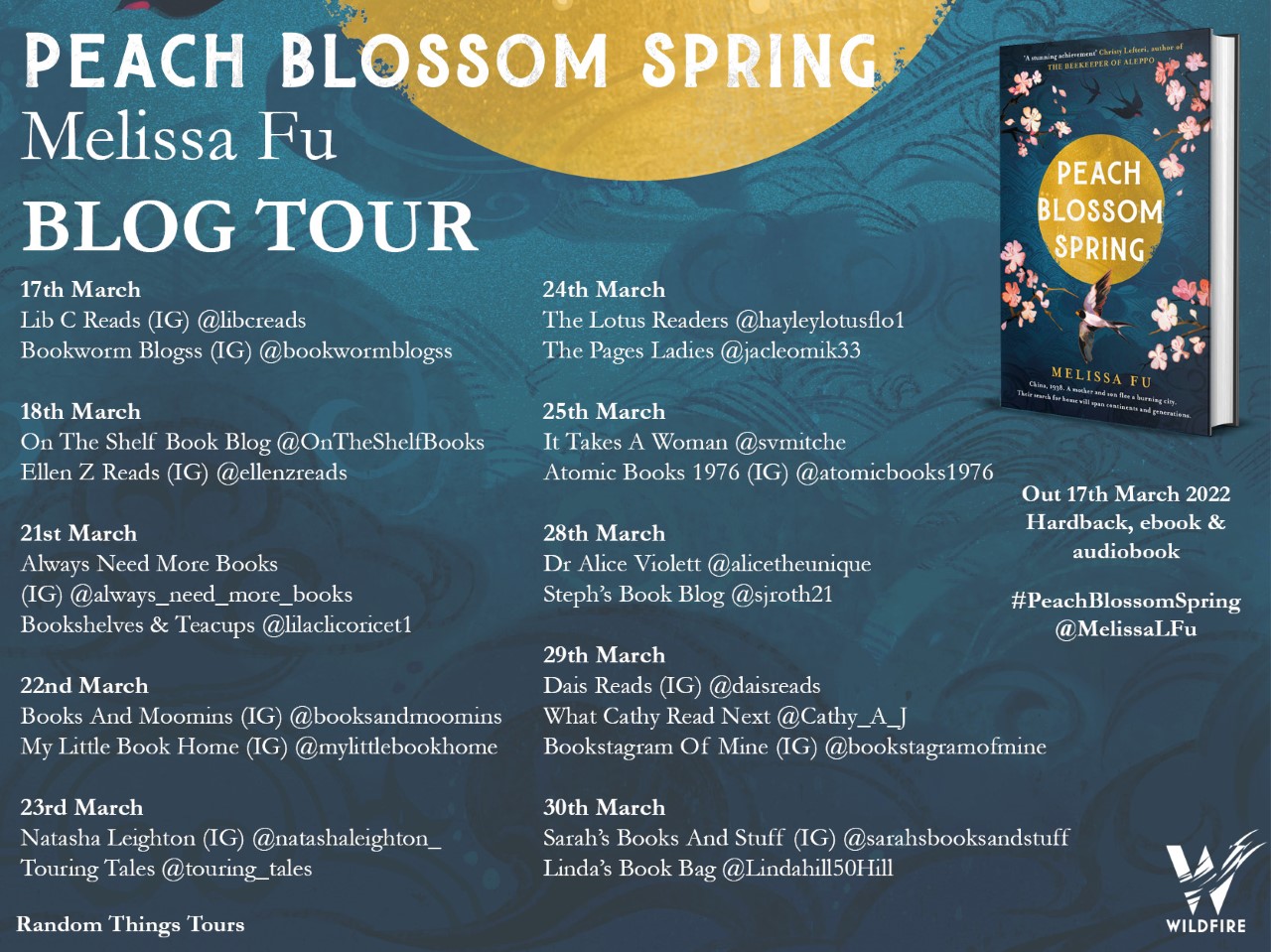
 Welcome to today’s stop on the blog your for Peach Blossom Spring by Melissa Fu. My thanks to Anne at Random Things Tours for inviting me to take part in the tour and to Headline for my digital review copy via NetGalley. Do check out the posts by my tour buddies for today, bookstagrammers Daisy at DaisReads and Seher at The Girl Who Reads.
 About the Book
With every misfortune there is a blessing and within every blessing, the seeds of misfortune, and so it goes, until the end of time.
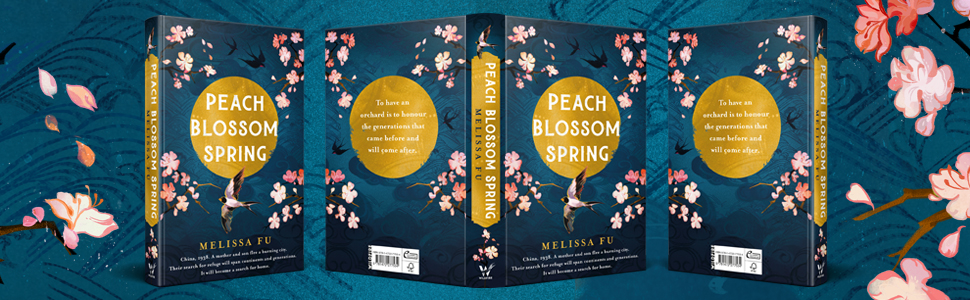
It is 1938 in China and, as a young wife, Meilin’s future is bright. But with the Japanese army approaching, Meilin and her four year old son, Renshu, are forced to flee their home. Relying on little but their wits and a beautifully illustrated hand scroll, filled with ancient fables that offer solace and wisdom, they must travel through a ravaged country, seeking refuge.
Years later, Renshu has settled in America as Henry Dao. Though his daughter is desperate to understand her heritage, he refuses to talk about his childhood. How can he keep his family safe in this new land when the weight of his history threatens to drag them down? Yet how can Lily learn who she is if she can never know her family’s story?
Spanning continents and generations, Peach Blossom Spring is a bold and moving look at the history of modern China, told through the story of one family. It’s about the power of our past, the hope for a better future, and the haunting question: What would it mean to finally be home?
Format: Hardcover (400 pages) Publisher: Wildfire
Publication date: 17th March 2022 Genre: Historical Fiction
Find Peach Blossom Spring on Goodreads
Purchase links
Bookshop.org
Disclosure: If you buy a book via the above link, I may earn a commission from Bookshop.org, whose fees support independent bookshops
Hive | Amazon UK
Links provided for convenience only, not as part of an affiliate programme
My Review
Peach Blossom Spring follows three generations of a Chinese family through six decades of social, geographical and cultural change. It focuses on two members of the Dao family – Meilin, wife of the younger son who fears she may now be a widow, and her son, Renshu.
Opening in 1938, Meilin and Renshu, along with Meilin’s brother-in-law and his family, are forced to flee their home in Changsa following the Japanese invasion of China. It’s the first in a long and dangerous journey that sees them move from place to place in search of safety. The scenes of panic as families attempt to escape bombing raids, take cover in crowded shelters and make long journeys, often on foot with only the possessions they can carry, are described in a way that really brings to life the horror and desperation. It is impossible to read some of the scenes without it bringing to mind the current situation in Ukraine. Throughout it all, Meilin’s one objective is to protect her son and to try to shield him from the full horror of what is going on around him. One way she does this is by telling him traditional Chinese stories using the beautiful illustrated scroll which is her most treasured possession. As well as a distraction, these stories constitute life lessons and offer ways of looking at the challenges one may face.
Meilin is a wonderful character who demonstrates fortitude and a determination to survive despite all the obstacles placed in her way. At some points, she is forced to make impossible choices and place herself in vulnerable situations, always prioritising the needs of her son over her own. Eventually she finds the means to get them to relative safety in Taiwan where she does everything she can to ensure a secure future for Renshu. Meilin’s story was the most powerful and engaging part of the book for me and I was rather sorry when the focus moved from her to Renshu.
Having said that, Renshu’s experiences when he travels to the United States to study is a fascinating exploration of what it is like to leave one culture for another and of the immigrant experience. He makes a deliberate decision to shed his former identity and create a new one – Dao Renshu becomes Henry Dao – and also to consign his past to the mental equivalent of a locked box, consciously splitting his life into ‘Renshu’s world’ and ‘Henry’s world’. Moreover, Henry fears any association with the politics of China might threaten his US citizenship or have consequences for his family in Taiwan.
In the final section of the book, the focus moves to Henry’s daughter, Lily. She longs to know more about her Chinese heritage, feeling as if she’s incomplete without this. ‘Sometimes, Lily feels that there’s something she’s supposed to know that she doesn’t, or something she’s supposed to be that she isn’t.’ There’s a touching scene in which she and her classmates are asked to construct their family trees and Lily feels ashamed that one side of her tree is blank. Lily cannot understand her father’s reluctance to allow her to learn Chinese – which she longs to do – not least so she can converse with her grandmother. She’s also perturbed by her father’s reticence about the years before he came to America. What she doesn’t know is that Henry fears he has nothing to offer Lily in the way of heritage. ‘What tradition could he pass down? A broken country? Suspicion and betrayal? Miles and miles of misery?’
When Henry finally unburdens himself to Lily, she writes down everything he tells her in much the same way as the author recalls writing down her own father’s experiences when he finally chose to share them with her, memories he had kept hidden for a long, long time. For Lily, learning about her father’s past finally fills in those gaps in her family history, allowing her to embrace both sides of her cultural identity.
In her note to readers the author explains that although the Dao family are an imagined family their experiences reflect the actual experiences of families who lived through the Sino-Japanese and Chinese Civil wars. As she notes, ‘Here is one of the great gifts of fiction: from many threads of human experience, we can weave a tapestry of narrative.’ In Peach Blossom Spring, the author has certainly woven an enthralling tapestry that provides an insight into China’s rich culture and takes the reader on an emotional journey through a turbulent period of Chinese history, one sadly reminiscent of the times we are living through.
In three words: Sweeping, dramatic, moving
Try something similar: The Good Earth by Pearl S. Buck
Follow this blog via Bloglovin
 About the Author
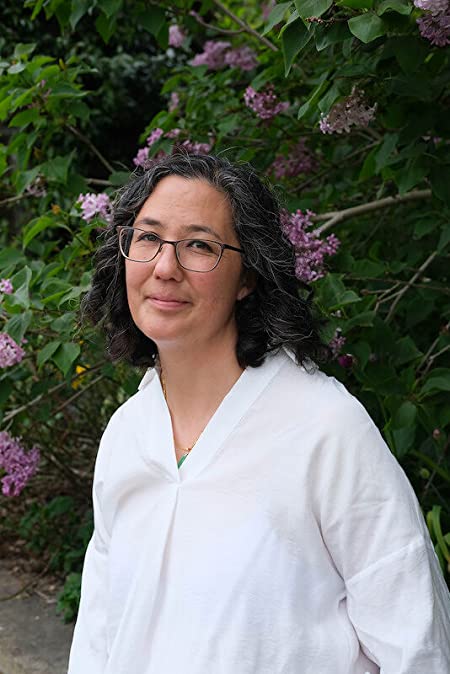
Melissa Fu grew up in Northern New Mexico and now lives near Cambridge, UK, with her husband and children. With academic backgrounds in physics and English, she has worked in education as a teacher, curriculum developer, and consultant.
Melissa was the regional winner of the Words and Women 2016 Prose Competition and was a 2017 Apprentice with the London-based Word Factory. Her work appears in several publications including The Lonely Crowd, International Literature Showcase, Bare Fiction, Wasafiri Online, and The Willowherb Review. In 2019, her debut poetry pamphlet, Falling Outside Eden, was published by the Hedgehog Poetry Press. In 2018/2019, Melissa received an Arts Council England, Developing Your Creative Practice grant and was the David TK Wong Fellow at the University of East Anglia. Peach Blossom Spring is her first novel.
Connect with Melissa
Website | Twitter | Instagram




 What Cathy Read Next...