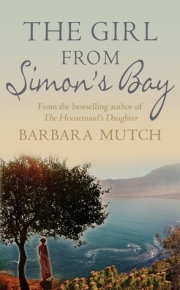
 About the Book
1937. Louise Ahrendts, daughter of a shipbuilder, is at home in Simon’s Town, a vibrant community in the Union of South Africa, with a Royal Navy port at its heart. Louise dreams of becoming a nurse and in a world of unwritten, unspoken rules about colour, she has the strength to make it a reality.
The outbreak of the Second World War brings a man into Louise’s world who she is determined to be with – despite all the obstacles life and conflict throw in their way. But when a new troubled moment of history dawns, can they find their way back to each other?
Format: Paperback (416 pages) Publisher: Allison & Busby
Publication date: 21st September 2017 Genre: Historical Fiction
Find The Girl from Simon’s Bay on Goodreads
Purchase links
Hive | Amazon UK
Links provided for convenience only, not as part of an affiliate programme
My Review
Although her family are not well-off, Louise has an idyllic childhood growing up in sight of the sea where she swims most days or watches her friend, Piet, dive for shells. Located on the shores of False Bay in the shadow of the Simonsberg mountains, Simon’s Town is a fishing community and the location of a Royal Navy port that provides employment for many of the townspeople, including Louise’s father. On the surface Simon’s Town is a multi-racial community with people of different colours and heritage living peacefully together. However, at a national level, the issue of race is never far away.
Louise’s parents see her future as finding a nice local boy and settling down to a life as wife and mother. However, Louise dreams of becoming a nurse: she wants to ‘fix’ people. Her ambition seems doomed to failure from the beginning, not because of her educational achievements or her commitment but because she is ‘coloured’. As the Matron of False Bay Hospital to which she applies writes, ‘I must caution you that no coloured applicant from a Simon’s Town school has ever been accepted’. However, Louise is not one to give up and eventually her persistence is rewarded. ‘Slowly, one person at a time, False Bay Hospital was learning to value my ability rather than scorning my background.’ Louise comes to believe that through the recognition of her nursing skills she has overcome the barriers of race, but as her mother cautions, ‘War has no time for a colour bar… The old ways will return in peacetime mark my words.’
Louise’s proficiency results in a secondment to the Royal Naval Hospital looking after men injured in the war, often critically. ‘This was no civilian establishment with a routine quota of tonsils and broken legs. This was nursing on the edge.’ It’s here that Louise meets Lieutenant David Horrocks with whom she instantly forms a bond as a result of their shared love of the sea and the landscape of the Cape peninsular.
Fraternisation between nurse and patient is frowned upon by the hospital establishment; a relationship between a white officer and a coloured woman is unthinkable. As their relationship develops, Louise and David are forced to meet in secret. But fear of disclosure or the danger David faces whenever his ship goes to sea is not the only obstacle facing them, as Louise will discover. It will mean an agonising decision, the consequences of which will determine the future path of their lives, and of others too.
Two thirds of the way through the story moves to thirty years later and shifts from being predominantly a wartime romance to one about the impact of apartheid on families like Louise’s with previously mixed communities being dispersed and segregated according to colour. This was something I knew about vaguely but the author really brings to life the realities for individuals and communities. It means Louise is separated from the seascape she loves so much and which has been the backdrop to her life. And the effective purging of non-white South Africans from official records, along with a reluctance by many to revisit events of the past, risks a connection being severed forever.
The Girl from Simon’s Bay is a moving love story set against the backdrop of war and social upheaval.
I received a review copy courtesy of Allison & Busby.
In three words: Tender, romantic, absorbing
Try something similar: Think of Me by Frances Liardet
 About the Author
Barbara was born and brought up in South Africa, the granddaughter of Irish immigrants. Before embarking on a writing career, she launched and managed a number of businesses both in South Africa and the UK. She is married and has two sons.
For most of the year the family lives in Surrey but spends time whenever possible at their home in the Cape. When not writing, Barbara is a pianist, a keen enthusiast of the Cape’s birds and landscape or fynbos.
Connect with Barbara
Website | Blog | Facebook

 On What Cathy Read Next last week