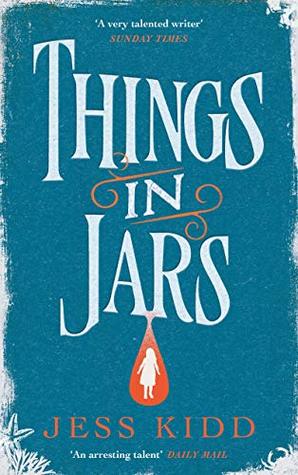
About the Book
London, 1863. Bridie Devine, the finest female detective of her age, is taking on her toughest case yet. Reeling from her last job and with her reputation in tatters, a remarkable puzzle has come her way. Christabel Berwick has been kidnapped. But Christabel is no ordinary child. She is not supposed to exist.
As Bridie fights to recover the stolen child she enters a world of fanatical anatomists, crooked surgeons and mercenary showmen. Anomalies are in fashion, curiosities are the thing, and fortunes are won and lost in the name of entertainment. The public love a spectacle and Christabel may well prove the most remarkable spectacle London has ever seen.
Format: ebook (416 pages) Publisher: Canongate
Publication date: 4th April 2019 Genre: Historical Fiction
Find Things in Jars on Goodreads
Purchase links
Bookshop.org
Disclosure: If you buy a book via the above link, I may earn a commission from Bookshop.org, whose fees support independent bookshops
Hive | Amazon UK
Links provided for convenience only, not as part of an affiliate programme
My Review
I really enjoyed Jess Kidd’s The Night Ship when I read it at the end of last year and, as a result, decided to add her to the list of authors for my BacklistBurrow reading project. Things in Jars has been languishing on my NetGalley shelf since 2019 so finally reading it has also helped with this year’s #NetGalleyNovember reading challenge. The other Jess Kidd novel I’m hoping to read is her debut, Himself, published in 2017.
Set in Victorian London, Things in Jars is a Gothic mystery that in its extensive cast of eccentric characters (including a seven-foot tall housemaid and a melancholic, tattoo-covered visitor from beyond the grave) is a kind of mash-up of a novel by Charles Dickens and Wilkie Collins with the addition of a generous slug of magic realism. The book oozes atmosphere – and a lot else besides – in its expressive descriptions of bustling, noisome 1860s London.
‘Follow the fulsome fumes from the tanners and the reek from the brewery, butterscotch rotten, drifting across Seven Dials. Keep on past the mothballs at the cheap tailor’s and turn left at the singed silk of the maddened hatter. Just beyond you’ll detect the unwashed crotch of the overworked prostitute and the Christian sweat of the charwoman. On every inhale a shifting scale of onions and scalded milk, chrysanthemums and spiced apple, broiled meat and wet straw, and the sudden stench of the Thames as the wind changes direction and blows up the knotted backstreets.’
This is a period when curiosities, including in human form, are displayed as objects of entertainment or sold to collectors and anatomists. Christabel, the young girl hidden away in a wing of the country house of Sir Edmund Athelstan Berwick, is a child with ‘singular traits’, perhaps even supernatural powers, whose origins are not initially clear. Her unique appearance makes her a valuable and hence sought after ‘curiosity’. And is there any connection between Christabel and the unusual weather afflicting the capital? ‘London has never seen rain like it. And now, all over the city the streets run with water, this foul, grey-foamed downpour. As if God had emptied his wash-tub after boiling Satan’s inexpressibles in it.’
The book’s plot concerns Bridie Devine’s search for the people responsible for kidnapping Christabel. The reader knows who the culprits are way before Bridie but this knowledge didn’t reduce the engrossing nature of the story as far as I was concerned. I thought Bridie was a brilliant character: resourceful, intuitive and brave. Described as ‘not the flinching kind’, she’s a woman rumoured to wear a dagger strapped to her thigh and keep poisonous darts in her boot heels. We learn quite a bit about Bridie’s unconventional and rather unhappy childhood, and how she acquired the unique skills she now possesses.
I loved the witty banter between her and ex-boxer Ruby Doyle, a figure who seems vaguely familiar to Bridie although she can’t quite put her finger on where they’ve met before. Ruby’s barbed comments (that only Bridie can hear) about the individuals she interviews as part of her investigation, as well as potential admirers of Bridie, are hilarious.
A historical crime mystery wouldn’t be complete without some good old-fashioned villains and the author provides at least two who are rotten to the core (one almost literally), along with some fantastically named characters.
I thoroughly enjoyed Things in Jars for it’s eccentricity, imagination and melodrama. Given Bridie’s obvious aptitude for crime-solving and the strong secondary characters, I thought the book had the makings of the first in a historical mystery series but the author obviously felt differently.
I received a review copy courtesy of Canongate via NetGalley.
In three words: Intriguing, imaginative, atmospheric
Try something similar: The Fascination by Essie Fox
About the Author
Jess was brought up in London as part of a large family from County Mayo. After returning to college as a mature learner on a bursary Jess lectured and taught creative writing to all age groups. Her debut novel, Himself, was shortlisted for the Irish Book Awards 2016, Authors’ Club Best First Novel Award 2017 and longlisted for the John Creasey (New Blood) Dagger 2017. Her second novel, The Hoarder, was shortlisted for Kerry Group Irish Novel of the Year 2019. Both books were selected for the BBC Radio 2 Book Club. Jess’s third novel, Things in Jars, was published to critical acclaim. Jess won the Costa Short Story Award in 2016 with ‘Dirty Little Fishes’ and has recently contributed short fiction to The Haunting Season, a collection of ghostly winter tales. Jess’s first book for children Everyday Magic is a teacher’s pick. Jess has lately been developing original TV and film projects alongside short fiction and her fifth novel. (Photo: Goodreads author page)
Connect with Jess
Twitter | Instagram

 On What Cathy Read Next last week