
My Week in Books – 20th January ‘19

MyWeekinBooks

New arrivals  

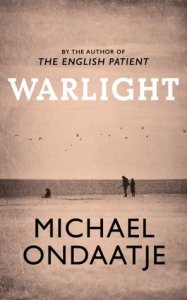
warlightWarlight by Michael Ondaatje (hardcover)

It is 1945, and London is still reeling from years of attritional war. 15-year-old Nathaniel and his sister seem to have been abandoned by their parents in a big house in Putney, and the ruined city is a strange Expressionist jungle after the Blitz, which the teenagers use as their playground. The Black Market and petty criminals are thriving and the two children’s eccentric guardians – nicknamed the Moth and the Darter – are busy smuggling munitions through the darkened London streets, or greyhounds from France through the rivers and canals.

When the children discover that their mother has not gone to Singapore as announced, and is actually engaged in perilous work for British Intelligence – and that the Moth and the Darter are protecting them from harm – the novel darkens and deepens into Nathaniel’s search for the truth: for the mother he lost once and may well lose again.

transcriptionTranscription by Kate Atkinson (hardcover, signed by the author)

In 1940, eighteen-year old Juliet Armstrong is reluctantly recruited into the world of espionage. Sent to an obscure department of MI5 tasked with monitoring the comings and goings of British Fascist sympathizers, she discovers the work to be by turns both tedious and terrifying. But after the war has ended, she presumes the events of those years have been relegated to the past for ever.

Ten years later, now a producer at the BBC, Juliet is unexpectedly confronted by figures from her past. A different war is being fought now, on a different battleground, but Juliet finds herself once more under threat. A bill of reckoning is due, and she finally begins to realize that there is no action without consequence.


On What Cathy Read Next last week

Blog posts

Monday – I shared my ideas about books published in 2018 that may be contenders for The Walter Scott Prize for Historical Fiction 2019.

Tuesday – The Top Ten Tuesday topics was New-To-Me Authors I Read in 2018.  It turns out I read quite a few.

Wednesday – WWW Wednesday is the opportunity to share what I’ve just read, what I’m currently reading and what I plan to read next…and have a good nose around to see what other bloggers are reading.   I also joined the blog tour for The Secret by Katharine Johnson sharing my review of this dual time novel set in present day and wartime Tuscany.

Thursday – Another day, another blog tour – this time to mark the publication in paperback of The Story Keeper by Anna Mazzola.  I republished my review from when I read the book last year.

Friday – I published my review of The Turn of Midnight by Minette Walters, the sequel to The Last Hours.

Saturday – I shared an introduction to my first Buchan of the Month for 2019, Prester John by John Buchan.

As always, thanks to everyone who has liked, commented on or shared my blog posts on social media this week.


On What Cathy Read Next this week

Currently reading

Planned posts

  • Top Ten Tuesday: Books I Meant to Read in 2018 But Didn’t Get To
  • Waiting on Wednesday
  • Book Review: Nemesis (Tom Wilde #3) by Rory Clements
  • Throwback Thursday/Book Review: The Edible Woman by Margaret Atwood

Book Review: The Turn of Midnight (Black Death #2) by Minette Walters

The Turn of MidnightAbout the Book

As the year 1349 approaches, the Black Death continues its devastating course across England. In Dorseteshire, the quarantined people of Develish question whether they are the only survivors.  Guided by their beloved young mistress, Lady Anne, they wait, knowing that when their dwindling stores are finally gone they will have no choice but to leave. But where will they find safety in the desolate wasteland outside?

One man has the courage to find out.

Thaddeus Thurkell, a free-thinking, educated serf, strikes out in search of supplies and news. A compelling leader, he and his companions quickly throw off the shackles of serfdom and set their minds to ensuring Develish’s future – and freedom for its people. But what use is freedom that cannot be gained lawfully? When Lady Anne and Thaddeus conceive an audacious plan to secure her people’s independence, neither foresees the life-threatening struggle over power, money and religion that follows…

Format: Hardcover (464 pp.), audiobook    Publisher: Allen & Unwin
Published: 4th October 2018 Genre: Historical Fiction

Purchase Links*
Amazon.co.uk  ǀ  Amazon.com  ǀ Hive.co.uk (supporting UK bookshops)
*links provided for convenience, not as part of any affiliate programme

Find The Turn of Midnight (Black Death #2) on Goodreads


My Review

The Turn of Midnight is the second book in the author’s ‘Black Death’ series, the follow-up to The Last Hours.  The Turn of Midnight can be read as a standalone, partly thanks to the useful rundown of the key characters and events from The Last Hours at the beginning of the book.  Like the first book,  The Turn of Midnight follows the fortunes of the inhabitants of the demesne of Develish in Dorseteshire.  However, whereas the focus of The Last Hours was their efforts to fend off the pestilence, The Turn of Midnight is concerned with the aftermath of the plague and its economic and social consequences for both Develish and the rest of Dorsetshire.

I’ll confess that I wasn’t as enamoured with The Last Hours as many other readers, having come to it with high expectations because of the author’s reputation as a writer of thrillers.  As well as feeling slightly let down by the nature of the ending (as I hadn’t realised there was a sequel planned), I also found the book over long and rather slower than I’d anticipated.  Unfortunately, I have similar feelings about The Turn of Midnight. However, I’m happy to accept this might be partly to do with listening to an audiobook version, which is an experience rather new to me.  I’m still getting used to the fact it takes longer to listen to a book than it would for me to read it!

In The Last Hours, the danger faced by the inhabitants of Develish as the plague sweeps the country, did at least provide a sense of jeopardy.   In The Turn of Midnight, Develish has survived the plague and the focus is on exploring further afield to replenish supplies  and establish the impact of the plague on the wider community.  A number of subplots were introduced in The Last Hours,  chiefly involving Lady Anne’s adopted daughter, Lady Eleanor, but she largely recedes into the background in The Turn of Midnight.  Instead there are lengthy (I am tempted to say ‘interminable’) descriptions of the journeys that serf-turned-steward, Thaddeus Thirkell, takes into the countryside, accompanied by some of the young men of Develish, in order to find supplies of grain and other foodstuffs, to recover other goods of value and visit other demesnes.

Some of the social impacts of the plague foreshadowed in the first book have come to pass.   For example, nobles dependent on serfs to restore the wealth of their lands are waking up to the fact that the law of supply and demand means the few serfs left alive will be able to bargain with landowners for their freedom, or even wages, in return for their labour.  Effectively, there has been a reshaping of the social order with the needs of survival thrusting ordinary people into positions of unaccustomed authority or forcing them to take responsibility for decision-making and organisation where they would previously have been used to taking direction.   Not all the nobility are able (or willing) to recognise how the position has changed.   Lady Anne, unusually egalitarian for a woman of her time, is one of the few who does recognise the need for adaptation.

The author explores once again the conflict between those who support the teachings of the Church that the plague was sent by God to punish the wicked and those, like Lady Anne, who recognise that the plague affected serf and noble, innocent and sinner alike and believe there were more practical reasons why some survived and others did not.  Views like hers are regarded as heresy by some.

Like The Last Hours, The Turn of Midnight is clearly the product of extensive research and contains a lot of historical detail I found fascinating.  However, the slow pace meant I didn’t enjoy the book as much as I hoped.  The narrator, Helen Keeley, does a good job, creating distinctive voices for the various characters (the majority of which are male) and skilfully handling regional and foreign accents.

I received a review copy of the book courtesy of publishers, Allen & Unwin, and Readers First but chose to listen to the audiobook version via the RBDigital app provided by my local library (partly to dip a toe in the water, so to speak, into the world of audiobooks).

Follow my blog with Bloglovin

In three words: Detailed, well-researched, slow-paced

Try something similar…The Outcasts of Time by Ian Mortimer (read my review here)


Minette WaltersAbout the Author

Minette Walters is a British mystery writer. After studying at Trevelyan College, University of Durham, she began writing in 1987 with The Ice House, which was published in 1992. She followed this with The Sculptress (1993), which received the 1994 Edgar Award for Best Novel. She has been published in 35 countries and won many awards. The Sculptress has been adapted for television in a BBC series starring Pauline Quirke. Her novels The Ice House, The Echo, The Dark Room, and The Scold’s Bridle have also been adapted by the BBC.  (Photo credit: Goodreads author page)

Connect with Minette

Website  ǀ  Goodreads