
A story of desire, secrets and memories
 About the Book
Description (courtesy of Goodreads): It is March 30th 1924. It is Mothering Sunday. How will Jane Fairchild, orphan and housemaid, occupy her time when she has no mother to visit? How, shaped by the events of this never to be forgotten day, will her future unfold? Beginning with an intimate assignation and opening to embrace decades, Mothering Sunday has at its heart both the story of a life and the life that stories can magically contain. Constantly surprising, joyously sensual and deeply moving, it is Graham Swift at his thrilling best.
Book Facts
- Format: ebook
- Publisher: Scribner
- No. of pages: 145
- Publication date: 25th February 2016
- Genre: Historical Fiction
Purchase Mothering Sunday from Amazon.co.uk, click here (link provided for convenience, not as part of any affiliate programme)
Find Mothering Sunday on Goodreads
My Review
Mothering Sunday is one of the novels on this year’s shortlist for The Walter Scott Prize for Historical Fiction. You can find a list of all the shortlisted novels here.
This is the first book I’ve read by Graham Swift and on the strength of the writing in this book, boy, what I have been missing. He is a master of observation with meaning drawn from gestures and objects, even from the way a man dresses.
‘Dressing, anyway, among their kind, was never conceived of as just flinging on of clothes. It was a solemn piecing together.’
‘It was in some way all for her – that she should watch him dress, watch his nakedness gradually disappear. Or that he just didn’t care. The sureness, the aloofness, the unaccountable unhurriedness.’
For a housemaid, Jane is unusual in that she has been taught to read and write. Foreshadowing her later life, she loves books and has a writer’s interest in words and their meanings. So when Milly the cook asks Jane, ‘Are you an orchid?’ when she clearly meant orphan, Jane muses:
‘And did it matter if she’d used the wrong word – if the wrong word was a better one? …And what if orphans really were called orchids? And if the sky was called the ground. And if a tree was called a daffodil. Would it make any difference to the actual nature of things? Or their mystery?’
Of course, Jane’s interest in words is a manifestation of the author’s own interest. A love of language, playful at times, is apparent throughout the book with words explored for oppositions and multiple meanings.
‘The sunshine only applauded their nakedness, dismissing all secrecy from what they were doing, though it was utterly secret.’
‘She knew him and she didn’t know him. She knew him in some ways better than anyone – she would always be sure of that – while knowing that no one else must ever know how much she knew him. But she knew him well enough to know the ways in which he was not knowable.’
‘He had ‘possessed’ [her body]. That was another word. He had possessed her body – her body being almost all she possessed. And could it be said that she had possessed and might always possess him?’
However the attraction of this book is not only about the wonderful quality of the writing. There is narrative power too as it takes a sudden, devastating turn a third of a way through, conveyed in just two simple sentences. As well as the story of an assignation between people of different positions in society on a pivotal day in both their lives, it seems to me the book is a meditation on words, writing and story-telling. This aspect becomes more of the focus in later parts of the book. As Jane reminisces about the events of that Mothering Sunday, she observes, ‘Well there was a whole story there, a story she’d sworn to herself never to tell. Nor had she. Nor would she. Though here she was, look, a storyteller by trade.’ But, of course, Jane has told us, the reader, her story.
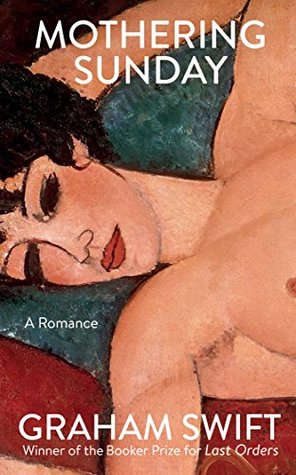
I thought this was an outstanding book and I’m afraid no review of mine can do it justice. I loved the sensual, lyrical writing. I also have to mention the absolutely stunning cover. Whoever chose the painting that appears on the Scribner edition – Modigliani’s “Reclining Nude” – deserves a prize as well.
In three words: Lyrical, sensual, intimate
Try something similar…The Vanishing Act of Esme Lennox by Maggie O’Farrell
 About the Author
Graham Colin Swift FRSL was born in London in 1949 and educated at Dulwich College, London, Queens’ College, Cambridge, and later the University of York. He was a friend of Ted Hughes. Some of his works have been made into films, including Last Orders, which starred Michael Caine and Bob Hoskins and Waterland which starred Jeremy Irons. Last Orders was a joint winner of the 1996 James Tait Black Memorial Prize for fiction and a mildly controversial winner of the Booker Prize in 1996, owing to the superficial similarities in plot to William Faulkner’s As I Lay Dying. Waterland was set in The Fens; it is a novel of landscape, history and family, and is often cited as one of the outstanding post-war British novels and has been a set text on the English Literature syllabus in British schools.
Follow Graham on Goodreads https://www.goodreads.com/author/show/3449.Graham_Swift

 About the Book
 About the Author

