#BookReview Adama by Lavie Tidhar @HoZ_Books

About the Book

Front cover of book Adama by Lavie Tidhar

There is no land without blood , and I water this land with the blood of my men.

Ruth’s family were in Budapest when the Nazis came.

Now Ruth is in Palestine, amid the bare hills inland from Haifa, breaking the rocky soil of an unyielding land before it breaks her.

With her comrades, her fellow kibbutzniks, she will build a better world. There will be green grass, orange trees and pomegranates, a land that is their own and no one else’s.

So they till their fields, dig their wells, build their homes and forge a new way of living, fiercely proud of their shared pursuit of a dream.

But as one generation begets another, the dream unravels, twisted into a dark tapestry of secrets and lies; sacrificed for revenge, forbidden love and murder.

Format: Hardback (400 pages) Publisher: Head of Zeus
Publication date: 14th September 2023 Genre: Historical Fiction

Find Adama on Goodreads

Purchase links 
Bookshop.org 
Disclosure: If you buy a book via the above link, I may earn a commission from Bookshop.org, whose fees support independent bookshops

Hive | Amazon UK 
Links provided for convenience only, not as part of an affiliate programme


My Review

Until I read other reviews of the book, I didn’t realise Adama was the second in a trilogy, the follow-up to Maror. However, I don’t think it’s essential to have read the earlier book although it would probably be helpful to fill in any gaps in your knowledge about the foundation of the state of Israel. Big gaps, in my case.

Having read the chapter that opens part one of the book, you might be forgiven for thinking – as I did – that Adama was a thriller not a work of historical fiction. In fact, you’d be partially right because throughout the book there is intrigue, betrayal and drama as well as a moving story charting the experiences of generations of one family. It made it a page-turner for me.

Following the death of her mother, Hanna finds a box containing old photographs and documents that sees her embark on a search for information about Esther’s past and her family history. It also provides a distraction from the recent breakdown of a relationship. Thereafter the book moves back and forth over the decades recounting events in the life of Ruth, her family, her lovers and other members of her kibbutz with the full picture only gradually emerging.

At times, Ruth’s utter commitment to preserving the kibbutz seems to border on obsession, especially as it becomes clear what she has been prepared to do to in order to protect it. She’s courageous but also single-minded, even ruthless. For her, the end justifies the means. At one point Ruth says, ‘I gave up everything for this land… I sacrificed’. But others’ sacrifice is giving up their lives. Their stories are dramatic, powerful and sometimes harrowing.

The book depicts Israel’s often violent struggle for survival including the brutality of British occupation during which refugees attempting to cross to Palestine from Europe in small boats were intercepted and sent to camps in Cyprus. (Plus ça change, plus c’est la même chose.)

I had a vague concept of what a kibbutz was but had no idea of the extent of their collective nature when they were first established. ‘They believed in sharing – land, crops, property and love. The kibbutz was going to be a new way of life… No more jealousy and no more ownership of things, but somewhere where things could be finally different.’ One example of that difference is that children lived separately from their parents (who had no financial responsibility for them) and were raised and educated communally. The book explores the conflict between the natural instincts of motherhood and commitment to the principles of the kibbutz. Ruth’s sister, Shosana, provides a counterpoint to Ruth’s unwavering beliefs. Initially a place of refuge for Shosana after her experiences during the Second World War, the kibbutz becomes a source of savagery.

By the end of the book, Hanna may not have learned everything she hoped but author leaves the reader with a striking image of the characters they have come to know.

The publisher’s description of Adama as a ‘sweeping historical epic’ is spot on. At the moment, it looks a dead cert to be among my books of the year and it has made me keen to explore the author’s backlist, including reading Maror.

I received a digital review copy courtesy of Head of Zeus via NetGalley.

In three words: Powerful, gripping, moving


About the Author
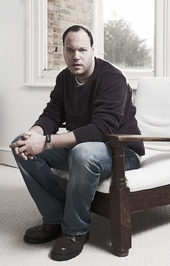
Lavie Tidhar was born just ten miles from Armageddon and grew up on a kibbutz in northern Israel. He has since made his home in London, where he is currently a Visiting Professor and Writer in Residence at Richmond University. He won the Jerwood Fiction Uncovered Prize for Best British Fiction, was twice longlisted for the International Dublin Literary Award and was shortlisted for the CWA Dagger Award and the Rome Prize. He co-wrote Art and War: Poetry, Pulp and Politics in Israeli Fiction, and is a columnist for the Washington Post. (Photo: Goodreads author page)

Connect with Lavie
Website | Twitter

#BookReview The Merchant’s Dilemma by Carolyn Hughes @writingcalliope

About the Book

Winchester, 1362. Seven months ago, accused of bringing plague and death from Winchester, Bea Ward was hounded out of Meonbridge by her former friends and neighbours. Finding food and shelter where she could, she struggled to make her way back to Winchester again.

Yet, once she arrived, she wondered why she’d come.

For her former lover – the love of her life – Riccardo Marchaunt, had married a year ago. And she no longer had the strength to go back to her old life on the streets. Frail, destitute and homeless, she was reduced to begging. Then, in January, during a tumultuous and destructive storm, she found herself on Riccardo’s doorstep. She had no plan, beyond hoping he might help her, or at least provide a final resting place for her poor body.

When Bea awakes to find she’s lying in Riccardo’s bed once more, she’s thankful, thrilled, but mystified. But she soon learns that his wife died four months ago, along with their newborn son, and finds too that Riccardo loves her now as much as he ever did, and wants to make her his wife. But can he? And, even if he can, could she ever really be a proper merchant’s wife?

Riccardo could not have been more relieved to find Bea still alive, when he thought he had lost her forever. She had been close to death, but is now recovering her health. He adores her and wants her to be his wife. But how? His father would forbid such an “unfitting” match, on pain of denying him his inheritance. And what would his fellow merchants think of it? And their haughty wives?

Yet, Riccardo is determined that Bea will be his wife. He has to find a solution to his dilemma… With the help of his beloved mother, Emilia, and her close friend, Cecily, he hatches a plan to make it happen.

But even the best laid plans sometimes go awry. And the path of love never did run smooth…

Format: ebook (232 pages) Publisher: Riverdown Books
Publication date: 21st September 2023 Genre: Historical Fiction, Romance

Find The Merchant’s Dilemma on Goodreads

Purchase link 
Amazon UK 
Link provided for convenience only, not as part of an affiliate programme


My Review

Carolyn Hughes describes The Merchant’s Dilemma as a ‘companion novel’ to her historical fiction series, ‘The Meonbridge Chronicles’, set in a small village in 14th century Hampshire. For those who’ve read previous books in the series, The Merchant’s Dilemma continues the story of two characters, Beatrix and Riccardo, who featured in the fourth book, Children’s Fate. However, it can easily be read as a standalone as there are plenty of references to prior events in the lives of Beatrix and Riccardo, meaning it would also be the ideal introduction to the author’s books.

As Carolyn admits, The Merchant’s Dilemma is a little more romantic and light-hearted than other books in the series and, being set in Winchester, it doesn’t immerse you in medieval life in quite the same way as the books set in Meonbridge so wonderfully do. In fact, its storyline involving romance between people of different classes could have come right out of Jane Austen.

Although Riccardo’s dilemma is understandable given his position in society and Bea’s past, it was Bea’s patience that I admired most. At every turn a new obstacle seems to be placed in the way of her becoming Riccardo’s wife, and even when one is removed another seemingly takes its place. Enter two brilliant characters: Riccardo’s mother, Emilia, and Emilia’s friend, Cecily. Together they embark on a plan to convince Winchester society that Beatrix is a suitable potential wife for Riccardo, training her on how to behave. With shades of Pygmalion, Beatrix must become Beatrice, learning to appear demure in public and only able to let her hair down – literally – in private.

I never doubted Riccardo’s love for Beatrix, even if he does appear obstinate and overly timid, testing her patience to the limit. The reader’s too, I suspect.

Luckily for Riccardo, Emilia and Cecily take charge of the situation given that he, his brother Giacomo and their former drinking buddies are making a right old mess of things with rumours starting to spread about the true nature of Beatrix’s past. The flames are fanned by Sarah, Giacomo’s harridan of a wife, who likes to think herself superior to everyone else but enjoys nothing better than trading the latest scurrilous gossip. Eventually even Riccardo is the subject of a dangerous slander.

After many trials and tribulations, The Merchant’s Dilemma concludes in the way all romances should, leaving the reader with a smile and a warm feeling inside.

I received a digital review copy courtesy of the author.

In three words: Engaging, lively, romantic


About the Author

Carolyn Hughes has lived much of her life in Hampshire. With a first degree in Classics and English, she started working life as a computer programmer, then a very new profession. But it was technical authoring that later proved her vocation, word-smithing for many different clients, including banks, an international hotel group and medical instrument manufacturers.

Although she wrote creatively on and off for most of her adult life, it was not until her children flew the nest that writing historical fiction took centre stage.

Carolyn has a Masters in Creative Writing from Portsmouth University and a PhD from the University of Southampton. 

Connect with Carolyn
Website | Twitter | Facebook