Book Review – Sufferance by Charles Palliser @guernica_ed

About the Book

When his nation is invaded and occupied by a brutal enemy, a well-intentioned man persuades his wife that they should give temporary shelter to a young girl who is at school with their daughter. He has no idea that the girl belongs to a community against whom the invader intends to commit genocide.

Days stretch into weeks and then months while the enemy’s pitiless hatred of the girl’s community puts all of the family in danger. Nobody outside the family can be trusted with the dangerous secret and the threat from outside unlocks a darkness that threatens to derail them all. 

Format: eARC (175 pages) Publisher: Guernica Editions
Publication date: 1st May 2024 Genre: Historical Fiction

Find Sufferance on Goodreads

Pre-order/purchase Sufferance from Bookshop.org [Disclosure: If you buy books linked to our site, we may earn a commission from Bookshop.org, whose fees support independent bookshops]


My Review

Having really enjoyed The Quincunx, Charles Palliser’s debut novel, which I read way back in 2018, I jumped at the chance to read Sufferance even though isn’t published until May. Rather than the huge chunk of Dickens-style epic of The Quincunx, Sufferance is a short novel but no less absorbing.

It’s set in an unnamed country in Eastern Europe that has been occupied and partitioned by an enemy during the Second World War. In fact the country is just the first of the many unnamed things in the novel. We never learn the name of the narrator, his wife, his two daughters or even the young girl he takes into his home in an act of (misplaced, as it turns out) charity. Or perhaps it’s self-interest as she belongs to a wealthy family – or so it appears. What we do know is that her surname marks her out as a member of an ironically named ‘protected community’ whose day to day lives and livelihoods are being progressively constrained by the occupying power. Again, the community is not named, the reader instead left to draw their own conclusions.

An unsettling air of menace permeates the book which only increases as our narrator finds he has placed himself and his family in danger by taking in the girl. His role as a government official tasked with enforcing some of the occupying power’s increasingly severe actions against the girl’s community complicates things further. He also faces his wife and daughters’ growing unhappiness with the girl’s presence. Spoiled and prone to untruthfulness, she is not a child it is easy to love.

Our narrator is forced to take more and more extreme measures to prevent the girl’s presence being discovered by the authorities. It’s difficult not to feel unsettled by some of these thing, and their obvious parallels, but then I think that’s the author’s intention. And to make us question the things we might be prepared to do – or not do – in similar circumstances. The simple prose with which the story unfolds only adds to the sinister feel of this skilfully crafted, dark little tale.

I received a digital review copy courtesy of Guernica Editions via NetGalley.

In three words: Chilling, intriguing, suspenseful
Try something similar: Mouth to Mouth by Antoine Wilson


About the Author

Charles Palliser is an American-born and British-based novelist. He is the author of five previous novels. His most well-known novel, The Quincunx, has sold over a million copies internationally. He lives in London, UK.

Book Review – The Madras Miasma by Brian Stoddart

About the Book

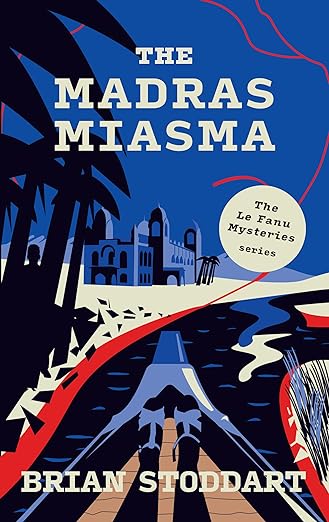
Book cover of The Madras Miasma (Le Fanu Mysteries #1) by Brian Stoddart

Madras in the 1920s. The British are slowly losing the grip on the subcontinent. The end of the colonial enterprise is in sight; the city on India’s east coast is teeming with intrigue. A grisly murder takes place against the backdrop of political tension. Superintendent Le Fanu, a man of impeccable investigative methods, is called in to find out who killed a respectable young British girl and dumped her in a canal, her veins clogged with morphine.

As Le Fanu, a man forced to keep his own personal relationship a secret for fear of scandal in the face British moral standards, begins to investigate, he quickly slips into a quagmire of Raj politics, rebellion and nefarious criminal activities that threaten not just to bury his case but the fearless detective himself.

Format: Paperback (296 pages) Publisher:
Publication date: 8th September 2014 Genre: Historical Fiction, Crime

Find The Madras Miasma on Goodreads

Purchase The Madras Miasma from Amazon UK [link provided for convenience not as part of an affiliate programme]


My Review

The Madras Miasma (previously published as A Madras Miasma and now reissued with a new cover design) is the first book in the author’s Superintendent Le Fanu historical crime series set in 1920s India.

As the book opens, Madras is a city of political unrest with a rising independence movement and a population divided along class, ethnic and religious lines. It’s also a magnet for the so-called ‘fishing fleet’, young women who have travelled from England in search of a husband. But behind the dancing, the cocktail drinking and the partying, there are darker things going on as the reader will discover.

The author gives Superintendent Christian Jolyon Brenton Le Fanu (known as Chris to his friends or LF for short) a comprehensive back story so he feels like a fully fleshed out character even though this is the first book in the series.

He’s separated from his wife and his traumatic experiences during the First World War, including the death of a close friend, have left him with a sense of despair and anger at any pointless waste of life. Being more tolerant and open-minded than many of the other British in Madras, he is suspected of pro-independence sympathies. Like many other fictional detectives, he has a boss with whom he doesn’t see eye to eye, and frankly who could blame him because the man is an idiot, and a dangerous idiot too. But fortunately Le Fanu has a highly competent sidekick in the form of Sergeant ‘Habi’ Habibullah. And while Colin Dexter’s Inspector Morse has his Jaguar, Le Fanu’s pride and joy is a1000cc Indian Powerplus motorcycle. Le Fanu’s blind spot is his inability to express his feelings or commit to a permanent relationship with the woman who often shares his bed. He also seems easily swayed by a lithe body in a silk dress.

Initially an investigation into the murder of one of the ‘fishing fleet’, the case rapidly becomes more complicated. ‘A dead white woman, political trouble, a belligerent Commissioner, an anxious and aggrieved British community, and a truculent police force made the worst possible combination.’ Le Fanu also unearths a deadly trade that reaches to the very heart of British colonial high society. The plot is satisfyingly complex so that it will keep you guessing until the final chapters. And with Le Fanu pondering his future, the end of the book sets things up nicely for the next book in the series, The Pallampur Predicament.

I received a digital review copy courtesy of (the now sadly defunct) Crime Wave Press.

In three words: Intriguing, atmospheric, assured
Try something similar: A Rising Man by Abir Mukherjee


About the Author

Author Brian Stoddart

Brian Stoddart is a writer of fiction and non-fiction who is now based in Queenstown, New Zealand. Born and educated a Kiwi he has worked around the world as an academic, university executive, aid and development consultant, broadcaster,commentator and blogger. He has written extensively on sports history, politics and culture as well as on India and south Asia in which field he completed his PhD.

He is now also a crime novelist. A Madras Miasma was the first in a series of books set in 1920s Madras in India, and featuring Superintendent Chris Le Fanu. The Pallampur Predicament was the second and A Straits Settlement the third. A Straits Settlement was longlisted for the 2017 Ngaio Marsh Award for Best New Zealand Crime Novel. A Greater God is the fourth in the Le Fanu series and appeared in 2018.

He has published extensively in non-fiction, too. A House in Damascus: Before the Fall recounts his experience of living in an old house in the Old City of Damascus immediately before the outbreak of the war in Syria. That memoir became an Amazon #1 in Middle East Travel, and won gold and silver medals at the 2012 e-Book Awards for Creative Non-Fiction and Travel respectively.

Brian Stoddart also works as an international higher education consultant on programs in Cambodia, Lao PDR, Syria and Jordan as well as in the UK and USA. This work follows a successful career as university researcher, teacher and senior executive which culminated in a term as Vice-Chancellor and President of La Trobe University in Australia where he is now an Emeritus Professor. That academic career took him all over the world including long periods in India, Malaysia, Canada, the Caribbean, China and Southeast Asia. He also writes extensively for mainstream and new media as well as expert commentary for press, radio and television. Brian is also a cruise ship lecturer, specialising in international affairs and history.

In his spare time, he enjoys photography, reading (especially crime fiction),travel to new places, and listening to music, especially gypsy jazz. (Photo: Goodreads author page/Bio: Author website)

Connect with Brian
X | Facebook