

Welcome to today’s stop on the blog tour for Revenge of Rome by Simon Scarrow which will be published on 7th November 2024. My thanks to Alara at Headline for inviting me to take part in the tour and for my review copy.
About the Book
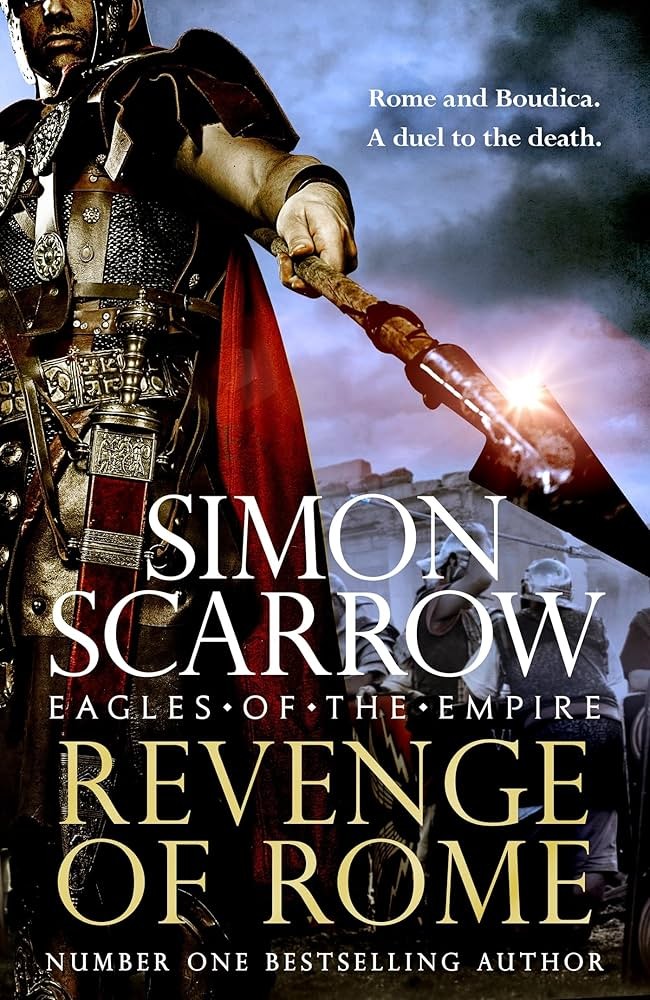
AD 61. Britannia is divided. The rebel horde has been defeated. But the leader, Boudica, and her remaining warriors are still at large. With them is the eagle standard of the Ninth Legion, taken in ambush, flaunted as proof that Rome can yet be beaten. The embers of rebellion are still glowing…
The toll has been heavy, with countless men lost, and major towns in ruins. The bodies of the dead are strewn across the streets. And for Centurion Macro, there is the scarring knowledge that his mother perished in the attack on Londinium.
As Macro’s heart burns for revenge, he and his comrade-in-arms Prefect Cato are tasked with hunting down the remnants of the enemy army. There can be no peace until the queen is captured or killed. And Roman honour will only be restored when the eagle standard has been recovered.
Format: Hardcover (432 pages) Publisher: Headline
Publication date: 7th November 2024 Genre: Historical Fiction
Find Revenge of Rome on Goodreads
Purchase Revenge of Rome on Bookshop.org [Disclosure: If you buy books linked to our site, we may earn a commission from Bookshop.org, whose fees support independent bookshops]
My Review
Revenge of Rome is the twenty-third book in Simon Scarrow’s ‘Eagles of the Empire’ series and sees the return of friends and comrades, Prefect Cato and Centurion Macro. For added spice we also have the famous warrior queen, Boudica. Cato, Macro and Boudica, that’s a truly fiery combination. Plus, we get a first glimpse of the young Agricola who would go on to great things.
The history books may have Boudica dead after the defeat of the rebel army she led, the battle which formed the climax of the previous book Rebellion, but in Revenge of Rome she’s very much alive and ready to bring the fight to Rome once again. Her implacable anger against the Roman Empire is not only because of their brutal subjugation of the tribal people of Britannica but also because of the cruel treatment meted out to her and her daughters. Boudica is utterly ruthless, demanding complete loyalty from her followers and removing anyone who shows even the slowest signs of wavering.
But Boudica has learned a lot from the defeat, including about Roman military tactics, and sets about transforming what’s left of the rebel army into an even more formidable enemy, one that lurks in the shadows, attacking when least expected, carrying on a kind of guerilla warfare designed to gradually erode the strength of the Roman forces and damage their morale.
Despite the fact they are bitter enemies, Boudica has respect for the abilities of Cato and Macro. (As readers of previous books will know, there’s history between the three of them, Macro especially.) She describes Cato as a man whose intelligence is matched by his good fortune and Macro as the greatest of Rome’s warriors.
The Roman legions assigned to Britannica have their own difficulties. They lost many men in the battle against the rebel horde which, at some points, was on a knife edge. The replacements are raw recruits who need to be whipped into shape. This is where Macro comes in and there’s a brilliant scene in which he addresses a batch of them in his own inimitable way.
Cato faces other pressures. Commander of the Roman forces in Britannica, Gaius Suetonius Paulinus, is demanding the complete destruction of the rebel force and the capture of Boudica so she can be led in chains through the streets of Rome before the Emperor Nero. It’s an almost possible task given the available manpower and the nature of the terrain. But as Cato observes, ‘As is often the case for such men, arrogance and ignorance trump wisdom on almost every occasion.’ Furthermore Suetonius is not a patient man since his own career – his life, even – depends on achieving a victory that will satisfy Nero.
However, Cato wonders about the wisdom of the approach, about what will happen should he succeed in punishing mercilessly the Icenians and their allies as Suetonius desires. As he reflects, ‘Often Rome stood for all that was best in the world. But sometimes she made grave errors, and was the very source of evil, forcing the best among her people to make great sacrifices in terms of blood and reputation to draw her back onto the right path, all the while being castigated by loud villains posturing as patriots‘.
It wouldn’t be a Simon Scarrow book without some great set piece action scenes, including the final assault on Boudica’s stronghold which requires all Cato’s strategic nous to overcome what seem like impenetrable obstacles. As always, Macro’s in the heat of the action. On the other side, Boudica seeks to rouse her followers for one last fight, even if it seems likely to end in defeat or death. Her rallying cry recalls the speech by Shakespeare’s Henry V on the eve of Agincourt. Describing them as ‘the lucky few’, she exhorts them to summon up their courage so that ‘all those who live after us on this island [may] recall and relive our deeds.’
There’s an elegaic sense about Revenge of Rome with both Cato and Macro pondering their futures. After all the death and destruction, the final chapters contain some moving moments. Although I very much hope it’s not the end of their adventures together, if it is, then Revenge of Rome ensures we’re going out on a high.
In three words: Gripping, authentic, dramatic
Try something similar: Invader (Agricola #1) by Simon Turney
About the Author

Simon Scarrow’s Roman soldier heroes Cato and Macro first appeared in 2000 in Under The Eagle, and have subsequently fought their way through over twenty novels, including Rebellion, Death to the Emperor and Centurion.
Simon is the author of many other acclaimed novels, from the Criminal Inspector Schenke thrillers set in Berlin during the Second World War to a quartet of novels about Wellington and Napoleon; from Sword & Scimitar, an historical drama based on the 1565 Siege of Malta, to Hearts of Stone, a story of Greek Resistance fighters, again in the Second World War. He has also written with co-authors to create Pirata, Invader and Arena, set in the Roman era, and Playing with Death, a contemporary thriller.
Connect with Simon
Website | X | Facebook



 What Cathy Read Next...