Book Review – Blue Postcards by Douglas Bruton #NOVNOV24

About the Book

Book cover of Blue Postcards

Once there was a street in Paris and it was called the Street of Tailors. This was years back, in the blue mists of memory.

Now it’s the 1950s and Henri is the last tailor on the street. With meticulous precision he takes the measurements of men and notes them down in his leather-bound ledger. He draws on the cloth with a blue chalk, cuts the pieces and sews them together. When the suit is done, Henri adds a finishing a blue Tekhelet thread hidden in the trousers somewhere, for luck. One day, the renowned French artist Yves Klein walks into the shop, and orders a suit. 

Format: Paperback (160 pages) Publisher: Fairlight Books
Publication date: 1st October 2021 Genre: Historical Fiction

Find Blue Postcards on Goodreads

Purchase Blue Postcards from Bookshop.org [Disclosure: If you buy books linked to our site, we may earn a commission from Bookshop.org, whose fees support independent bookshops]


My Review

I purchased this slim little volume when it was longlisted for The Walter Scott Prize for Historical Fiction in 2021. Sadly it has languished on my bookshelf ever since. Thankfully, the Novellas In November reading event hosted by Cathy at 746 Books and Rebecca at Bookish Beck has given me the impetus to read it.

It has an unusual structure: 500 numbered paragraphs each including the word ‘blue’. Sometimes the word blue describes the colour of an object – a glass, a dress, a tie – or an element of nature – the sea or sky. At other times, it’s a phrase such as ‘out of the blue’ or ‘feeling blue’. Along the way, we also get historical detail about use of the colour blue such as the significance of its use in religious art.

Intertwined with this meditation on the colour blue are three interconnected stories. The first starts with the narrator’s purchase of an old blue postcard from a young woman named Michelle and goes on to describe their subsequent relationship (real or imagined). The second depicts events in the life of Yves Klein, the artist who originally created the postcard. The third is the story of Henri, a Jewish tailor, who makes a suit for Klein, a suit the latter considers lucky and associates with his increasing success in the art world.

Although Henri’s story is set in the 1950s, other events do not necessarily unfold in linear time, as the narrator himself admits. Some might not even have happened at all. Memory is a theme that runs throughout the book whether that’s the unreliability of memory, such as remembering things that never happened but you wish had happened, the pain caused by reliving certain memories or the memories evoked by an object – a sugar bowl, for example – or a place.

When it came to the story of Yves Klein, it wasn’t until I read a review of the book by another reader that I discovered he was a real person and that the seemingly outrageous works of art described in the book really existed and were not a satirical comment on the art world by the author. I’m not sure whether knowing Klein was a real person would have changed my view of the book’s inventiveness. I suspect it might have.

There’s a lot of humour in the book, in particular some of the means by which the author inserts the colour blue into certain paragraphs. Having said that, there is a degree of repetition.

I can see why Blue Postcards, with its imaginative structure, made it on to the Walter Scott Prize longlist, but I can also understand why it didn’t make the shortlist. Personally, I would have liked more of Henri’s story and why he takes the action he does in the final pages.

In three words: Imaginative, funny, poignant
Try something similar: Red Is My Heart by Antoine Laurain & Le Sonneur


About the Author

Author Douglas Bruton

Douglas Bruton has been published in various publications including Northwords Now, New Writing Scotland, Aesthetica and the Irish Literary Review. His short stories have won competitions including Fish and the Neil Gunn Prize. He has had two novels published, The Chess Piece Magician and Mrs Winchester’s Gun Club. (Photo: Publisher author page)

Connect with Douglas
Goodreads

Book Review – Eye of the Raven by Tim Hodkinson @AriesFiction

About the Book

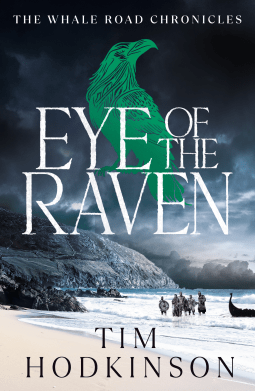
Book cover of Eye of the Raven by Tim Hodkinson

For the first time, Einar and the Wolf Coats find themselves divided, on opposing sides in a time of the Wolf Coats in Ireland, and Einar in the Saxon domains of England.

Einar leads a warband for King Aethelstan, but struggles to find acceptance as a Norseman in Saxon lands. Can he truly make common cause with the wily king of the English, if that means Vikings like himself are now his enemies? The rewards of alliance with Aethelstan could be all he desires… or a brutal death.

But other threats loom from the north and west. With war brewing and a great battle on the horizon, can Einar and his comrades reunite in time – or will a clash for the ages make their split a permanent one?

Format: Paperback (384 pages) Publisher: Head of Zeus
Publication date: 7th November 2024 Genre: Historical Fiction

Find Eye of the Raven on Goodreads

Purchase Eye of the Raven from Bookshop.org [Disclosure: If you buy books linked to our site, we may earn a commission from Bookshop.org, whose fees support independent bookshops]


My Review

Eye of the Raven is the seventh book in The Whale Road Chronicles featuring Icelandic warrior, Einar Unnsson. (The ‘whale-road’ is a very old poetic term for the sea.) It would be possible to enjoy Eye of the Raven as a standalone but you’d be missing out on the previous history of the various characters. Having said that, I’ve only read one other book in the series, The Serpent King and enjoyed it without having read the three that preceded it.

It’s 937 AD and the country we now know as Britain is an amorphous entity made up of multiple fiefdoms ruled by self-styled kings or jarls (Norse or Danish chieftans) who have little love for one another. Treaties are made, and frequently broken. At this time, the majority of central and southern England is controlled by the Anglo-Saxon king, Aethelstan of Wessex, the grandson of Alfred the Great. A devout Christian, he is determined to bring all of England under his control and combat the threat from the Scots, the Welsh and whoever else fancies a piece of his kingdom.

From being a member of the band of warriors known as the Wolf Coats, Einar has become their sworn enemy as a result of his actions at the end of the last book. The Wolf Coats’ leader, Ulrich, has vowed to kill him for what he perceives as his betrayal of the oath Einar swore. And there’s one particular member of the Wolf Coats who is keen to see Einar dead for their own very personal reasons.

There’s a thread that runs through the book, that of identity. For example, in order to be accepted by the Anglo-Saxons, Einar has adopted the garb of a Saxon, shaved off his beard and been forced – outwardly at least – to abandon his Norse religious beliefs in favour of Christian teachings. Cultural identity is often blurred: some of those on opposing sides may share a common cultural ancestry, whilst some on the same side may speak different languages and worship different gods. In some cases it’s possible to be too Saxon to inspire loyalty, in others not Saxon enough.

The action comes thick and fast with the battle scenes described in visceral detail. ‘The air was thick with the acrid scent of sweat and fear, the metallic tang of blood, and the stench of opened guts and emptied bowels.‘ I liked the fact that although we get the cut and thrust of battle, we also get to see the preparation for conflict that individuals go through, from the practical to the emotional. And we get a sense of just what it takes to face an enemy where the chances are you’ll end up dead or maimed. Not to mention the psychological toll of so much killing.

The climax of the book is the Battle of Brunanburh, a truly bloody affair. (In fact, it’s often cited as one of the bloodiest battles ever held on British soil.) The run-up to the battle is a game of bluff and double-bluff, and it’s here we see that Aethelstan is the master of that game, always a few steps ahead of everyone else. A bit of luck helps as well.

‘The slaughter, the sorrow, the cowardice, the shame, the cruelty, the bravery, the deeds of great renown. All is beheld in the eye of the raven.’ Eye of the Raven will appeal to those who like their historical fiction fast-paced and with plenty of full-on action.

I received a review copy courtesy of Head of Zeus via NetGalley.

In three words: Authentic, action-packed, gripping
Try something similar: For Lord & Land by Matthew Harffy


About the Author

Author Tim Hodkinson

Tim Hodkinson grew up in Northern Ireland where the rugged coast and call of the Atlantic ocean led to a lifelong fascination with Vikings and a degree in Medieval English and Old Norse Literature. Tim’s more recent writing heroes include Ben Kane, Giles Kristian, Bernard Cornwell, George R.R. Martin and Lee Child. After several years in the USA, Tim returned to Northern Ireland, where he lives with his wife and children. (Photo: Amazon author page)

Connect with Tim
Website | X | Goodreads