
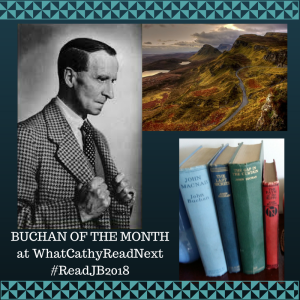
Buchan of the Month: Introducing… The Power-House

Buchan of the Month

The Power-House is the first book in my Buchan of the Month reading project. To find out more about the project and my reading list for 2018, click here. If you would like to read along with me you will be very welcome – leave a comment on this post or on my original challenge post to let me know you’re taking part.

What follows is an introduction to the book (no spoilers!). It is also an excuse to show pictures of my prized first edition of The Power-House (without dust jacket, unfortunately) found in a bookshop on the island of Iona, of all places. As Buchan might have put it, I had ‘tramped’ through the cold, wet rain that day in search of the shop and was rewarded with this treasure.

I will be posting my review of the book later in the month.


“You think that a wall as solid as the earth separates civilisation from barbarism. I tell you the division is a thread, a sheet of glass.”

The Power-House first appeared in Blackwood’s Magazine of December 1913. However, it wasn’t until May 1916, following the success of The Thirty-Nine Steps (published in 1915), that William Blackwood & Sons published The Power-House in novel form. Clearly they were hoping to cash in on the success of The Thirty-Nine Steps and this seems to have been an astute decision because, according to Buchan’s first biographer, Janet Adam Smith, The Power-House (priced at one shilling) had sold 24,000 copies by the end of 1916.

The Power-House DedicationIn the dedication to The Power-House, John Buchan writes, “I have printed this story, written in the smooth days before the war, in the hope that it may enable an honest man here and there to forget for an hour the too urgent realities”. He also wryly observes that the dedicatee, Major-General Sir Francis Lloyd, shares his own “liking for precipitous yarns”.

In describing The Power-House as a ‘yarn’, commonly defined as a long or rambling story, especially one that is implausible (although The Power-House is neither long nor rambling), it seems Buchan intended this first foray into the thriller genre to be a form of escapism from the troubled times the world was living through. In fact, he always used the self-deprecating term ‘shocker’ rather than thriller to describe his adventure stories.

The hero of The Power-House is Edward Leithen, whom Christopher Harvie describes as ‘the first and last of Buchan’s heroes’ and ‘the one closest in character to his author’. In fact, Leithen had earlier appeared briefly in ‘Space’ a short story by Buchan in his collection The Watcher by the Threshold, published in 1902. In The Power-House, Leithen recounts his story to a group of friends during a duck shooting trip, explaining “I once played the chief part in a rather exciting business without ever once budging from London”.

Although an early novel, The Power-House touches on a theme that will recur in later Buchan books, namely the fragility of civilisation. The period during which Buchan was writing The Power-House was a troubled time in his life. In 1910 he had unsuccessfully stood for Parliament and the following year his father died. This was followed by further family tragedy when his younger brother, Willie, died suddenly from an infection contracted while in India. Added to this, Buchan began to suffer from the digestive problems that would plague him for the rest of his life. It was a troubling time in world events as well. As Christopher Harvie notes, “The Power-House announces the terrific anarchy to be loosed upon the world”.

Janet Adam Smith describes Buchan’s recipe for The Power-House (and The Thirty-Nine Steps) as ‘brisk, improbable action played out against a realistic background’. In his autobiography, Memory-Hold-The-Door, Buchan describes himself as ‘a natural storyteller, the kind of man who for the sake of his yarns would in prehistoric days have been given a seat by the fire and a special chunk of mammoth’.

So find yourself a comfy reading spot and turn to the first page of The Power-House…

Sources:
John Buchan, Memory-Hold-The-Door (Hodder & Stoughton, 1964 [1940])
David Daniell, The Interpreter’s House: A Critical Assessment of the Work of John Buchan (Nelson, 1975)
Christopher Harvie, ‘Introduction’ to The Leithen Stories by John Buchan (Canongate Classics, 2000)
Kate Macdonald, John Buchan: A Companion to the Mystery Fiction (McFarland, 2009)
Janet Adam Smith, John Buchan: A Biography (OUP, 1985 [1965])

Book Review: Death Comes for the Archbishop by Willa Cather

Death Comes For The ArchbishopAbout the Book

In 1851 Father Jean Marie Latour comes as the Apostolic Vicar to New Mexico. What he finds is a vast territory of red hills and tortuous arroyos, American by law but Mexican and Indian in custom and belief. In the almost forty years that follow, Latour spreads his faith in the only way he knows—gently, although he must contend with an unforgiving landscape, derelict and sometimes openly rebellious priests, and his own loneliness.

The novel is based on the life of Jean-Baptiste Lamy (1814-1888), and partially chronicles the construction of the Cathedral Basilica of St. Francis of Assisi.

Format: ebook (306 pp.)                       Publisher: Annie Rose Books
Published: 25th January 2016 [1927] Genre: Historical Fiction, Modern Classics

Purchase Links*
Amazon.co.uk ǀ  Amazon.com
*links provided for convenience, not as part of any affiliate programme

Find Death Comes for the Archbishop on Goodreads


My Review

Set in the mid-nineteenth century, Death Comes for the Archbishop tells the story of two priests – Bishop Jean Marie Latour and Father Joseph Vaillant – who are sent to establish the Catholic Church in the newly acquired territory of New Mexico.  The book is episodic in nature, almost a collection of short stories or parables, depicting their experiences and many of the characters they encounter along the way.

In fulfilling the task they have been entrusted with, and in order to carry out their pastoral duties, they are forced to travel vast distances across harsh but beautiful landscape.  I was left with a sense of awe for the courage and determination of these pioneering men, inspired by their faith to undertake such arduous and dangerous journeys, often only with a native guide, their trusty mules and simple rations.  Along the way they come across venality, immorality and corruption, sometimes by priests who have become used to running their parishes as personal fiefdoms.

One of the things I loved about the book is the depiction of the friendship between the two men, formed in their earliest days as trainee priests at a seminary in their native France.  Despite frequently being apart for long stretches of time and the fact that Latour, as the senior of the two, must often send his friend on dangerous journeys, their friendship prevails to the very end of their lives.  Despite being quite different in character – Latour ‘gracious to everyone, but known to a very few’, Vaillant a man who ‘added a glow to whatever kind of human society’ – the two men share a love of good food and wine and an unshakeable belief in their vocation.

Latour, perhaps, is more sensitive to the traditional beliefs and customs of the native Indians and their need for a certain ‘theatricality’ about the practice of their religion, with women throwing down their shawls for him to walk on, people clamouring to kiss his Episcopal ring and gaudy decoration of their churches.

The author seems admiring of the Indians attitude to their environment, lauding their sympathetic approach to the land they inhabit and which they consider sacred.  (This is contrasted with the European’s desire to ‘master nature, to arrange and recreate’.)

‘It was as if the great country was asleep, and they wished to carry on their lives without awakening it; or as if the spirits of the earth and air and water were things not to antagonize and arouse.  When they hunted, it was with the same discretion; and Indian hunt was never a slaughter.  They ravaged neither the rivers nor the forest, and if they irrigated, they took as little water as would serve their needs.  The land, and al that it bore, they treated with consideration; not attempting to improve it, they never desecrated it.’

Latour too gradually falls in love with the landscape of New Mexico as this scene close to the end of the book demonstrates:

‘In New Mexico he always woke a young man; not until he rose and began to shave did he realize that he was growing older.  His first consciousness was a sense of the light dry wind blowing in through the windows, with the fragrance of hot sun and sage-brush and sweet clover; a wind that made one’s body feel light and one’s heart cry “To-day, today” like a child’s.’  

My first introduction to Willa Cather’s writing was through O Pioneers!, which I then followed with My Antonia, perhaps her most well-known book.  From the very start, I admired her beautiful writing and wonderful storytelling and these qualities were evident once more in Death Comes for the Archbishop.  As noted earlier, the book is episodic in nature and certain chapters read more like short stories.  One I particularly liked was December Night, in which the Bishop’s ‘dark night of the soul’ is restored by the piety of an old woman prevented by her cruel employers from practising her faith.

This book forms part of my Classics Club list and my 2018 TBR Pile Reading Challenge.

Follow my blog with Bloglovin

In three words: Inspiring, engaging, friendship

Try something similar…Sick Heart River by John Buchan


Willa CatherAbout the Author

Wilella Sibert Cather was born in Back Creek Valley (Gore), Virginia, in December 7, 1873. Her novels on frontier life brought her to national recognition. In 1923 she was awarded the Pulitzer Prize for her novel, One of Ours (1922), set during World War I. She grew up in Virginia and Nebraska. She then attended the University of Nebraska, initially planning to become a physician, but after writing an article for the Nebraska State Journal, she became a regular contributor to this journal. Because of this, she changed her major and graduated with a bachelor’s degree in English. After graduation in 1894, she worked in Pittsburgh as writer for various publications and as a school teacher for approximately 13 years, thereafter moving to New York City for the remainder of her life. She travelled widely and often spent summers in New Brunswick, Canada. In later life, she experienced much negative criticism for her conservative politics and became reclusive, burning some of her letters and personal papers, including her last manuscript. She was elected a Fellow of the American Academy of Arts and Sciences in 1943. In 1944, Cather received the gold medal for fiction from the National Institute of Arts and Letters, an award given once a decade for an author’s total accomplishments. She died of a cerebral haemorrhage at the age of 73 in New York City.

Goodreads