
 Huntingtower is the eighth book in my John Buchan reading project, Buchan of the Month. To find out more about the project and my reading list for 2018, click here. If you would like to read along with me you will be very welcome – leave a comment on this post or on my original challenge post. I’ll be sharing my review later this month. What follows is an introduction to the book (no spoilers!).
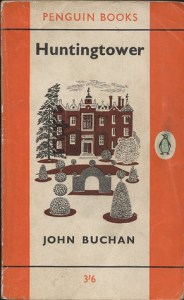 Huntingtower was published in the UK in August 1922 by Hodder & Stoughton and in the US in November 1922 by George H Doran Company. Like many of Buchan’s early novels, it had first appeared in serial form, in this case in Street & Smith’s The Popular Magazine in the editions published on 20th August and 7th September 1921.
David Daniell, author of The Interpreter’s House: A Critical Assessment of the Work of John Buchan, describes Huntingtower as ‘a stirring adventure’ and notes that it was the first novel Buchan wrote at Elsfield, the house in Oxfordshire that became his family home. Buchan scholar Kate MacDonald, describes Huntingtower as an ‘ostensibly gentle thriller’ with ‘elements of classic Stevensonian romance’, a comparison Buchan would no doubt have been happy with given that Robert Louis Stevenson, along with Sir Walter Scott, was one of his literary heroes.
Huntingtower introduces readers to Dickson McCunn, retired middle-aged Glasgow grocer. He is based on Scottish literary professor, William Paton Ker, to whom the book is dedicated. In the book, along with modernist English poet, John Heritage, and Scottish landowner, Archie Roylance, Dickson McCunn becomes involved in the rescue of Princess Saskia who has been captured by a group of dastardly Bolsheviks. The book also introduces the reader to the gang of street urchins known as the ‘Gorbals Die-Hards’ – a sort of equivalent of Sherlock Holmes’ trusty ‘Baker Street Irregulars’. Kate MacDonald sees the Gorbals Die-Hards as Buchan’s response to the overly sentimental treatment of children (and of rural life in general) in the so-called ‘Kailyard School’ of Scottish fiction that flourished in the late nineteenth and early twentieth century.
Dickson McCunn was to feature in two further Buchan novels – Castle Gay (1930) and The House of the Four Winds (1935) – although MacDonald describes these as ‘continuations’ rather than sequels. Hodder & Stoughton published a compendium of the stories in 1937 under the title Adventures of Dickson McCunn. A film version of Huntingtower was released in 1927 starring the well-known Scottish music-hall artist of the time, Harry Lauder, as Dickson McCunn. A six-part BBC TV series was broadcast in 1957 and there was a second adaptation in 1978.
Huntingtower was a reasonable commercial success, selling 18,000 copies in its first year of publication. Buchan’s biographer, Janet Adam Smith, reports that by 1960 it had combined sales of 230,000. Huntingtower was published by Penguin in 1956 and this edition had sold 104,000 copies by June 1964.
Sources:
David Daniell, The Interpreter’s House: A Critical Assessment of the Work of John Buchan (Nelson, 1975)
Kate Macdonald, John Buchan: A Companion to the Mystery Fiction (McFarland, 2009)
Janet Adam Smith, John Buchan: A Biography (OUP, 1985 [1965])

 About the Book
 About the Author

