Buchan of the Month: Introducing Augustus by John Buchan #ReadJB2019

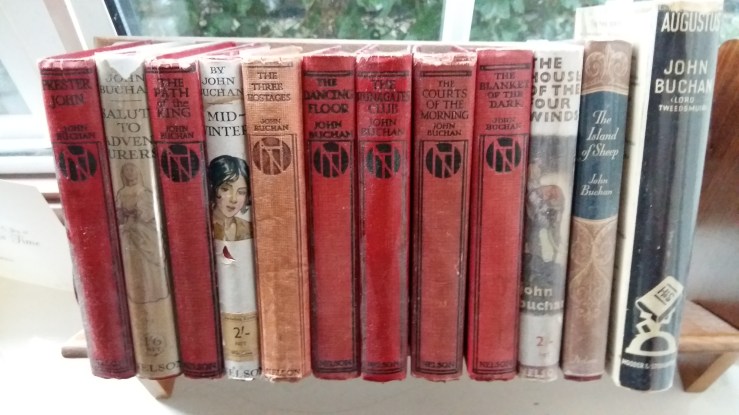
buchan of the month 2019 poster

In honour of Nonfiction November, I’ve chosen John Buchan’s biography of the Roman Emperor Augustus as my Buchan of the Month. You can find out more about the project and my reading list for 2019 here. What follows is an introduction to Augustus.   I will be publishing my review of the book later this month.
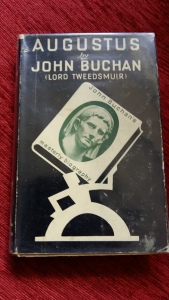

AugustusBuchanAugustus was published by Hodder & Stoughton in the UK and by Houghton Mifflin in the US in October 1937.

Buchan (by this time, Lord Tweedsmuir) started work on the book soon after his arrival in Canada following his appointment as Governor-General. Janet Adam Smith, Buchan’s first biographer, records how when he had completed his official duties and ‘disposed of the day’s chores, he would turn at once to the biography of Augustus’. Buchan received long distance help with research for the book from two friends: Hugh Last, Professor of Ancient History at Oxford (where Buchan had studied) and Roberto Weiss. The latter looked out newly published material, checked references and later oversaw the book’s translation into Italian.

Professor Last was suitably impressed with the finished product, remarking that the book ‘puts us so-called experts as much in your debt for its demonstration of the way in which Augustus should be treated as it does the larger public’, going on to describe it as ‘by far the best general interpretation of its subject’. The book was greeted with approval by many other historians.

David Daniell praises Buchan as a painstaking historian and a ‘modern interpreter who had a powerful sense of the future’. Buchan himself was conscious of the parallels with contemporary events given he was working on the book at the same time as Europe was witnessing the rise of Mussolini and Hitler. In the preface to the book he writes: ‘The convulsions of our time may give an insight into the problems of the early Roman empire which was perhaps unattainable by scholars who lived in easier days‘. Buchan even sent a copy of Augustus to President Roosevelt, saying ‘I hope it may interest you for many of his problems are your own’.

At the end of the book, Buchan points out similarities between the two ages: Once again the crust of civilization has grown thin, and beneath can be heard the muttering of primeval fires. Once again many accepted principles of government have been overthrown, and the world has become a laboratory where immature and feverish minds experiment with unknown forces.‘ (The concept of the thin crust of civilization was one Buchan had previously explored in his adventure novels, notably The Power-House.)

Despite its positive reception by historians, Augustus sold only 5,000 copies in the UK in the first year of its publication. By 1960, that figure had reached 36,000 boosted by the release of a cheap edition in 1942.

My Buchan of the Month for December will be the final Richard Hannay adventure, The Island of Sheep.

Sources:

Janet Adam Smith, John Buchan: A Biography (OUP, 1985 [1965])
David Daniell, The Interpreter’s House: A Critical Assessment of John Buchan (Nelson, 1975)
Kenneth Hillier and Michael Ross, The First Editions of John Buchan: A Collector’s Illustrated Biography (Avonworld, 2008)
buchan of the month 2019

#BookReview Chanel’s Riviera by Anne de Courcy #NonficNov

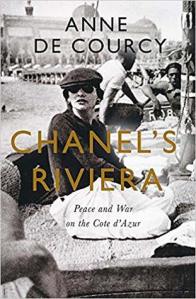
Chanels RivieraAbout the Book

Far from worrying about the onset of war, the burning question on the French Riviera in 1938 was whether one should curtsey to the Duchess of Windsor.

Featuring a sparkling cast of historical figures, writers and artists including Winston Churchill, Daisy Fellowes, Salvador Dalí, the Windsors, Aldous Huxley and Edith Wharton – and the enigmatic Coco Chanel at its heart – Chanel’s Riviera is a sparkling account of a period where such deep extremes of luxury and terror had never before been experienced.

From the glamour of the pre-war parties and casinos, to Robert Streitz’s secret wireless transmitter in the basement of La Pausa – Chanel’s villa that he created – while Chanel had her German lover to stay during the war, Chanel’s Riviera explores the fascinating world of the Cote d’Azur elite in the 1930s and 1940s, enriched with original research that brings the lives of both rich and poor, protected and persecuted, to vivid life.

Format: Audiobook                            Publisher: Orion
Publication date: 13th June 2019  Genre: History, Nonfiction

Find Chanel’s Riviera:  Peace and War on The Côte d’Azur, 1930 – 1944 on Goodreads

Purchase Links*
Amazon.co.uk | Hive (supporting UK bookshops)
*links provided for convenience, not as part of any affiliate programme


My Review

When I heard Anne de Courcy talk about her book at Henley Literary Festival last month (read my full review of the event here) she described Chanel’s Riviera as a ‘biography of the Riviera’. I think that’s a fair description because readers expecting the majority of the book to be about Chanel may be disappointed. Yes, Chanel does feature a lot but in sections of the book she is either on the periphery or absent entirely. For example, she spent periods during the war in Paris rather than on the Riviera.

What the book does well is conjure up the glamour and hedonism of life on the Riviera for the rich and famous before the war. The author describes how it became a haven for writers and artists like Picasso, Ernest Hemingway, Somerset Maugham, H G Wells and Jean Cocteau, as well as society figures such as Winston Churchill and, later, the Duke and Duchess of Windsor.

The mood changes suddenly following the outbreak of war. The book depicts the arrival of refugees from Northern Europe, including Jews fleeing persecution, and the food shortages that followed the fall of France in 1940 as supplies were diverted to Germany. Life for many living on the Cote d’Azur became really tough and the author uses material from diaries and contemporary sources to tell the harrowing stories of individuals.

Other than her reputation as a designer, I knew very little about Chanel’s life before reading this book. It was interesting to learn of her rise from humble beginnings to doyenne of the fashion world. However, I can’t say everything I learned made me warm to Chanel as a person. For instance, I was shocked to learn of her anti-Semitic views.

In the book the author addresses claims that Chanel collaborated with the Nazis. For example, she suggests Chanel’s taking of a senior German officer as a lover was principally aimed at trying to gain the release of her nephew who was being held as a prisoner of war by the Germans. However I found myself wondering if ‘the will to survive’ was sufficient justification for some of Chanel’s actions.

As the author recounts, partly what kept Chanel free from the retaliation meted out to others accused of collaboration was the reopening of her Paris store following its liberation in 1944 and the offer of a free bottle of her iconic perfume for every US soldier to take home to their wife or sweetheart. That and being able to produce papers demonstrating her friendship with Winston Churchill.

Chanel’s Riviera is clearly the product of extensive research. For me, the most interesting element of the book was seeing the impact of the Second World War on an area of France which had hitherto been the playground of the rich and famous.

I listened to the audio book version narrated by Sophie Roberts. Chanel’s Riviera is also available in hardcover and as an ebook.


contributor-anne-de-courcyAbout the Author

Anne de Courcy is the author of thirteen widely acclaimed works of social history and biography, including The Husband HuntersThe Fishing FleetThe Viceroy’s Daughters and Debs At War.

In the 1970s she was Woman’s Editor on the London Evening News and in the 1980s she was a regular feature-writer for the Evening Standard. She is also a former features writer and reviewer for the Daily Mail.  She lives in London SW3. (Photo credit: Publisher author page)

Connect with Anne

Website