#TopTenTuesday Tips For Success With Reading Challenges

Top Ten Tuesday new

Top Ten Tuesday is a weekly meme created by The Broke and the Bookish and now hosted by Jana at That Artsy Reader Girl.

The rules are simple:

Each Tuesday, Jana assigns a new topic. Create your own Top Ten list that fits that topic – putting your unique spin on it if you want. Everyone is welcome to join but please link back to That Artsy Reader Girl in your own Top Ten Tuesday post. Add your name to the Linky widget on that day’s post so that everyone can check out other bloggers’ lists. Or if you don’t have a blog, just post your answers as a comment.

This week it’s a freebie with participants free to come up with their own topic. A few weeks ago I dedicated a Top Ten Tuesday post to Reasons I Fail At Reading Challenges. As well as a lot of other bloggers identifying with many of my reasons, there were also some great tips suggested. So today’s post is a way of sharing those tips and recognising the supportive nature of the book blogging community.


Tip 1 – Set targets lower to allow for other releases and random finds (The Scented Library)

Tip 2 – Take full advantage of the facility to swap books where a challenge allows it (The Secret Library)

Tip 3 – Join challenges for which you don’t need to read specific books (The Secret Library)

Tip 4 – Stick to reading challenges you know you can achieve, e.g. Goodreads (The Night Is Dark And Full Of Books

Tip 5 – Make challenges perpetual so you can read on indefinitely (Readerbuzz)

Tip 6 – Only join challenges that fit your reading pattern (Blue Mood Cafe)

Tip 7 – Stick to small monthly challenges that fit with books you’d read anyway (A Novel Glimpse)

Tip 8 – Pick what’s right for you to strike the right balance between the camaraderie that comes with taking part in a challenge and it not feeling like work  (Jen Ryland)

And a final two from me (although whether I take my own advice is doubtful based on past experience)…

Tip 9 – Remember you don’t have to join every challenge going. There’s always next year!

Tip 10 – Remind yourself of these tips before you start signing up for 2020 reading challenges


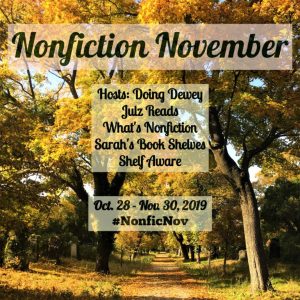
#NonficNov Nonfiction November: Nonfiction Favourites

nonficnovgraphic-e1569211904841-768x768

This week’s discussion prompt for Nonfiction November is Nonfiction Favorites hosted by Leann of Shelf Aware.

Leann says, ‘We’ve talked about how you pick nonfiction books in previous years, but this week I’m excited to talk about what makes a book you’ve read one of your favourites’.

  • Is the topic pretty much all that matters?
  • Are there particular ways a story can be told or particular writing styles that you love?
  • Do you look for a light, humorous approach or do you prefer a more serious tone?
  • What qualities make you add a nonfiction book to your list of favourites?

I have to admit I found this week’s question a little difficult to answer as I don’t read that much nonfiction… except in November! However, using my list from the first discussion prompt of this year’s Nonfiction November, I think I can draw some conclusions.

Subject matter is the main thing that draws me to a book and it helps if it has some sort of personal connection. For example, I’m a keen gardener so a book like Where The Hornbeam Grows by Beth Lynch was always likely to appeal to me although, unlike the authoruthor, I’ve never had to make a new life in another country. Similarly, my political views incline more to the left than the right so the memoirs of a figure such as Alan Johnson, former Home Secretary in the Labour government, naturally pique my interest. Finally, as regular followers of my blog will know, anything about John Buchan is likely to grab my attention.

When it comes to writing styles, I think my choice shows I like the personal touch. For instance, what particularly appealed to me about reading the latest biography of John Buchan was that it was written by his granddaughter, Ursula Buchan. Even though she never met him, her insight as a member of his family offered an unique element.

I read a lot of historical fiction and the Second World War is a favourite period. This carries over to my choice of nonfiction. Often reading about a particular aspect in a work of fiction makes me want to find out more; the fact behind the fiction, if you like. Occasionally it can happen the other way around as well. An example is one of my book pairings from week two of Nonfiction November. Reading Monopoli Blues about the role of the Special Operations Executive (SOE) in World War 2 meant Eight Hours From England by Anthony Quayle caught my eye. Even more so since it is a fictionalized account of the author’s own wartime service with the SOE.

My final thought is there are often features I particularly like in nonfiction books such as photographs, maps, diagrams and extracts from diaries or letters.

What attracts you to a nonfiction book?