The Sea Gate by Jane Johnson #BookReview @HoZ_Books

Welcome to today’s stop on the blog tour for The Sea Gate by Jane Johnson, which is available now as an ebook and will be published in hardback on 3rd September 2020. My thanks to Vicky Joss at Head of Zeus for inviting me to take part in the tour and for my review copy via NetGalley. You can read my review below but do also check out the post by my tour buddy, Frankie at Chicks, Rogues and Scandals.
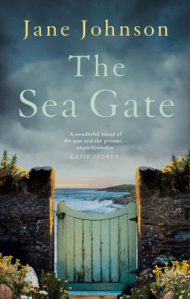

cover181972-mediumAbout the Book

One house, two women, a lifetime of secrets…

Following the death of her mother, Becky begins the sad task of sorting through her empty flat. Starting with the letters piling up on the doormat, she finds an envelope post-marked from Cornwall. In it is a letter that will change her life forever. A desperate plea from her mother’s elderly cousin, Olivia, to help save her beloved home.

Becky arrives at Chynalls to find the beautiful old house crumbling into the ground, and Olivia stuck in hospital with no hope of being discharged until her home is made habitable.

Though daunted by the enormity of the task, Becky sets to work. But as she peels back the layers of paint, plaster and grime, she uncovers secrets buried for more than seventy years. Secrets from a time when Olivia was young, the Second World War was raging, and danger and romance lurked round every corner…

The Sea Gate is a sweeping, spellbinding novel about the lives of two very different women, and the secrets that bind them together.

Format: ebook (448 pages)           Publisher: Head of Zeus
Publication date: 4th June 2020 Genre: Historical Fiction

Find The Sea Gate on Goodreads

Pre-order/Purchase links*
Amazon UK| Hive (supporting UK bookshops)
*links provided for convenience not as part of an affiliate programme


My Review

I was first introduced to the writing of Jane Johnson when I read her book Court of Lions. That book’s setting (Granada) was a little different from the Cornwall of The Sea Gate but the two novels share similarities. For example, they both feature the interweaving of past and present story lines and a plot involving hidden secrets.

I recall finding the storyline of Court of Lions set in the present day slightly less engaging than that set in the past, although to be fair that was largely because the latter was so powerful. However, in The Sea Gate I had no such difficulty as the author gives the reader equally compelling stories and sympathetic characters in both time periods.

The Olivia the reader encounters in the present day initially appears a rather irascible and difficult old lady. However, as Becky soon discovers, she’s incredibly spirited and tougher than she seems. “There’s still so much fire in her, so much character, a sort of fierce, frail heroism. I wish I’d known Olivia when she was younger.” The reader is granted Becky’s wish as the story moves back to 1943 and Olivia’s wartime childhood at Chynalls. With her mother away in London and her father serving abroad, Olivia is left largely to fend for herself. Her life is changed through a chance meeting brought about, as she puts it, by “misunderstanding and xenophobia”. Despite being the “epitome of difference”, she and the other character form an unbreakable bond and a chain of events is set in motion that will have far-reaching consequences.

Becky’s discovery of the letter from Olivia in her mother’s belongings, gives her just the project she needs to distract her from recent events in her life, doubts about her relationship with partner Eddy, and worries about the future. She decides, “It’s time to take some responsibility for a change, to try to do some good in the world, to help my elderly cousin as I was never able to help my own mother.” The fact Olivia lives amid the glorious landscape of Cornwall helps Becky’s decision too. “Sea and sky fuse at the distant horizon. Spangles of light glitter like spilled treasure, undulating with the rolling of the waves… This is the Cornwall I have always imagined. The sense of wildness and isolation, of fairy tale and possibility.”

I particularly liked the way Becky’s renovation of Chynalls mirrors her own psychological and physical “renovation”. It was truly heart-warming to witness her growing self-confidence, independence of spirit and the reawakening of her creativity. As Becky admits herself, “Fear has trapped me, rendered me immobile and powerless…fear of everything, really. I’d forgotten I even had wings, let alone how to use them.” Becky’s inner strength doesn’t escape Olivia’s observant eyes though, recognising in Becky “That family gumption. The never-give-up look.” The nature of Becky’s gumption will become evident in the most satisfying way later in the book.

Alongside supervising the renovation of Chynalls by brothers, Mo and Reda, Becky becomes curious to find out more about Olivia’s past. Sorting through old letters and photograph albums, she concludes, “Cousin Olivia is, like Chynalls, stuffed with secrets, and I feel compelled to find out what I can.” What is the meaning of the symbols carved on the sea gate, for instance, or the identity of the artist whose paintings line the walls? Deliciously for the reader, Becky starts to feel “Little mysteries surround me, deliberately withholding themselves, trembling on the edge of revelation.

I mentioned earlier the subtle connections between the stories of Olivia and Becky. These only increase as the book progresses. Echoes upon echoes, if you like. For example, both Olivia and Becky find themselves in need of guardian angels to protect them from those who would take advantage of them. And I must give a special mention to something else Olivia and Becky share – the gloriously foul-mouthed parrot, Gabriel, to whom it’s definitely worth paying attention.

In the second half of the book, as Becky gets closer to discovering the secret hidden for so long, the pace accelerates, the tension really ratchets up and there are moments of melodrama. The creaks of an old house, the sudden striking of a grandfather clock that has up until then been silent and a thunderstorm are just some of the ingredients that help to create a distinctly spine-tingling atmosphere. For Becky, “The house is full of secrets, and sometimes they come out and whisper together in the night.” However, secrets have a way of not remaining hidden and reading a book such as The Sea Gate wouldn’t be half so satisfying if they did, would it? Never fear, there’s a lot to be discovered before the full picture is revealed.

The Sea Gate is a skilfully crafted dual time story about two women from different generations who are nevertheless bound together by shared experiences and by a cliff-top house that has carefully guarded a shocking secret for decades.

In three words: Atmospheric, suspenseful, emotional

Try something similar: The Walls We Build by Jules Hayes

Follow this blog via Bloglovin


Jane JohnsonAbout the Author

Jane Johnson is a British novelist and publisher. She is the UK editor for George R.R. Martin, Robin Hobb and Dean Koontz and was for many years publisher of the works of J.R.R. Tolkien. Married to a Berber chef she met while researching The Tenth Gift, she lives in Cornwall and Morocco.

Connect with Jane
Website | Twitter | Facebook


Patrol by Fred Majdalany #BookReview #BlogTour @I_W_M @angelamarymar

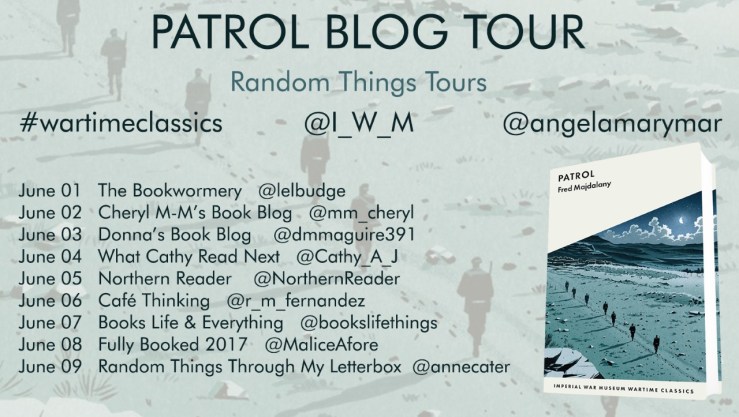
Patrol BT Poster

Welcome to today’s stop on the blog tour for Patrol by Fred Majdalany, another in the Imperial War Museum’s Wartime Classics series. My thanks to Anne at Random Things Tours for inviting me to participate and to Angela Martin and the Imperial War Museum for my review copy.

The Wartime Classics series was launched in September 2019 to great acclaim. The novels were all written either during or just after the Second World War and are currently out of print. As part of the Imperial War Museum’s commitment to telling the stories of those who experienced conflict first hand, each novel is written directly from the author’s own experience and takes the reader right into the heart of the battle.

Each book has an introduction by Alan Jeffreys (Senior Curator, Second World War, Imperial War Museums) that sets it in context and gives the wider historical background. He says, ‘researching the Wartime Classics has been one of the most enjoyable projects I’ve worked on in my years at IWM. It’s been very exciting rediscovering these fantastic novels and helping to bring them to the wider readership they so deserve’.

You can find a complete list of the books published so far in the Wartime Classics series here.

Look out for my review of another book in the series, Warriors for the Working Day by Peter Elstob later this month.


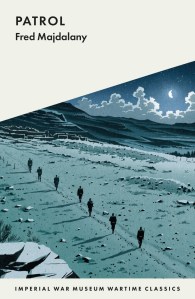
Patrol CoverAbout the Book

1943, the North African desert. Major Tim Sheldon, close to battle-exhaustion, is tasked with carrying out a futile and unexpected patrol mission. Fred Majdalany’s intimate, tense novel puts this so-called minor action centre stage, as over the course of the day and through the night of the patrol itself, Sheldon reminisces about his time as a soldier, his own future, and what it means to confront fear.

Patrol was a bestseller when it was first published in 1953. Clearly autobiographical, it is based on Fred Madjalany’s own experiences in Tunisia as part of the North African campaign, in particular his command of a night patrol and his time in hospital when wounded. The fictional battalion in the novel is based on 2nd Battalion, Lancashire Fusiliers into which Madjalany was commissioned in 1940. Infantry battalions such as this were constantly in action with little respite, and the officers were very young by peace time standards. The stress of battle aged them considerably.

Format: Paperback (192 pages)      Publisher: Imperial War Museum
Publication date: 23rd April 2020 Genre: Fiction

Find Patrol on Goodreads

Purchase links*
Publisher | Amazon UK | Hive (supporting UK bookshops)
*links provided for convenience not as part of an affiliate programme


My Review

“He was stubbornly certain that tonight’s effort would serve no useful purpose whatsoever.”

What really comes across as Sheldon leads his men out on what he believes is a futile exercise – a night time reconnaissance patrol in enemy held territory to the so-called White Farm – is the “deep loneliness of command”. Despite his meticulous preparations and reconnaissance, at one point Sheldon fears he may have led the patrol off their intended course in the darkness of no-man’s land. The burden of responsibility weighs so heavy on him that his previous gratitude for his men’s willingness to follow him so unquestioningly becomes an entirely different emotion. “He hated them because he was lost and could feel their eyes behind him. He hated them because the whole patrol was unnecessary and silly…” Unlike the reader, little does Sheldon know just how random, if not criminally negligent, was the choice of White Farm as the objective for their patrol.

In the middle section of the book, Sheldon’s looks back on his wartime experiences up to this point, including his relationship with a nurse during time spent in hospital recovering from a wound incurred during a previous skirmish with the enemy. It’s a period which seems to him now to have been “an interlude of unreality, a fantasy, a mad incredible honeymoon”. It was also during this period that he had his first face-to-face encounter with the enemy in the person of a wounded German officer. He reflects on the strange metamorphosis of “the Enemy” from an abstraction into a person, a person he finds himself thinking as they chat about books and music, “not at all unlike himself”.

Thanks to the helpful and informative introduction by Alan Jeffreys, I was able to get my head around the Army hierarchy – brigades, battalions, companies, and so on. A theme of the book is the gulf that Sheldon perceives between the demeanour, experiences and, frankly, the capability of those at the top, and those on the front line. “They were a curious lot, these HQ people: they had the glossy, confident look of successful businessmen, Sheldon thought. Rotarians in uniform, that’s what they were.”

One of many fascinating and insightful observations by the author is that, far from what one might expect, the war brings with it a degree of simplification: the simplification of merely following orders. So, during the patrol, Sheldon’s “private universe” becomes “a long thin strip of light, seven men wide, with White Farm at the end of it, and all he had to do for the present was to get there”.

Patrol is not just a moving and compelling account of the experience of war but contains some fine writing. I was particularly struck by the section in which Sheldon recalls his experience of an attack on an enemy outpost, the skirmish in which he was wounded. It’s described in short, often single word sentences vividly conjuring up the noise and confusion of battle. I also loved this description of the experience of coming back to base after a night operation. “To a returning patrol first light is sacred and miraculous: not the dawning of a new day but of a new life.”

The final scenes in the book left me with an even stronger sense of the futility of war and the waste of human life it represents. In his introduction, Alan Jeffreys notes that the author’s wife, Sheila Howarth, wrote, ‘I believe in Patrol he was writing his epitaph’. If that is so, the book is a fitting epitaph to a courageous man, and to many others like him.

In three words: Compelling, immersive, authentic

Try something similar: Eight Hours From England by Anthony Quayle

Follow this blog via Bloglovin


About the Author

Frederick Majdalany (1913 – 1967) was the son of a Manchester-based Lebanese family. His original first name was Fareed, which he changed to Frederick or Fred. He was also known as ‘Maj’. He worked as a journalist, drama critic and theatre publicist pre-war. He volunteered in 1939 and was commissioned into the 2nd Battalion, Lancashire Fusiliers in 1940, serving in North Africa and Italy. He was wounded at the Battle of Medjez-el-Bab, returning to the battalion five weeks later with the rank of captain, was later promoted to major, and commanded a company. His unit landed at Taranto in September 1943 where he was awarded the Military Cross during the Italian campaign.

In October 1944 he returned home to become an instructor at an officer cadet training unit, which he later commanded, until demobilization in November 1945. After the war Majdalany resumed his career as a journalist and also worked for the BBC on historical scripts for radio and TV. He published novels and military histories, all of which were very well received. He was also involved with International PEN.

Fred Majdalany suffered a stroke in 1957 and died ten years later.