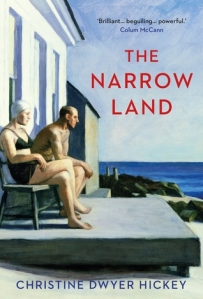
 About the Book
1950: late summer season on Cape Cod. Michael, a ten-year-old boy, is spending the summer with Richie and his glamorous but troubled mother. Left to their own devices, the boys meet a couple living nearby – the artists Jo and Edward Hopper – and an unlikely friendship is forged.
She, volatile, passionate and often irrational, suffers bouts of obsessive sexual jealousy. He, withdrawn and unwell, depressed by his inability to work, becomes besotted by Richie’s frail and beautiful Aunt Katherine who has not long to live – an infatuation he shares with young Michael.
A novel of loneliness and regret, the legacy of World War II and the ever-changing concept of the American Dream.
Format: Hardcover (384 pages) Publisher: Atlantic Books
Publication date: 7th March 2019 Genre: Historical Fiction
Find The Narrow Land on Goodreads
Purchase links*
Amazon UK | Hive (supporting UK bookshops)
*links provided for convenience not as part of an affiliate programme
My Review
The Narrow Land comes garlanded with praise: by book bloggers whose opinion I respect; from literary critics; and, not least, by the judges of The Walter Scott Prize for Historical Fiction who awarded it the 2020 prize. You can hear Christine reading an excerpt from the book here.
Commenting on their decision, the judges observed, “It’s a risky business, portraying the marriage of two artists, particularly when both the marriage and the art have already been picked over by biographers and art historians”. For my part, although I knew Edward Hopper’s name and had a vague idea of the kind of art he made, I knew nothing about his wife or their life together. Therefore I came to the book without any preconceptions – except, naturally, that I should expect a high quality of writing. I was certainly not disappointed in that respect.
The book is divided into a number of sections, the first five of which are named after the movements of The Planets by Holst. For example, the opening chapter, in which young Michael travels to Cape Cod (the ‘narrow land’ of the title) to join the Kaplan family for the summer, is called ‘The Bringer of War’ (Mars). Michael (the Americanised version of his true name) has been rescued from post-war Germany and brought to America to be adopted by the Novaks. He is urged to leave the war behind as if he somehow carries it with him about his person. The title could equally reference the turbulent relationship of the Hoppers or the enmity that quickly develops between Michael and Ritchie.
With subtle irony, the chapter detailing the Labor Day garden party thrown by Mrs Kaplan is ‘The Bringer of Jollity’ (Jupiter), although for some of the guests, including Josephine Hopper, the party is the scene of anything but jollity. Never one for small talk, Josephine feels out of place and abandoned by her husband who, as usual, is the centre of attention.
In her speech at the garden party, Mrs Kaplan quotes President Truman’s words from his directive on displaced persons: “This is the opportunity for America to set an example for the rest of the world in cooperation towards alleviating human misery”. However, her singling out of Michael for attention, although no doubt well-intentioned, sets in motion other events.
Throughout the book the reader is given glimpses of the traumatic events Michael witnessed in Berlin before he arrived in America . There is a particularly moving chapter in the section entitled ‘Die Trummerfrauen‘ – a phrase I had to look up but which I then recognised from another book I read recently, Then We Take Berlin by John Lawton. Die Trummerfrauen (or “rubble women”) is the name given to the women who, in the aftermath of WW2, cleared away the rubble of the bombed cities of Germany, including Berlin. Trying to salvage something from the rubble is perhaps a metaphor for what many of the characters in The Narrow Land are trying to do.
It seems to me that what unites the characters is they are all searching for something. Michael is searching for security and a way to erase the memories of the traumatic events he has witnessed. It’s why he creates a place where he can feel safe and it drives other actions that will prove significant later in the book. As well as physical ailments, Edward Hopper is suffering from the artist’s equivalent of writer’s block. He’s desperately searching for inspiration, fixated on finding the woman who inspired a previous painting or the right kind of sky. ‘And he sees nothing he hasn’t seen before and feels nothing much either.‘
Josephine Hopper is searching for recognition of her own creativity and for a way to come out of the shadow of her husband, quite literally in one respect. Being shorter than her husband, she describes him at one point as ‘looming like a skyscraper right behind her‘. Having supported her husband in expressing his artistic talents for many years, she has come to resent her position as ‘the torch bearer leading the way’ or ‘the stone they use to step across the water’.
I’m aware some readers have found Josephine a difficult character to like. (As it happens, she is never referred to by her first name, not even by her husband, but mostly just as ‘she’, ‘her’ or ‘Mrs Aitch’ .) It’s true that she can be spiteful, argumentative and difficult. As she says, ‘Words are the deadliest weapons: merciless, vicious, diseased. Cut them and pus would ooze out.’ Josephine is definitely a master when it comes to using words as a weapon but, thanks to the author’s skill, I found I could understand her frustration, if not always the way she acts.
We see her softer side in her relationship with Michael. In Mrs Aitch, as he refers to her, Michael finds a kindred spirit; someone who doesn’t insist on the social niceties like addressing women as ‘Ma’am’ and who retains a sense of fun. They understand each other and form a touching bond. For her part, Josephine finds in Michael someone who wants her for a change, not just as a route to her husband. She reflects on one of the outings she and Michael go on together: ‘And she knows then: what has been removed is loneliness and what has been added is love’. I really felt for her when she cries, “What I care about is my wasted life. My life. I had something once, I had spark and potential and creativity.”
The Walter Scott Prize judges especially praised Christine Dwyer Hickey for reaching “into the guts of the marriage of Jo and Edward Hopper and into the heart of the creative impulse itself”. I have to agree because The Narrow Land is a painstaking, forensic dissection of a troubled marriage: the small acts of kindness, the petty acts of spite, the angry silences, the arguments, the routines and habits that have become all too familiar, the mutual disappointments, the rare agreements. But, as in so many relationships, a shared history and treasured memories keep them together. The final chapter depicts a poignant scene which the author imagines to be the inspiration for Hopper’s painting, Cape Cod Morning. You can see an image of the painting here.
The Narrow Land is a moving exploration of regret, loneliness, frustration and disappointment, and the poignant story of two people who find it hard to be together but even harder to be apart.
My thanks to Atlantic Books and Readers First for my review copy.
In three words: Insightful, intimate, acutely-observed
Try something similar: Mrs Hemingway by Naomi Wood
Follow this blog via Bloglovin
 About the Author
Christine Dwyer Hickey is an award-winning novelist and short story writer. Twice winner of the Listowel Writers’ Week short story competition, she was also a prize-winner in the prestigious Observer/Penguin short story competition. Her best-selling novel Tatty was chosen as one of the 50 Irish Books of the Decade, longlisted for the Orange Prize and shortlisted for the Hughes & Hughes Irish Novel of the Year Award, for which her novel The Dancer was also shortlisted. Last Train from Liguria was nominated for the Prix Européen de Littérature. Cold Eye of Heaven won the Irish Novel of the Year 2012 and was nominated for the IMPAC 2013 award. She lives in Dublin. (Photo credit: Publisher author page)
Connect with Christine
Website


 Welcome to today’s stop on the blog tour for A Quiet Death in Italy by Tom Benjamin. My thanks to Rachel at Rachel’s Random Resources for inviting me to participate in the tour and to Constable for my digital review copy. You can read my review below but do also take a look at the posts by my tour buddies, The Magic of Wor(l)ds and Tizi’s Book Review.
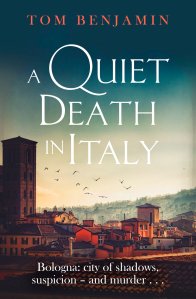 About the Book
 About the Author


 What Cathy Read Next...