
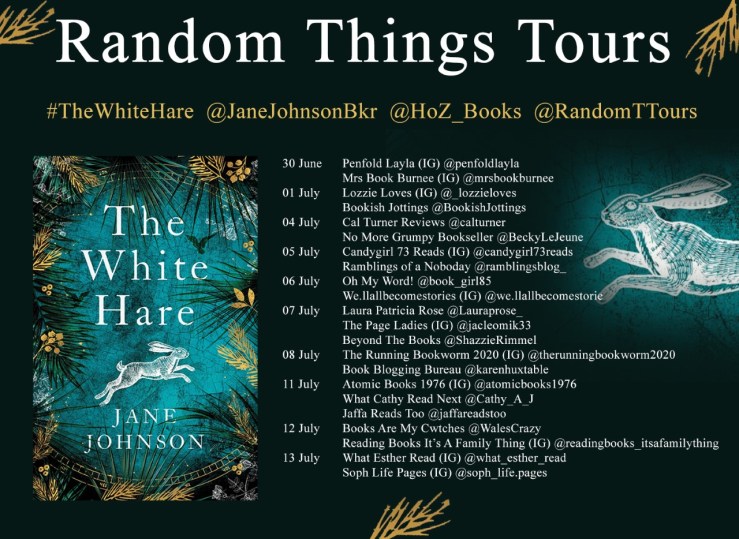
 Welcome to today’s stop on the blog tour for The White Hare by Jane Johnson. My thanks to Anne at Random Things Tours for inviting me to take part in the tour and to Head of Zeus for my digital review copy via NetGalley. Do check out the reviews by my tour buddies for today Atomic Books 1976 over on Instagram and Jo at JaffaReadsToo.
 About the Book
In the far west of Cornwall lies the White Valley, which cuts deeply through bluebell woods down to the sea at White Cove. The valley has a long and bloody history, laced with folklore, and in it sits a house above the beach that has lain neglected since the war. It comes with a reputation and a strange atmosphere, which is why mother and daughter Magdalena and Mila manage to acquire it so cheaply in the fateful summer of 1954.
Magda has grand plans to restore the house to its former glory as a venue for glittering parties, where the rich and celebrated gathered for cocktails and for bracing walks along the coast. Her grown daughter, Mila, just wants to escape the scandal in her past and make a safe and happy home for her little girl, Janey, a solitary, precocious child blessed with a vivid imagination, much of which she pours into stories about her magical plush toy, Rabbit.
The White Valley comes with a long, eventful and often bloody history, laced with tall tales and local legends. Locals say that a white hare may be seen running through the woods there. Some say it is a phantasm, or superstitious nonsense; others say the hare is as real as you or me. It may be a sign of ill omen; or a blessing. Feeling fragile and broken-hearted, cast out of her old life, Mila is in great need of a new start and all the luck she can get.
Format: Hardback (448 pages) Publisher: Head of Zeus
Publication date: 23rd June 2022 Genre: Historical Fiction
Find The White Hare on Goodreads
Purchase links
Bookshop.org
Disclosure: If you buy a book via the above link, I may earn a commission from Bookshop.org, whose fees support independent bookshops
Hive | Amazon UK
Links provided for convenience only, not as part of an affiliate programme
My Review
If you think of historical fiction as being like a cake then The White Hare has all the ingredients necessary to make something appetizing: a remote location, a house with a mysterious history, elements of the supernatural, the scars of a country emerging from war, troubled relationships, oh, and a handsome stranger.
There is a timeless quality to the book with only a few references to the Second World War pointing to it being set in 1954. The remoteness of White Cove and the nearby village gives a sense of a place somewhat detached from modern life. ‘The old ways run deep in this part of the county. It’s a place full of ancient mysteries and a great deal of superstition.’ In this respect Cornwall with its rich history of legends and its ancient monuments makes an ideal setting for the story. It’s believable that the supernatural is not far from the surface in this part of the world and that life is lived very much to the rhythm of nature. It also goes some way to explaining the villagers initial hostility towards the new arrivals. ‘The valley doesn’t welcome outsiders.’
Mila’s mother, Magdalena (sometimes referred to in the book as Magda or Mother) is a rather unlikeable character. She’s self-obsessed, prone to fits of anger and seems determined to ‘punish’ her daughter for the failure of a relationship in which Mila was the innocent party, despite the fact it has provided the funds for the purchase and refurbishment of White Cove. Even when the details of Magdalena’s past are revealed, I found it hard to forgive her treatment of her daughter and granddaughter. I did like though the fact the story involves (for the times) an unconventional relationship although, rather contradictorily, the possibility of the disclosure of a similar relationship is shown to have a very different outcome.
Although for me the book moved at a sedate pace, the constant sense of unease the author created helped maintain my interest. There are a number of odd occurrences from ‘mishaps and minor accidents’ to strange visions, many associated with Mila’s daughter, Janey. Some of these defy rational explanation whilst others prove to have more conventional causes. I enjoyed how many of the strange events tied in with the history of the area and that they were given expression through women. The prologue and epilogue neatly reflect this.
Towards the end of the book the pace picked up as, one after another, secrets are revealed, animosity is replaced by acceptance and unexpected good fortune signals a different future for many of the characters.
In three words: Atmospheric, intriguing, enjoyable
Try something similar: The Marsh House by Zoe Somerville
Follow this blog via Bloglovin
 About the Author
Jane Johnson is a British novelist and publisher. She is the UK editor for George R.R. Martin, Robin Hobb and Dean Koontz and was for many years publisher of the works of J.R.R. Tolkien. Married to a Berber chef she met while researching The Tenth Gift, she lives in Mousehole in Cornwall and Morocco.
Connect with Jane
Website | Twitter | Facebook

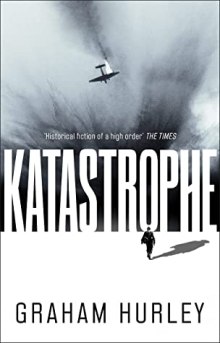
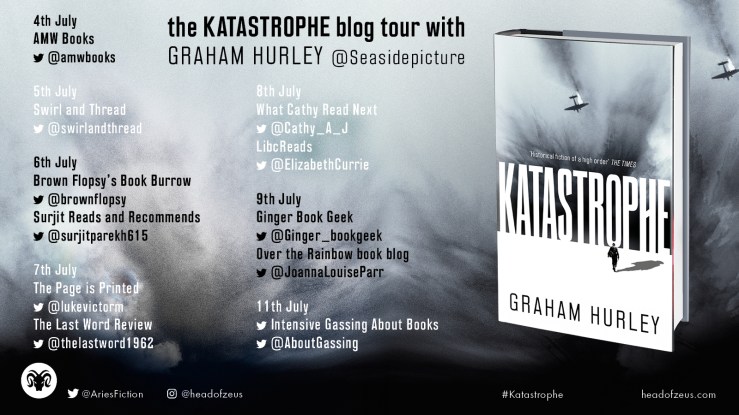 Welcome to today’s stop on the blog tour for Katastrophe by Graham Hurley. My thanks to Sophie at Ransom PR for inviting me to take part in the tour and to Head of Zeus for my review copy. Do check out the review by my tour buddy for today, Elizabeth at
  About the Book
 About the Author
 What Cathy Read Next...