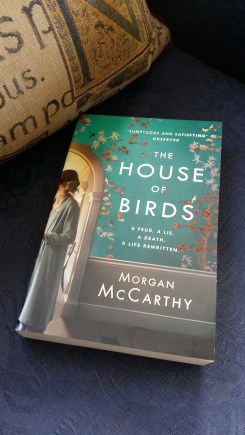
#BookReview The House of Birds by Morgan McCarthy

TheHouseofBirdsAbout the Book

Oliver has spent years trying to convince himself that he’s suited to a life of money making in the city, and that he doesn’t miss a childhood spent in pursuit of mystery, when he cycled around the cobbled lanes of Oxford, exploring its most intriguing corners.

When his girlfriend Kate inherits a derelict house – and a fierce family feud – she’s determined to strip it, sell it and move on. For Oliver though, the house has an allure, and amongst the shelves of discarded, leather bound and gilded volumes, he discovers one that conceals a hidden diary from the 1920s.

So begins a quest: to discover the identity of the author, Sophia Louis. It is a portrait of war and marriage, isolation and longing and a story that will shape the future of the abandoned house – and of Oliver – forever.

Format: Paperback (464 pages)  Publisher: Tinder Press
Publication date: 1st June 2017 Genre: Dual Time

Find The House of Birds on Goodreads

Purchase links
Bookshop.org
Disclosure: If you buy a book via the above link, I may earn a commission from Bookshop.org, whose fees support independent bookshops

Hive | Amazon UK
Links provided for convenience only, not as part of an affiliate programme


My Review

It will come as no secret to regular followers of this blog that I sometimes find dual-time novels problematic, often finding myself more drawn to the past timeline than the present. However, in The House of Birds, the author manages to pull off the feat of making the two timelines both equally interesting and, indeed, interdependent.

The book moves between the present day story of Oliver, who finds himself rather adrift having quit a job he never really liked but not sure exactly what he wants to do next, and that of Sophia Louis whose life is documented in a journal Oliver discovers when clearing out the old house inherited by his girlfriend, Kate, who is off in New York pursuing a promotion opportunity. What starts as a project to fill a gap between jobs becomes something more as Oliver begins to feel a connection with the house, an obligation to save it even.  Unravelling the mystery of just who Sophia Louis was and what became of her provides Oliver with something to focus on, to draw him out of his apathetic state.

I liked the way Sophia’s story is revealed in instalments, in a way that is akin to a puzzle. Indeed, at one point, Oliver becomes irritated that her journal ends suddenly and, seemingly, unfinished. ‘Oliver was baffled and outraged. He felt keenly that Sophia – so aware of her reader had treated him unfairly.’ I also loved Sophia’s witty, teasing style of writing, often addressing her reader directly. But just who is Sophia’s intended reader? And why did she feel the need to hide the journal?

The story Sophia tells is one of disappointment, sadness, forbidden love, thwarted ambition, and the cruel and longlasting legacy of war, in this case the First World War. The latter is embodied in a character who is a tragic figure – ‘the grim king of a grim land’ – imprisoned in self-imposed silence and seeing the world as full of danger, of ‘black and smoking chaos’.

But how much of the story Sophia tells is true? Could her journal be fiction rather than fact? Indeed, Oliver ponders, ‘What if Sophia were a character in someone else’s novel?’ (I bet the author had a little chuckle to herself when she wrote that.)

As Oliver follows the trail Sophia has left, puzzling it out alongside the reader, it causes him to reflect on his own life. As he observes, ‘It’s ironic really. [Sophia] knew exactly what she wanted, but she couldn’t have any of it. I’ve had the opportunity to do whatever I want to do, and it seems like in almost thirty years I’ve only just managed to work out what that might be’. Oliver undergoes a kind of epiphany as he realises it’s not too late to pursue his childhood ambition, a path he was dissuaded from taking by his parents. In a way, he comes to feel he owes it to Sophia.

There is some beautiful descriptive writing, full of clever metaphors, such as this passage in which Oliver, as a young boy, first glimpses the rather neglected ‘House of Birds’ and its overgrown garden.

‘The darkly varnished ivy was tussling with the white bindweed over ownership of a sagging fence, while not far away, a honeysuckle, unchallenged, had claimed a garden table and swallowed a small tree. The lawn was an army massing under high spears, its regiments filing into the cracks between the paving stones to do battle with the dandelions. Above them the wisteria maintained a lordly rule over the house itself, loaded with it spectacular purple flowers, hundreds of fluttering confetti showers clamouring for the friskings of the bees.’

The House of Birds is the first novel I’ve read by Morgan McCarthy and, although she has written three previous novels, none of them appear to have been as positively received by readers as this one, and she has written nothing since. That’s a shame because I really enjoyed The House of Birds. I found the story enthralling, romantic without being sentimental and with some really clever touches. In fact, I imagined Sophia laughing to herself at an inspired one that occurs towards the end of the book.

In three words: Tender, intriguing, assured

Try something similar: The House at Helygen by Victoria Hawthorne


Morgan McCarthyAbout the Author

Morgan McCarthy lives in Berkshire, and has been writing since primary school. She is the author of four novels: The Other Half of Me, The Outline of Love, Strange Girls and Ordinary Women, and The House of Birds. (Bio/photo: Publisher author page)

Connect with Morgan
WebsiteGoodreads

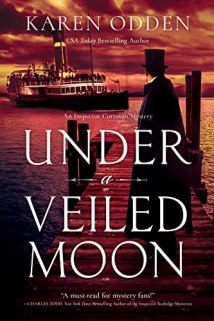
#BookReview Under a Veiled Moon by Karen Odden

Under A Veiled MoonAbout the Book

September 1878. One night, as the pleasure boat the Princess Alice makes her daily trip up the Thames, she collides with the Bywell Castle, a huge iron-hulled collier. The Princess Alice shears apart, throwing all 600 passengers into the river; only 130 survive. It is the worst maritime disaster London has ever seen, and early clues point to sabotage by the Irish Republican Brotherhood, who believe violence is the path to restoring Irish Home Rule.

For Scotland Yard Inspector Michael Corravan, born in Ireland and adopted by the Irish Doyle family, the case presents a challenge. Accused by the Home Office of willfully disregarding the obvious conclusion, and berated by his Irish friends for bowing to prejudice, Corravan doggedly pursues the truth, knowing that if the Princess Alice disaster is pinned on the IRB hopes for Home Rule could be dashed forever.

Corrovan’s dilemma is compounded by Colin, the youngest Doyle, who has joined James McCabe’s Irish gang. As violence in Whitechapel rises, Corravan strikes a deal with McCabe to get Colin out of harm’s way. But unbeknownst to Corravan, Colin bears longstanding resentments against his adopted brother and scorns his help.

As the newspapers link the IRB to further accidents, London threatens to devolve into terror and chaos. With the help of his young colleague, the loyal Mr. Stiles, and his friend Belinda Gale, Corravan uncovers the harrowing truth – one that will shake his faith in his countrymen, the law, and himself.

Format: ebook (336 pages)                Publisher: Crooked Lane Books
Publication date: 11th October 2022 Genre: Historical Fiction, Mystery

Find Under a Veiled Moon (Inspector Corravan #2) on Goodreads

Purchase links
Bookshop.org
Disclosure: If you buy a book via the above link, I may earn a commission from Bookshop.org, whose fees support independent bookshops

Hive | Amazon UK
Links provided for convenience only, not as part of an affiliate programme


My Review

Under a Veiled Moon is the second in Karen Odden’s Inspector Michael Corravan historical mystery series, the follow-up to Down a Dark River, a book I very much enjoyed. In fact, I ended my review of that book by saying I hoped it was the first of many cases for Corravan so it was a pleasure to be reunited with him, as well as other characters from the first book such as his former partner, the resourceful and diligent Gordon Stiles, his just a little bit more than a friend, novelist Belinda Gale, and the Doyle family who took him in many years before. Belinda is one of my favourite characters. She’s an independent woman who has made her own way in the world and who now has connections with influential figures in London society. Perhaps her greatest gift though is her understanding of Corravan’s needs – and not just his physical ones either. As he remarks at one point, ‘It certainly wasn’t the first time she had presented me with an insight that steered an entire investigation into a channel I hadn’t explored’.  (Notice the river-related metaphors by the way?)

Once again, the reader gets a clear sense of Corravan the policeman – determined, resilient and with a strong sense of justice. As he says himself, ‘My persistance usually yielded results.’  But we also get an insight into the man he has been, which includes pickpocket, prize-fighter and dockhand. His past life has not been without tragedy and he has regrets about things he has done, or failed to do. All this makes him a satisfyingly well-rounded character. Corravan’s Irish heritage also forms an important part of the story given that the political situation relating to Ireland is a key element of the book’s plot.

The real life collision of the Princess Alice pleasure boat with the collier Bywell Castle, which resulted in many fatalities, forms one strand of a story into which the author weaves political intrigue, racial prejudice, gang warfare and acts of breathtaking wickedness carried out as a result of a perverted philosophy.

As before, the River Thames plays a key role in the book, its filthy, murky waters providing an apt metaphor for the seedy goings on in the sprawling city through which it flows. It plays an instrumental role as well, with knowledge of its tidal ebbs and flows proving crucial to events. One memorable and rather moving scene sees Corravan take to the river to perform a particularly tragic homecoming. The vivid descriptions of the thoroughfares and alleyways of London – in particular Whitechapel – and of the sights, sounds and smells (ugh) of the city all help to create a great sense of place.  You wouldn’t necessarily want to have lived there yourself but you can definitely imagine what it would have been like for those who did.

If you love historical mysteries with an intricate plot and authentic period atmosphere, then I have no hesitation in recommending Under a Veiled Moon. Actually, I do; read Down a Dark River first.  To my delight, the book’s last line suggests more cases – and challenges- lie ahead for Corravan, and possibly an answer to a question that has haunted him.

My thanks to the author for my digital review copy.

In three words: Atmospheric, intriguing, assured

Try something similar: Death Makes No Distinction by Lucienne Boyce


Karen OddenAbout the Author

Karen Odden earned her PhD in English from New York University and subsequently taught literature at the University of Wisconsin-Milwaukee. She has contributed essays to numerous books and journals, written introductions for Victorian novels in the Barnes & Noble classics series, and edited for the journal Victorian Literature and Culture (Cambridge UP). Her previous novels, also set in 1870s London, have won awards for historical fiction and mystery. A member of Mystery Writers of America and Sisters in Crime and the recipient of a grant from the Arizona Commission on the Arts, Karen lives in Arizona with her family and her rescue beagle Rosy. (Photo: Author website)

Connect with Karen
Website | Twitter | Facebook