#BookReview #Ad The English Führer by Rory Clements @ZaffreBooks

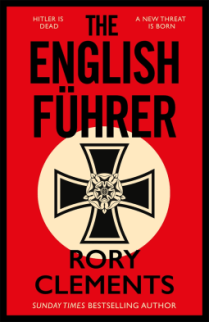
The English FuhrerAbout the Book

Autumn 1945 – Off the east coast of England, a Japanese sub surfaces, unloads its mysterious cargo, then blows itself to pieces.

Former spy Professor Tom Wilde is enjoying peacetime in Cambridge, settling back into teaching and family life. Until a call from senior MI5 boss Lord Templeman brings him out of retirement.

A nearby village has been locked down by the military, its residents blighted by a deadly illness. No one is allowed in or out.

There are rumours the Nazi machine is still operational, with links to Unit 731, a notorious Japanese biological warfare research laboratory. But how could they possibly be plotting on British soil – and why?

What’s more, Wilde and Templeman’s names are discovered on a Gestapo kill list. And after a series of assassinations an unthinkable question emerges: could an Englishman be behind the plot?

Format: eARC (400 pages)                Publisher: Zaffre
Publication date: 19th January 2023 Genre: Historical Fiction, Thriller

Find The English Führer on Goodreads

Purchase links
Bookshop.org
Disclosure: If you buy a book via the above link, I may earn a commission from Bookshop.org, whose fees support independent bookshops

Hive | Amazon UK
Links provided for convenience only, not as part of an affiliate programme


My Review

From the moment I read Corpus back in 2017, I knew I was going to love the Tom Wilde series and to my mind it just keeps getting better and better.

The conclusion of the previous book, The Man in the Bunker, saw Wilde involved in the defection of a Soviet intelligence officer and he harbours lingering doubts about the whole affair. Something just doesn’t seem quite right about it. He even begins to doubt those he has previously trusted.

The plot is way too involved to describe without giving spoilers but it includes biological warfare, far right extremism and the impact of the changes in the world order following the end of the Second World War.  Your enemy’s enemy may not always remain your friend. We get a picture of a Britain struggling to reconstruct itself, not just physically – ‘The rubble was still there, the bombed houses had not been rebuilt and water mains went unfixed’ –  but politically and psychologically. ‘The rage on all sides of those whose loved ones were killed by bombs, bullet, fire, water and gas didn’t just vanish like smoke because peace treaties were signed.’

As Rory Clements observes in his afterword to the book, ‘It is a world exhausted by war, desperate for peace – and extremely vulnerable because few have any appetite for further conflict’. This is the foundation upon which the author builds the compelling story at the heart of the book. It involves some extremely nasty goings-on, sadly based on fact.

I was particularly pleased to see Tom’s wife, Lydia, playing a prominent part in the story. She’s a woman trying to balance the responsibilities of motherhood with her ambition to become a doctor as well as battling to overcome the obstacles still in place for women wishing to pursue a career, in particular married women.

Wilde’s investigations involve him in breathless escapes across country in order to escape the agents of a foreign power as well as finding himself accused of murder.  The adjective that immediately sprang to mind was ‘Buchanesque’. (Regular followers of my blog will know I’m a fan of the works of John Buchan.) So I was thrilled when, at one point in the book, the hapless Detective Inspector Shirley, rebukes Wilde, ‘This is a murder enquiry, not The Thirty-Nine Steps’.

The author keeps the action coming and the tension high until the very last page.  If you’re a fan of historical thrillers that combine espionage with adventure then they don’t come better than this.

I received a review copy courtesy of Zaffre via NetGalley.

In three words: Gripping, fast-paced, intriguing

Try something similar: The Thirty-Nine Steps by John Buchan of course!


Rory ClementsAbout the Author

Rory Clements was born on the edge of England in Dover. After a career in national newspapers, he now writes full time in a quiet corner of Norfolk, where he lives with his wife, the artist Naomi Clements Wright. He won the CWA Ellis Peters Historical Award in 2010 for his second novel, Revenger, and the CWA Historical Dagger in 2018 for Nucleus. Three of his other novels – MartyrPrince and The Heretics – have been shortlisted for awards.

To find out more about his books, join the Rory Clements Readers’ Club via the link in his website. (Photo credit: Author website)

Connect with Rory
Website | Twitter | Facebook

#BookReview #Ad My Father’s House by Joseph O’Connor

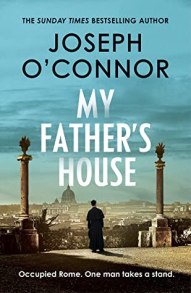
My Father's HouseAbout the Book

September 1943: German forces occupy Rome. Gestapo boss Obersturmbannführer Paul Hauptmann rules with terror. Hunger is widespread. Rumours fester. The war’s outcome is far from certain.

Diplomats, refugees, and escaped Allied prisoners flee for protection into Vatican City, at one fifth of a square mile the world’s smallest state, a neutral, independent country within Rome. A small band of unlikely friends led by a courageous Irish priest is drawn into deadly danger as they seek to help those seeking refuge.

Format: Hardback (288 pages)          Publisher: Vintage
Publication date: 26th January 2023 Genre: Historical Fiction

Find My Father’s House on Goodreads

Purchase links
Bookshop.org
Disclosure: If you buy a book via the above link, I may earn a commission from Bookshop.org, whose fees support independent bookshops

Hive | Amazon UK
Links provided for convenience only, not as part of an affiliate programme


My Review

My only previous experience of Joseph O’Connor’s work is his novel Shadowplay, a fictionalized account of the life of Bram Stoker which was shortlisted for the Walter Scott Prize for Fiction 2020. That book utilised a number of structural techniques including diary entries, letters and transcripts of conversations as well as more traditional third person narration, and the same is true of this latest novel. My Father’s House is set in Rome, more precisely in the Vatican, during the Nazi occupation and is described by the publishers as a ‘WWII-era “great escape” novel’.  The book is based on the true story of Monsignor Hugh O’Flaherty who, along with others, risked his life to smuggle thousands of Jews and escaped Allied prisoners out of Italy. The cover for the operations is a choir, with musical or literary terms used as code words.

Although Hugh O’Flaherty is the key character I loved the way the author brought to life the other members of the group. They recount their experiences by means of transcripts of interviews recorded twenty years after the events in question allowing the reader to hear the distinctive voices the author has created for them. For example, the acerbic wit and Irish lilt of displomat’s wife, Delia Kiernan – ‘Some little jack-in-office of a penpusher thinks he’ll lord it over yours truly? Take the back of my arse and boil it’. Or the Italian-American slang of Enzo Angeluccio or the Cockney accent and sardonic asides of John May. Describing his first encounter with his future employer and fellow member of the choir, Sir D’Arcy Osborne, in a Soho nightclub frequented by gay men: ‘So Sir D’Arcy’s in one midnight with a couple of his old school muckers and they’re larking about with the drag boys. It’s coming on a bit fairyland and hark-at-her, Gladys, and they’re calling Sir D’Arcy ‘Francesca’, just good clean fun…’

There are also brilliant little details about life in neutral Vatican City such as the fact it was necessary for residents to apply for a haircut pass the leave its boundaries.

A thriller wouldn’t be thrilling if there wasn’t a formidable opponent. In this case it’s the utterly ruthless Gestapo boss Obersturmbannführer Paul Hauptmann.  One of the standout parts of the book for me was a section entitled ‘The Hunstman’ in which the author gives us a chilling insight into Hauptmann’s domestic life in his heavily fortified home in a former museum that is almost like a prison, and to the motivation for his vile actions. Driven by a deluded patriotism, he dreams of delivering to Hitler a conquest that will strengthen his career and bring prosperity to his family. ‘An example to the whole Fatherland. The Hauptmanns.’

All the while the members of the choir are working on the plans for forthcoming missions they are mindful of the risks they are running. ‘What was being rehearsed would have got us tortured to death by Hauptmann.’ Judging by what we learn about him, he’d have enjoyed that.

The description of My Father’s House as a ‘literary’ thriller is spot on because, alongside the gripping story, the narrative has some brilliant stylistic flourishes. I loved the way the author includes passages made up of short, sharp bursts of descriptive prose that are almost like poetry.  ‘On the fourth floor, breathless, he unlocks the scriptorium and enters. The vast shutters of his workplace half-closed. Bowed bookshelves. Onyx inkwells. Stacks of mouldering files. Mousegnawed dissertations on Christology. Quills and their sharpeners. Letter-openers. Ledgers. Spiderwebbed portraits of virginal martyrs. A knot of tangled scapulars dangling from a doorknob, near a trinity of rickety candlesticks. Relics and rat traps. A skull doing duty as memento mori. Tomes. Bones. Combed texts of encyclicals. Leaded windows left unwashed for a long as anyone can remember.’

My Father’s House is a thrilling story of heroism, intrigue and ingenuity told with great panache.

In three words: Compelling, atmospheric, stylish


Joseph O'ConnorAbout the Author

Joseph O’Connor was born in Dublin. His books include Cowboys and IndiansInishowenStar of the Sea (American Library Association Award, Irish Post Award for Fiction, France’s Prix Millepages, Italy’s Premio Acerbi, Prix Madeleine Zepter for European novel of the year), Redemption FallsGhost Light (Dublin One City One Book Novel 2011) and Shadowplay (Irish Book Awards Novel of the Year, Costa Novel of the Year shortlist). His fiction has been translated into forty languages.

He received the 2012 Irish PEN Award for Outstanding Contribution to Literature and in 2014 he was appointed Frank McCourt Professor of Creative Writing at the University of Limerick. (Photo/bio: Publisher author page)

Connect with Joseph
Website