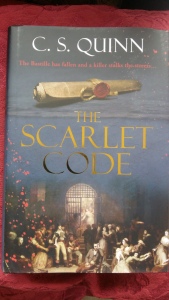
#BookReview The Scarlet Code by C. S. Quinn @CorvusBooks

20200716_094106About the Book

England’s best spy. France’s deadliest conspirator.

Paris, 1789. The Bastille has fallen and Parisians pick souvenirs from the rubble. A killer stalks the lawless streets. His victims are female aristocrats. His executions use the most terrible methods of the ancient regime.

English spy Attica Morgan is laying low in Paris, helping nobles escape. When her next charge falls victim to the killer’s twisted machinations, Attica realises she alone can unmask him. But now it seems his deadly sights are set on her.

As the city prisons empty and a mob mobilises to storm Versailles, finding a dangerous criminal is never going to be easy. Attica’s only hope is to enlist her old ally, reformed pirate Jemmy Avery, to track the killer though his revolutionary haunts. But even with a pirate and her fast knife, it seems Attica might not manage to stay alive.

Format: Hardcover (400 pages)       Publisher: Corvus
Publication date: 6th August 2020 Genre: Historical Fiction, Mystery

Find The Scarlet Code on Goodreads

Purchase links*
Amazon UK | Hive (supporting UK bookshops)
*links provided for convenience not as part of an affiliate programme


My Review

The Scarlet Code is the second book in C. S. Quinn’s Revolutionary Spy series featuring female spy and trained assassin, Attica Morgan. It was published as an ebook on 4th June 2020 and is now also available in hardback. Although I wish I’d had time to read the first book in the series, The Bastille Spy, I’m pleased to say The Scarlet Code works perfectly well as a standalone read.

Attica Morgan makes a feisty and engaging heroine. She’s brave, smart, resourceful and is handy in a tight spot; not surprising when you’ve been trained as an assassin. And believe me, Attica gets herself into plenty of tight spots. Given her African heritage and keen sense of justice, Attica is passionately opposed to the slave trade and committed to doing whatever she can to end it. This includes rescuing abolitionists from the clutches of those whose wealth and power are threatened by the idea of equality for all. Despite her position in English society – she is, after all, Lady Morgan – Attica remains an outsider. “I do not fit anywhere. I am too dark to be English, too fair to be African.”

I really liked Attica’s friendship with dashing pirate Jemmy Avery, himself the product of “dockyard alliances and foreign flings“. It’s a partnership of equals based on mutual regard and fuelled by light-hearted banter with just a hint that something more than friendship could lie beneath the surface. He’s certainly the person who understands Attica best. “Some people are born to talk and flatter, others are bred for action.” No prizes for guessing which category Attica falls into.

Attica’s relationship with mentor and spy-master, Atherton, is equally intriguing. He’s a key figure in an organisation known as the Sealed Knot, “a partially legal hinterland of spies, crooks and thieves” which secretly pursues the interests of the British government at home and abroad. Atherton is an inventor of all sorts of gadgets useful for espionage; an 18th century version of ‘Q’ from Ian Fleming’s James Bond novels, if you like.

Set against the backdrop of revolutionary France, Attica finds herself beset by enemies on every side. Not just ruthless killers on the streets of Paris and those opposed to the abolition of slavery but an old adversary, none other than Robespierre himself. The contrast between the wealth and excesses of the nobility and the poverty of the citizens of Paris is stark, making for exciting scenes as the populace rise in protest. Add to the mix an evil villain described as “A hunter… a man who stalks by night“, plenty of narrow escapes and some fantastic set pieces in locations such as the Louvre and the Palace of Versailles and you have all the ingredients for an exciting page-turner. Or perhaps, on reflection, a white water ride might be a better description, with dangerous undercurrents and treacherous obstacles hidden beneath the surface.

Can Attica turn the tables on those out to thwart her? She’d not be worth her salt if she can’t. Perhaps, though, there is one enemy who knows her weaknesses better than she does herself. The trap is set. Will she swallow the bait? It’s going to be a battle of wits.

From its dramatic opening chapter, The Scarlet Code moves along at a terrific pace. A glorious mixture of intrigue and swashbuckling action worthy of a golden age Hollywood movie starring Errol Flynn, it will delight readers who like their historical fiction to come with a generous helping of adventure. As for me… I may just have found a new series to fall in love with.

My thanks to Corvus and Readers First for my advance review copy.

In three words: Action-packed, thrilling, adventure

Try something similar: Traitor (Mercia Blakewood #3) by David Hingley

Follow this blog via Bloglovin


-tjv5EVe_400x400About the Author

C. S. Quinn is a travel and lifestyle journalist for The Times, the Guardian and the Mirror, alongside many other magazines. Prior to this, Quinn’s background in historic research won prestigious postgraduate funding from the British Art Council. Quinn combined this with her first-hand experiences in far-flung places to create her bestselling The Thief Taker series. The Scarlet Code is the second novel in her new Revolutionary Spy series featuring Attica Morgan. (Photo credit: author Twitter profile)

Connect with C. S. Quinn
Website | Facebook | Twitter | Instagram


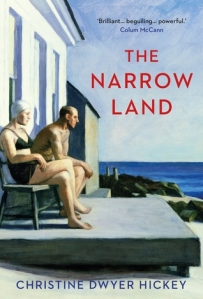
The Narrow Land by Christine Dwyer Hickey #BookReview @AtlanticBooks

The Narrow LandAbout the Book

1950: late summer season on Cape Cod. Michael, a ten-year-old boy, is spending the summer with Richie and his glamorous but troubled mother. Left to their own devices, the boys meet a couple living nearby – the artists Jo and Edward Hopper – and an unlikely friendship is forged.

She, volatile, passionate and often irrational, suffers bouts of obsessive sexual jealousy. He, withdrawn and unwell, depressed by his inability to work, becomes besotted by Richie’s frail and beautiful Aunt Katherine who has not long to live – an infatuation he shares with young Michael.

A novel of loneliness and regret, the legacy of World War II and the ever-changing concept of the American Dream.

Format: Hardcover (384 pages)      Publisher: Atlantic Books
Publication date: 7th March 2019 Genre: Historical Fiction

Find The Narrow Land on Goodreads

Purchase links*
Amazon UK | Hive (supporting UK bookshops)
*links provided for convenience not as part of an affiliate programme


My Review

The Narrow Land comes garlanded with praise: by book bloggers whose opinion I respect; from literary critics; and, not least, by the judges of The Walter Scott Prize for Historical Fiction who awarded it the 2020 prize. You can hear Christine reading an excerpt from the book here.

Commenting on their decision, the judges observed, “It’s a risky business, portraying the marriage of two artists, particularly when both the marriage and the art have already been picked over by biographers and art historians”. For my part, although I knew Edward Hopper’s name and had a vague idea of the kind of art he made, I knew nothing about his wife or their life together. Therefore I came to the book without any preconceptions – except, naturally, that I should expect a high quality of writing. I was certainly not disappointed in that respect.

The book is divided into a number of sections, the first five of which are named after the movements of The Planets by Holst. For example, the opening chapter, in which young Michael travels to Cape Cod (the ‘narrow land’ of the title) to join the Kaplan family for the summer, is called ‘The Bringer of War’ (Mars). Michael (the Americanised version of his true name) has been rescued from post-war Germany and brought to America to be adopted by the Novaks. He is urged to leave the war behind as if he somehow carries it with him about his person. The title could equally reference the turbulent relationship of the Hoppers or the enmity that quickly develops between Michael and Ritchie.

With subtle irony, the chapter detailing the Labor Day garden party thrown by Mrs Kaplan is ‘The Bringer of Jollity’ (Jupiter), although for some of the guests, including Josephine Hopper, the party is the scene of anything but jollity. Never one for small talk, Josephine feels out of place and abandoned by her husband who, as usual, is the centre of attention.

In her speech at the garden party, Mrs Kaplan quotes President Truman’s words from his directive on displaced persons: “This is the opportunity for America to set an example for the rest of the world in cooperation towards alleviating human misery”. However, her singling out of Michael for attention, although no doubt well-intentioned, sets in motion other events.

Throughout the book the reader is given glimpses of the traumatic events Michael witnessed in Berlin before he arrived in America . There is a particularly moving chapter in the section entitled ‘Die Trummerfrauen‘ – a phrase I had to look up but which I then recognised from another book I read recently, Then We Take Berlin by John Lawton. Die Trummerfrauen (or “rubble women”) is the name given to the women who, in the aftermath of WW2, cleared away the rubble of the bombed cities of Germany, including Berlin. Trying to salvage something from the rubble is perhaps a metaphor for what many of the characters in The Narrow Land are trying to do.

It seems to me that what unites the characters is they are all searching for something. Michael is searching for security and a way to erase the memories of the traumatic events he has witnessed. It’s why he creates a place where he can feel safe and it drives other actions that will prove significant later in the book. As well as physical ailments, Edward Hopper is suffering from the artist’s equivalent of writer’s block. He’s desperately searching for inspiration, fixated on finding the woman who inspired a previous painting or the right kind of sky. ‘And he sees nothing he hasn’t seen before and feels nothing much either.

Josephine Hopper is searching for recognition of her own creativity and for a way to come out of the shadow of her husband, quite literally in one respect. Being shorter than her husband, she describes him at one point as ‘looming like a skyscraper right behind her‘. Having supported her husband in expressing his artistic talents for many years, she has come to resent her position as ‘the torch bearer leading the way’ or ‘the stone they use to step across the water’.

I’m aware some readers have found Josephine a difficult character to like. (As it happens, she is never referred to by her first name, not even by her husband, but mostly just as ‘she’, ‘her’ or ‘Mrs Aitch’ .) It’s true that she can be spiteful, argumentative and difficult. As she says, ‘Words are the deadliest weapons: merciless, vicious, diseased. Cut them and pus would ooze out.’ Josephine is definitely a master when it comes to using words as a weapon but, thanks to the author’s skill, I found I could understand her frustration, if not always the way she acts.

We see her softer side in her relationship with Michael. In Mrs Aitch, as he refers to her, Michael finds a kindred spirit; someone who doesn’t insist on the social niceties like addressing women as ‘Ma’am’ and who retains a sense of fun. They understand each other and form a touching bond. For her part, Josephine finds in Michael someone who wants her for a change, not just as a route to her husband. She reflects on one of the outings she and Michael go on together: ‘And she knows then: what has been removed is loneliness and what has been added is love’. I really felt for her when she cries, “What I care about is my wasted life. My life. I had something once, I had spark and potential and creativity.

The Walter Scott Prize judges especially praised Christine Dwyer Hickey for reaching “into the guts of the marriage of Jo and Edward Hopper and into the heart of the creative impulse itself”. I have to agree because The Narrow Land is a painstaking, forensic dissection of a troubled marriage: the small acts of kindness, the petty acts of spite, the angry silences, the arguments, the routines and habits that have become all too familiar, the mutual disappointments, the rare agreements. But, as in so many relationships, a shared history and treasured memories keep them together. The final chapter depicts a poignant scene which the author imagines to be the inspiration for Hopper’s painting, Cape Cod Morning. You can see an image of the painting here.

The Narrow Land is a moving exploration of regret, loneliness, frustration and disappointment, and the poignant story of two people who find it hard to be together but even harder to be apart.

My thanks to Atlantic Books and Readers First for my review copy.

In three words: Insightful, intimate, acutely-observed

Try something similar: Mrs Hemingway by Naomi Wood

Follow this blog via Bloglovin


Deirdre power photographerAbout the Author

Christine Dwyer Hickey is an award-winning novelist and short story writer. Twice winner of the Listowel Writers’ Week short story competition, she was also a prize-winner in the prestigious Observer/Penguin short story competition. Her best-selling novel Tatty was chosen as one of the 50 Irish Books of the Decade, longlisted for the Orange Prize and shortlisted for the Hughes & Hughes Irish Novel of the Year Award, for which her novel The Dancer was also shortlisted. Last Train from Liguria was nominated for the Prix Européen de Littérature. Cold Eye of Heaven won the Irish Novel of the Year 2012 and was nominated for the IMPAC 2013 award. She lives in Dublin. (Photo credit: Publisher author page)

Connect with Christine
Website

20200620_094404