Patrol by Fred Majdalany #BookReview #BlogTour @I_W_M @angelamarymar

Patrol BT Poster

Welcome to today’s stop on the blog tour for Patrol by Fred Majdalany, another in the Imperial War Museum’s Wartime Classics series. My thanks to Anne at Random Things Tours for inviting me to participate and to Angela Martin and the Imperial War Museum for my review copy.

The Wartime Classics series was launched in September 2019 to great acclaim. The novels were all written either during or just after the Second World War and are currently out of print. As part of the Imperial War Museum’s commitment to telling the stories of those who experienced conflict first hand, each novel is written directly from the author’s own experience and takes the reader right into the heart of the battle.

Each book has an introduction by Alan Jeffreys (Senior Curator, Second World War, Imperial War Museums) that sets it in context and gives the wider historical background. He says, ‘researching the Wartime Classics has been one of the most enjoyable projects I’ve worked on in my years at IWM. It’s been very exciting rediscovering these fantastic novels and helping to bring them to the wider readership they so deserve’.

You can find a complete list of the books published so far in the Wartime Classics series here.

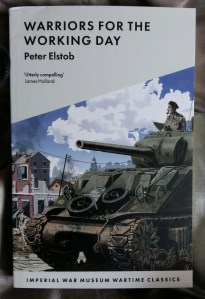
Look out for my review of another book in the series, Warriors for the Working Day by Peter Elstob later this month.
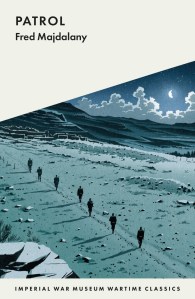

Patrol CoverAbout the Book

1943, the North African desert. Major Tim Sheldon, close to battle-exhaustion, is tasked with carrying out a futile and unexpected patrol mission. Fred Majdalany’s intimate, tense novel puts this so-called minor action centre stage, as over the course of the day and through the night of the patrol itself, Sheldon reminisces about his time as a soldier, his own future, and what it means to confront fear.

Patrol was a bestseller when it was first published in 1953. Clearly autobiographical, it is based on Fred Madjalany’s own experiences in Tunisia as part of the North African campaign, in particular his command of a night patrol and his time in hospital when wounded. The fictional battalion in the novel is based on 2nd Battalion, Lancashire Fusiliers into which Madjalany was commissioned in 1940. Infantry battalions such as this were constantly in action with little respite, and the officers were very young by peace time standards. The stress of battle aged them considerably.

Format: Paperback (192 pages)      Publisher: Imperial War Museum
Publication date: 23rd April 2020 Genre: Fiction

Find Patrol on Goodreads

Purchase links*
Publisher | Amazon UK | Hive (supporting UK bookshops)
*links provided for convenience not as part of an affiliate programme


My Review

“He was stubbornly certain that tonight’s effort would serve no useful purpose whatsoever.”

What really comes across as Sheldon leads his men out on what he believes is a futile exercise – a night time reconnaissance patrol in enemy held territory to the so-called White Farm – is the “deep loneliness of command”. Despite his meticulous preparations and reconnaissance, at one point Sheldon fears he may have led the patrol off their intended course in the darkness of no-man’s land. The burden of responsibility weighs so heavy on him that his previous gratitude for his men’s willingness to follow him so unquestioningly becomes an entirely different emotion. “He hated them because he was lost and could feel their eyes behind him. He hated them because the whole patrol was unnecessary and silly…” Unlike the reader, little does Sheldon know just how random, if not criminally negligent, was the choice of White Farm as the objective for their patrol.

In the middle section of the book, Sheldon’s looks back on his wartime experiences up to this point, including his relationship with a nurse during time spent in hospital recovering from a wound incurred during a previous skirmish with the enemy. It’s a period which seems to him now to have been “an interlude of unreality, a fantasy, a mad incredible honeymoon”. It was also during this period that he had his first face-to-face encounter with the enemy in the person of a wounded German officer. He reflects on the strange metamorphosis of “the Enemy” from an abstraction into a person, a person he finds himself thinking as they chat about books and music, “not at all unlike himself”.

Thanks to the helpful and informative introduction by Alan Jeffreys, I was able to get my head around the Army hierarchy – brigades, battalions, companies, and so on. A theme of the book is the gulf that Sheldon perceives between the demeanour, experiences and, frankly, the capability of those at the top, and those on the front line. “They were a curious lot, these HQ people: they had the glossy, confident look of successful businessmen, Sheldon thought. Rotarians in uniform, that’s what they were.”

One of many fascinating and insightful observations by the author is that, far from what one might expect, the war brings with it a degree of simplification: the simplification of merely following orders. So, during the patrol, Sheldon’s “private universe” becomes “a long thin strip of light, seven men wide, with White Farm at the end of it, and all he had to do for the present was to get there”.

Patrol is not just a moving and compelling account of the experience of war but contains some fine writing. I was particularly struck by the section in which Sheldon recalls his experience of an attack on an enemy outpost, the skirmish in which he was wounded. It’s described in short, often single word sentences vividly conjuring up the noise and confusion of battle. I also loved this description of the experience of coming back to base after a night operation. “To a returning patrol first light is sacred and miraculous: not the dawning of a new day but of a new life.”

The final scenes in the book left me with an even stronger sense of the futility of war and the waste of human life it represents. In his introduction, Alan Jeffreys notes that the author’s wife, Sheila Howarth, wrote, ‘I believe in Patrol he was writing his epitaph’. If that is so, the book is a fitting epitaph to a courageous man, and to many others like him.

In three words: Compelling, immersive, authentic

Try something similar: Eight Hours From England by Anthony Quayle

Follow this blog via Bloglovin


About the Author

Frederick Majdalany (1913 – 1967) was the son of a Manchester-based Lebanese family. His original first name was Fareed, which he changed to Frederick or Fred. He was also known as ‘Maj’. He worked as a journalist, drama critic and theatre publicist pre-war. He volunteered in 1939 and was commissioned into the 2nd Battalion, Lancashire Fusiliers in 1940, serving in North Africa and Italy. He was wounded at the Battle of Medjez-el-Bab, returning to the battalion five weeks later with the rank of captain, was later promoted to major, and commanded a company. His unit landed at Taranto in September 1943 where he was awarded the Military Cross during the Italian campaign.

In October 1944 he returned home to become an instructor at an officer cadet training unit, which he later commanded, until demobilization in November 1945. After the war Majdalany resumed his career as a journalist and also worked for the BBC on historical scripts for radio and TV. He published novels and military histories, all of which were very well received. He was also involved with International PEN.

Fred Majdalany suffered a stroke in 1957 and died ten years later.

#WWWWednesday – 3rd June 2020

WWWWednesdays

Hosted by Taking on a World of Words, this meme is all about the three Ws:

  • What are you currently reading?
  • What did you recently finish reading?
  • What do you think you’ll read next?

Why not join in too?  Leave a comment with your link at Taking on a World of Words and then go blog hopping!


Currently reading

A book for a blog tour and an audiobook (yes, it is the same one as last week, and the week before…).  

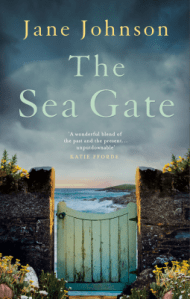
cover181972-mediumThe Sea Gate by Jane Johnson (eARC, courtesy of Head of Zeus via NetGalley)

A broken family, a house of secret – an entrancing tale of love and courage set during the Second World War.

After Rebecca’s mother dies, she must sort through her empty flat and come to terms with her loss. As she goes through her mother’s mail, she finds a handwritten envelope. In it is a letter that will change her life forever.

Olivia, her mother’s elderly cousin, needs help to save her beloved home. Rebecca immediately goes to visit Olivia in Cornwall only to find a house full of secrets—treasures in the attic and a mysterious tunnel leading from the cellar to the sea, and Olivia, nowhere to be found.

As it turns out, the old woman is stuck in hospital with no hope of being discharged until her house is made habitable again. Rebecca sets to work restoring the home to its former glory, but as she peels back the layers of paint and grime, she uncovers even more buried secrets—secrets from a time when the Second World War was raging, when Olivia was a young woman, and when both romance and danger lurked around every corner…

A sweeping and utterly spellbinding tale of a young woman’s courage in the face of war and the lengths to which she’ll go to protect those she loves against the most unexpected of enemies.

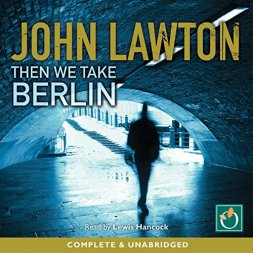
Then We Take Berlin AudioThen We Take Berlin (Joe Wilderness #1) by John Lawton (audiobook)

Joe Wilderness is a World War II orphan, a condition that he thinks excuses him from common morality. Cat burglar, card sharp, and Cockney wide boy, the last thing he wants is to get drafted. But in 1946 he finds himself in the Royal Air Force, facing a stretch in military prison . . . when along comes Lt Colonel Burne-Jones to tell him MI6 has better use for his talents.

Posted to occupied Berlin, interrogating ex-Nazis, and burgling the odd apartment for MI6, Wilderness finds himself with time on his hands and the devil making work. He falls in with Frank, a US Army captain, with Eddie, a British artilleryman and with Yuri, a major in the NKVD and together they lift the black market scam to a new level. Coffee never tasted so sweet. And he falls for Nell Breakheart, a German girl who has witnessed the worst that Germany could do and is driven by all the scruples that Wilderness lacks.

Fifteen years later, June 1963. Wilderness is free-lance and down on his luck. A gumshoe scraping by on divorce cases. Frank is a big shot on Madison Avenue, cooking up one last Berlin scam . . . for which he needs Wilderness once more. Only now they’re not smuggling coffee, they’re smuggling people. And Nell? Nell is on the staff of West Berlin’s mayor Willy Brandt, planning for the state visit of the most powerful man in the world: “Ich bin ein Berliner!”

Then We Take Berlin is a gripping, meticulously researched and richly detailed historical thriller – a moving story of espionage and war, and people caught up in the most tumultuous events of the twenty-first century.


Recently finished

Links from the title will take you to my review or the book’s entry on Goodreads

Patrol CoverPatrol by Fred Majdalany (paperback, courtesy of Imperial War Museum and Random Things Tours)

1943, the North African desert. Major Tim Sheldon, exhausted and battle-weary, is tasked with carrying out a futile and unexpected patrol mission. Fred Majdalany’s intimate, tense novel puts this so-called minor action centre stage, as over the course of the day and through the night of the patrol itself, Sheldon reminisces about his time as a soldier, his own future, and what it means to confront fear.

Based on Fred Majdalany’s own wartime experience with the Lancashire Fusiliers in North Africa, this new edition of a 1953 classic includes a contextual introduction from the Imperial War Museum which sheds new light on the true events that so inspired the author. (Review to follow for blog tour)

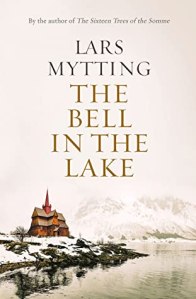
The Bell in the LakeThe Bell in the Lake by Lars Mytting, trans. by Deborah Dawkin (e-book, courtesy of MacLehose Press and NetGalley)

Norway, 1880. Winter is hard in Butangen, a village secluded at the end of a valley. The lake has frozen, and for months the ground is too hard to bury the dead. Astrid Hekne dreams of a life beyond all this, beyond marriage, children, and working the land to the end of her days. Then Pastor Kai Schweigaard takes over the small parish, with its 700-year-old stave church carved with pagan deities. The two bells in the tower were forged by Astrid’s forefather in the sixteenth century, in memory of conjoined twins Halfrid and Gunhild Hekne. They are said to hold supernatural powers.

The villagers are wary of the pastor and his resolve to do away with their centuries-old traditions, though Astrid also finds herself drawn to him. And then a stranger arrives from Dresden, with grand plans for the church itself. For headstrong Astrid this may be a provocation too far.

Talented architecture student Gerhard Schönauer is an improbable figure in this rugged community. Astrid has never met anyone like him; he seems so different, so sensitive. She finds that she must make a choice: for her homeland and the pastor, or for an uncertain future in Germany. Then the bells begin to ring… (Review to follow)

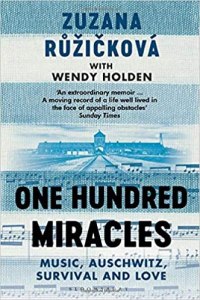
One Hundred MiraclesOne Hundred Miracles by Zuzana Ruzicková with Wendy Holden (review copy, courtesy of Bloomsbury)

Zuzana Ruzicková grew up in 1930s Czechoslovakia dreaming of two things: Johann Sebastian Bach and the piano. But her melodic childhood was torn apart when, in 1939, the Nazis invaded. Uprooted from her home and transported from Auschwitz to Hamburg to Bergen-Belsen, Zuzana endured the unimaginable. Through it all, a slip of paper printed with her favourite piece of Bach’s music became her talisman.

Reborn through the unwavering power of music, Zuzana would go on to become one of the twentieth century’s most renowned musicians and the only harpsichordist to record the entirety of Bach’s keyboard works. bereaved , starved, and afflicted with crippling injuries to her musician’s hands, the teenage Zuzana faced a series of devastating losses. Yet with every truck and train ride,

Armed with this ‘proof that beauty still existed’, Zuzana’s fierce bravery and passion ensured her survival of the greatest human atrocities of all time, and would continue to sustain her through the brutalities of post-war Communist rule. Harnessing her talent and dedication, and fortified by the love of her husband, the Czech composer Viktor Kalabis,

Zuzana’s story, told here in her own words before her death in 2017, is a profound and powerful testimony of the horrors of the Holocaust, and a testament in itself to the importance of amplifying the voices of its survivors today. It is also a joyful celebration of art and resistance that defined the life of the ‘first lady of the harpsichord’- a woman who spent her life being ceaselessly reborn through her music. (Review to follow)

Buchan of the Month Banner 2020.jpgThe Last Secrets by John Buchan (hardcover)

A detailed record of some of the main explorative achievements of the first two decades of the twentieth century and a fascinating glimpse into one the most exciting epochs for exploration.


What Cathy (will) Read Next

20200325_131506-1Warriors for the Working Day by Peter Elstob (paperback, courtesy of Imperial War Museum and Random Things Tours)

Based on Peter Elstob’s own wartime experiences, Warriors for the Working Day follows one tank crew as they proceed from the beaches of Normandy into newly liberated Western Europe, brilliantly evoking the claustrophobia, heat and intensity of tank warfare.