 About the Book
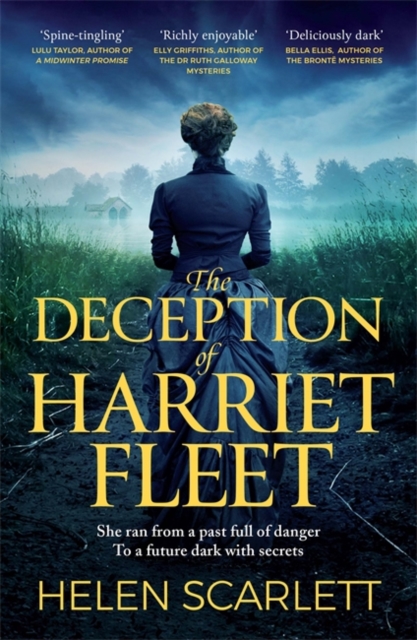
1871. An age of discovery and progress. But for the Wainwright family, residents of the gloomy Teesbank Hall in County Durham the secrets of the past continue to overshadow their lives.
Harriet would not have taken the job of governess in such a remote place unless she wanted to hide from something or someone. Her charge is Eleanor, the daughter of the house, a fiercely bright eighteen-year-old, tortured by demons and feared by relations and staff alike. But it soon becomes apparent that Harriet is not there to teach Eleanor, but rather to monitor her erratic and dangerous behaviour – to spy on her.
Worn down by Eleanor’s unpredictable hostility, Harriet soon finds herself embroiled in Eleanor’s obsession – the Wainwright’s dark, tragic history. As family secrets are unearthed, Harriet’s own begin to haunt her and she becomes convinced that ghosts from the past are determined to reveal her shameful story. For Harriet, like Eleanor, is plagued by deception and untruths.
Format: Hardcover (368 pages) Publisher: Quercus
Publication date: 1st April 2021 Genre: Historical Fiction
Find The Deception of Harriet Fleet on Goodreads
Purchase links
Bookshop.org
Disclosure: If you buy a book via the above link, I may earn a commission from Bookshop.org, whose fees support independent bookshops
Hive | Amazon UK
Links provided for convenience only, not as part of an affiliate programme
My Review
The publishers describe The Deception of Harriet Fleet as ‘dark and brimming with suspense’ and ‘an atmospheric Victorian chiller set in brooding County Durham’. It certainly has all the elements of a Gothic mystery: a remote house – Teesbank Hall – that’s chilly in more than one sense of the word; subjects that can’t be talked about; household members who rarely venture outside the house and don’t welcome visitors; locked attic rooms; and footsteps in the night. It was also the scene of a tragedy that means the local villagers give it a wide berth, even after twenty years.
And there’s Eleanor, Harriet’s pupil, who is treated like a prisoner for reasons no-one is particularly keen to explain in any detail, referring simply to ‘a weakness of the mind’ and ‘qualities that must be…suppressed’. No wonder that before long, Harriet begins to believe she’s been employed more as gaoler than a governess. Eleanor’s only ally within the family seems to be her brother, Henry, to whom Harriet takes an instant dislike. However, as we learned from Pride and Prejudice, first impressions can be deceptive.
Gradually the initially chilly relationship between Eleanor and Harriet starts to thaw, especially as Harriet starts to see parallels between her own situation and Eleanor’s, constrained in their life choices by their gender. In addition, as Harriet learns more about the family’s history, her curiosity leads her to make what will turn out to be a dangerous bargain with Eleanor.
From early on in the book, by her own admission, the reader knows Harriet is guilty of betrayal, theft and deception. Therefore, although Harriet describes Teesbank Hall as having ‘something grim and sinister’ about it, she also thinks of it as ‘a hiding place’ and, later, even as a sanctuary. I think it becomes fairly obvious what she’s fleeing from but I believe even the most observant reader will still find there are some surprises in store.
The blurb refers to the period in which the book is set as ‘an age of discovery and progress’. However, as the book explores, at the fringes of these developments were more questionable theories such as a belief in phrenology. Even less enlightened was the approach to mental health issues, especially in women, with a diagnosis of ‘hysteria’ commonplace and frequently linked with reproduction, menstruation or viewed as a sign of ‘unnatural sexual urges’.
As the story reaches it’s dramatic conclusion, with echoes of Jane Eyre and Rebecca, Harriet has need to cling to her personal mantra more than ever: “I will not let circumstances destroy me. I will survive this. Everything will pass”. Perhaps, after all, what seemed hopeless may not be entirely lost.
From its dramatic prologue to the book’s epilogue entitled ‘Aftermath’, The Deception of Harriet Fleet is an absorbing story of family secrets, betrayal, grief, jealousy and a desire for vengeance.
In three words: Atmospheric, dramatic, immersive
Try something similar: The Conviction of Cora Burns by Carolyn Kirby
Follow this blog via Bloglovin
 About the Author
Helen Scarlett is a writer and English teacher based in the north east of England. Her debut historical novel, The Deception of Harriet Fleet, is a chilling take on nineteenth-century classics such as Jane Eyre seen through modern eyes. It is set in County Durham, close to where Helen lives with her husband and two daughters.
Connect with Helen
Twitter