
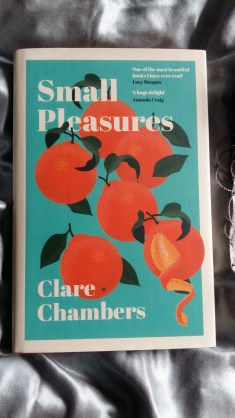
 About the Book
1957, south-east suburbs of London. Jean Swinney is a feature writer on a local paper, disappointed in love and – on the brink of forty – living a limited existence with her truculent mother: a small life from which there is no likelihood of escape.
When a young Swiss woman, Gretchen Tilbury, contacts the paper to claim that her daughter is the result of a virgin birth, it is down to Jean to discover whether she is a miracle or a fraud. But the more Jean investigates, the more her life becomes strangely (and not unpleasantly) intertwined with that of the Tilburys: Gretchen is now a friend, and her quirky and charming daughter Margaret a sort of surrogate child. And Jean doesn’t mean to fall in love with Gretchen’s husband, Howard, but Howard surprises her with his dry wit, his intelligence and his kindness – and when she does fall, she falls hard.
But he is married, and to her friend – who is also the subject of the story she is researching for the newspaper, a story that increasingly seems to be causing dark ripples across all their lives. And yet Jean cannot bring herself to discard the chance of finally having a taste of happiness…
But there will be a price to pay, and it will be unbearable.
Format: Hardcover (352 pages) Publisher: Wiedenfeld & Nicolson
Publication date: 9th July 2020 Genre: Historical Fiction
Find Small Pleasures on Goodreads
Purchase links
Bookshop.org
Disclosure: If you buy a book via the above link, I may earn a commission from Bookshop.org, whose fees support independent bookshops
Hive | Amazon UK
Links provided for convenience only, not as part of an affiliate programme
My Review
Longlisted for the Womens Prize for Fiction 2021, I’m pretty sure Small Pleasures is going to be one of my favourite books this year. For that I have to thank the team at Waterstones in Reading for selecting it for their first post-lockdown book club and making me pluck it from my bookshelves.
From their first meeting, Jean senses something in Gretchen’s husband Howard that makes her feel she can unburden herself to him despite the relatively short time she has known him. ‘She was aware that Howard was hardly an appropriate confidante, but he was so sensible and safe and unlikely to do anything at all except sympathize, that she couldn’t restrain herself.’ I loved the way their relationship progresses in small, tentative steps: a glance or touch of the hand, a compliment, a hitherto unspoken secret, a gift that is the product of ‘careful and loving workmanship’.
Clare Chambers shows such insight into the loving relationship that develops between Jean and Howard. Yes, there is passion but there are also ‘the small acts of domestic intimacy – sharing a bath, preparing a meal side by side at the stove, putting clean sheets on the bed..’ Can’t you just imagine how Jean, who has often felt lonely and the highlight of whose evenings has frequently been listening to the Light Programme on the radio with her mother, could savour such moments.
I also enjoyed the relationship that developed between Jean and Gretchen’s daughter, Margaret. Jean enjoys taking on the role of ‘unofficial aunt’ and taking Margaret on outings. Jean is constantly surprised by Margaret’s ‘charming and unexpected comments – at once innocent and profound’, even if such comments include complex words that would not usually be in the vocabulary of a young girl, and which she claims are whispered to her by angels.
Jean’s relationship with Howard gives her a glimpse of a different future, one she could never have imagined or thought she deserved. This is brought home by a holiday Jean and her mother take. In the hotel they are staying at, Jean sees another mother and daughter and the mother’s obvious complete dependence on her daughter gives Jean an uncomfortable insight into what perhaps awaits her. Despite this, Jean suffers a constant sense of guilt about her relationship with Howard, what it might do to Gretchen, and more importantly Margaret, and how this can be combined with meeting her mother’s needs. This leads Jean to make an act of great sacrifice, one which will involve giving up everything she has come to hold dear.
For me the playing out of the relationship between Jean and Howard was so completely enthralling, I almost forgot about the event that brought them together, Gretchen’s claim that Margaret is the result of a virgin birth. Whether you believe it is a possibility or are sceptical from the start, the process of trying to establish the truth will keep you enthralled and amazed at what was scientifically possible even back in the 1950s. In the end, it is Jean’s journalistic instincts and tenacity that leads to uncovering the truth.
Readers for whom, like me, the opening page of Small Pleasures remained at the back of their mind whilst reading the book, will have experienced a growing sense of unease as the months go by and a particular date draws near. I’m not ashamed to admit that the ending of the book – and a bunch of roses – reduced me to tears but I like to think the opportunity for miracles survives even in the darkest places.
There was so much I loved about Small Pleasures that I’m not going to say much more other than to encourage you to read it for yourself. However, I will share my favourite line from the book: ‘I love him, she thought with a kind of wonderment. I never intended to, but now I do’.
In three words: Tender, intimate, heart-breaking
Follow this blog via Bloglovin
 About the Author
Clare Chamber’s first job after reading English Literature at Hertford College, Oxford, was working for Diana Athill at Andre Deutsch. Clare’s first novel Uncertain Terms was published by Diana at André Deutsch in 1992 and she is the author of five other novels. Small Pleasures, her first work of fiction in ten years, became a word-of-mouth hit on publication and was selected for BBC 2’s ‘Between the Covers’ book club. (Bio/photo credit: Publisher author page)
Connect with Clare
Goodreads | Twitter |

 About the Book
 About the Author

