
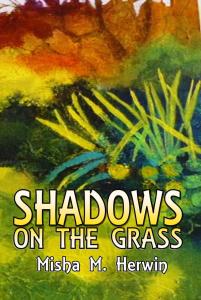
Book Review: Shadows on the Grass by Misha M. Herwin

ShadowsontheGrassAbout the Book

Every family has its secrets. In the nineteen-sixties Bristol, seventeen-year-old Kate is torn between the new sexual freedom and her rigid Catholic upbringing. Her parents have high expectations of her. She, however, is determined to lead her own life.  Mimi, her grandmother, is dying. In her final hours, Mimi’s cousin, the Princess, keeps watch at her bedside. Born in the same month, in the same year, the two women are bound by their past and a terrible betrayal.

Meanwhile, caught between the generations, Mimi’s daughter Hannah struggles to come to come to terms with her relationship with her mother, and struggles to keep the peace between her daughter and her husband. She too must find her own way in a land foreign to her, in a new post-war world, where the old certainties have gone and everything she knows has been swept away.

Format: ebook (220 pp.)                 Publisher: The Penkhull Press
Published: 11th January 2018        Genre: Literary Fiction

Purchase Links*
Amazon.co.uk
*links provided for convenience, not as part of any affiliate programme

Find Shadows on the Grass on Goodreads


My Review

Set in Bristol in 1965, the book focuses on three generations of women who are each in their own way struggling to come to terms with their past, their Polish heritage and the modern day.

Mimi is dying and, as she moves in and out of consciousness, events in the past prey on her mind: memories of bereavement, exile, love, loss and betrayal.  The carefree girl she once was has grown into a disappointed, bitter old woman who tests the bounds of family loyalty to the limits with her cruel words and intransigence.   Even her old friend, the Princess Marianna, is not spared.

Hannah, Mimi’s daughter, is weighed down by the mental and physical strain of caring for her ailing mother.  Yet there is nothing Hannah would not do for her family – her husband Gregor, daughter Kate and young son Peter – putting their needs before her own desires and aspirations, hiding her own fears and worries.  Having never experienced affection from Mimi, whose favourite was Hannah’s older brother Jan, Hannah is determined her own family will not want for love or care. ‘Her family was the most important thing in her life.  If any of them were unhappy, or in pain, so was she.  She wanted nothing but the best for them.  And what about you? the demon cried and her stomach lurched, as she saw that to give everything to her husband and children was to leave herself bankrupt.’

Moody and rebellious, Kate is conflicted between the strict Catholic faith she has been brought up in and her desire to explore sexually and venture beyond the expectations of her family.  ‘There was no way she was drowning in religion like her mother.’

One of the themes of the book is the convergence of past and present, the idea that a thin veil exists between the two.   “I think that maybe,” Kate grappled with the concept, “we’re all part of the universe and sometimes things get muddled and slip through the cracks.”  Often characters see or experience things that immediately transport them in their mind’s eye to the past, evoking memories of childhood and adolescence.   Some of these memories are happy but many are traumatic – such as the wartime experiences of Mimi and Marianna (the Princess) and their exile from Poland.  Other memories are unwelcome, bringing to the surface secrets that were better left buried or feelings of guilt for past actions, even for escaping death.

Marianna’s way of coping with these memories is to transform them into fairy tales, merging fact with fiction, rewriting past events as she would have liked them to happen.  ‘The facts of my life are all there, yet how much of what I told her was true and how much was not?  I doubt whether even I know, after all this time.  Besides, what does it matter?  We all do it.  We weave our fantasies about ourselves, because the truth is too cruel and constructing our own reality is the only way we can survive.’ It is only Mimi’s impending death that forces Marianna to face the demons from the past.

There is some wonderfully descriptive language in the book.  ‘The afternoon sun hung hot and furious above the street; its heat collecting on the small walled courtyard.  The only relief was where the shadow of the house sliced across the stone flags bisecting the area into light and dark.  Geraniums wilted in their pots, the ivy clung limply to the wall and the climbing rose dropped, its leaves white with dust.’

The writing has a sensual quality to it with evocative descriptions of bodily sensations – scent, touch and taste.  ‘Kate sat back and pressed her bare legs against the statue.  The bronze flank of the lion was smooth and warm between her thighs.  Her dress was so short it scarcely covered her pants.  Her sandals were sticky against the soles of her feet.  The leather sucked at her skin as she moved.  She hooked her hair behind her ears and felt the night air slip in under her arms, sweet as honey over her breasts.’

The author switches from past to present tense in the book with the scenes in the past being in present tense and those in the present in the past tense (I think, because I only noticed it part way through the book).  Sometimes this occurred within chapters as events, sights and sounds triggered memories for the characters. Personally, I’m not sure this stylistic device added anything to the book although it didn’t affect my enjoyment.

I found this a fascinating book, full of interesting ideas, rich in detail and characterisation.  I received an advance reader copy courtesy of the author in return for an honest review.

Follow my blog with Bloglovin

In three words: Emotional, intimate, expressive

Try something similar…Letting Go by Maria Thompson Corley (click here to read my review)


Misha HerwinAbout the Author

Misha M Herwin is a writer of books for adults and (as Misha Herwin) for children. She has had a number of short stories published in anthologies, in UK and US including The Way to My Heart, Voices of Angels, The Darkest Midnight in December, The Yellow Room and Bitch Lit, among others.  Misha blogs regularly at http://authorselectric.blogspot.co.uk/ and is available for Q&As and interviews.

Connect with Misha

Website ǀ  Twitter  ǀ  Goodreads


Book Review: Under an Amber Sky by Rose Alexander

UnderanAmberSkyAbout the Book

When Sophie Taylor’s life falls apart, there is only one thing to do: escape and find a new one.  Dragged to Montenegro by her best friend Anna, Sophie begins to see the light at the end of a very dark tunnel. But when she stumbles into an old, run-down house on the Bay of Kotor she surprises even herself when she buys it.  Surrounded by old furniture, left behind by the former inhabitants, Sophie becomes obsessed by a young Balkan couple when she discovers a bundle of letters from the 1940s in a broken roll-top desk. Letters that speak of great love, hope and a mystery Sophie can’t help but get drawn into.  Days in Montenegro are nothing like she expected and as Sophie’s home begins to fill with a motley crew of lodgers the house by the bay begins to breathe again. And for Sophie, life seems to be restarting. But letting go of the past is easier said than done…

Format: eBook (258 pp.)              Publisher: HQ Digital
Published: 24th May 2017            Genre: Fiction, Romance

Purchase Links*
Amazon.co.uk ǀ  Amazon.com
*links provided for convenience, not as part of any affiliate programme

Find Under an Amber Sky on Goodreads


My Review

Tragically and suddenly bereaved, Sophie feels strangely drawn to an old house in need of renovation near Kotor in Montenegro.  Taken there by her friend, Anna, on a restorative holiday following her bereavement, Sophie decides to cut her ties with the UK and the sad memories it holds, purchase the house and make it her home.  Her decision is partly influenced by letters she discovers in the house dating back to the Italian occupation of Montenegro in World War II and her desire to understand the story behind them and why they have remained unread.

The stages of Sophie’s grief are convincingly portrayed and her decision to up sticks and move abroad doesn’t seem so unbelievable given her state of mind and the fact that Matt, her husband, was not only her best friend but the person she had relied on for almost everything.  In fact, her first few months in Kotor pass in a kind of haze, with an overwhelming torpor permeating her, making it a challenge to even get out of bed some days.  ‘She could have been a decaying Miss Havisham, moving among the sordid remnants of her misery.’  

Gradually, though, the atmosphere of her surroundings seems to work its magic on her.  She even observes parallels between Kotor’s ability to recover from disaster and her own process of recovery.  ‘After the earthquake in 1979, the local craftsmen had rebuilt the entire town by hand, stone by stone, painstakingly reassembling it just as it had been for centuries before, but better, stronger, more able to withstand future tremors.  Maybe it was possible to put things back together.  To remake them.’

Having suffered the terrible misfortune of losing her husband, Sophie’s fortunes change as not only (conveniently) does a builder arrive on her doorstep who can undertake the renovations needed to the house but it’s not long before she meets two equally attractive men: Darko, who helps her translate the letters and provides details about wartime events in Kotor; and Anton (Ton), who is battling demons of his own.   The dynamics and likely outcome of this triangle seemed fairly obvious to me but, surprisingly, it takes Sophie some time to work it out.

When the author contacted me about reviewing her book, there were two things that influenced my decision to say yes.  One was the setting, as I’ve visited Kotor twice (although only as a one day stop on a cruise) and been completely charmed by the place.  I thought the author really captured the beauty of Kotor, its lakeside setting surrounded by mountains (reminiscent of Norwegian fjords) and the charming old town full of narrow streets and hidden squares.   The beer is pretty cheap as well. [There are some great photo’s of locations from the book on Rose’s website – see bottom of this post.] The author also paints a wonderful picture of the open, welcoming people of Montenegro.  I really enjoyed this aspect of the book and the insight into the wartime history of the country.

This historical aspect was the second element that attracted me to the book, in particular the mystery of the letters that Sophie finds.  They take the reader back in time to World War II and start Sophie on a quest to find out more about Mira, the writer of the letters, and Dragan, the man to whom Mira is writing.  I’ll be honest and say the letters didn’t seem completely realistic to me. There were too many literary flourishes – more, I think, than you would put in a letter even if you had a poetic bent.  For example: ‘Her eyes were so red with crying, the lids so puffy, that she looked like a paper version of herself left out in the rain to swell and bloat.’

Furthermore, I was greedy for more detail of Mira and Dragan’s story and found myself still a little peckish at the end of the book.  I wondered if perhaps, alongside the letters and Sophie’s modern day experiences, a separate narrative told through the eyes of Mira and/or Dragan might have worked.  In fact, maybe their story and events in Montenegro during the war would make great material for a whole separate book (the historical fiction fan in me coming out here).

There is a lot to enjoy about Under an Amber Sky and if you adore a well-written story with an element of romance, set in an enchanting location, full of emotion and a little sadness but tinged with hope, then this is the book for you.  I received a review copy courtesy of the author and publishers, HQ Digital, in return for an honest and unbiased review.

Follow my blog with Bloglovin

In three words: Emotional, hopeful, romance

Try something similar…Under A Tuscan Sky by Karen Aldous (click here to read my review)


Rose AlexanderAbout the Author

Rose has had more careers than is probably strictly necessary, including TV producer/director making programmes for all the major broadcasters, freelance feature writer for publications including The Guardian and secondary school English teacher, not forgetting cocktail waitress, melon picker and interior designer.

Writing a novel is, however predictable the line seems, the realisation of Rose’s childhood dream and the result of finally finding ‘a voice’.  The triumph is that the voice was heard above the racket created by her three children plus rescue cat (tabby white, since you ask). Rose likens the experience of penning Garden of Stars, a multi-layered love story, to another recent achievement of learning to ice-skate: progress is two-slides-forward-one-back; insecurity, self-doubt and despondence reign supreme; onlookers laugh, mock or even worse, smile indulgently…. But the finished manuscript, polished and pristine, is like the perfect pirouette performed on freshly raked ice. (Rose can’t do pirouettes yet, obviously, they just made the best simile.)

Rose is currently working on several new projects including a novel based on a relative’s true story of an epic journey as a ‘flüchtlinge’, fleeing the vengeance of the rampaging Red Army as Nazi Germany collapsed.

Connect with Rose

Website  ǀ  Twitter  ǀ  Goodreads