
New arrivals
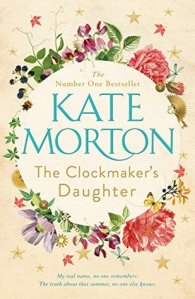 The Clockmaker’s Daughter by Kate Morton (eARC, NetGalley)
My real name, no one remembers. The truth about that summer, no one else knows.
In the summer of 1862, a group of young artists led by the passionate and talented Edward Radcliffe descends upon Birchwood Manor on the banks of the Upper Thames. Their plan: to spend a secluded summer month in a haze of inspiration and creativity. But by the time their stay is over, one woman has been shot dead while another has disappeared; a priceless heirloom is missing; and Edward Radcliffe’s life is in ruins.
Over one hundred and fifty years later, Elodie Winslow, a young archivist in London, uncovers a leather satchel containing two seemingly unrelated items: a sepia photograph of an arresting-looking woman in Victorian clothing, and an artist’s sketchbook containing a drawing of a twin-gabled house on the bend of a river. Why does Birchwood Manor feel so familiar to Elodie? And who is the beautiful woman in the photograph? Will she ever give up her secrets?
Told by multiple voices across time, The Clockmaker’s Daughter is a story of murder, mystery and thievery, of art, love and loss. And flowing through its pages like a river is the voice of a woman who stands outside time, whose name has been forgotten by history, but who has watched it all unfold: Birdie Bell, the clockmaker’s daughter.
 The Psychology of Time Travel by Kate Mascarenhas (limited edition proof copy, courtesy of Head of Zeus)
1967: Four female scientists invent a time-travel machine. They are on the cusp of fame: the pioneers who opened the world to new possibilities. But then one of them suffers a breakdown and puts the whole project in peril…
2017: Ruby knows her beloved Granny Bee was a pioneer, but they never talk about the past. Though time travel is now big business, Bee has never been part of it. Then they receive a message from the future – a newspaper clipping reporting the mysterious death of an elderly lady…
 2018: When Odette discovered the body she went into shock. Blood everywhere, bullet wounds, flesh. But when the inquest fails to answer any of her questions, Odette is frustrated. Who is this dead woman that haunts her dreams? And why is everyone determined to cover up her murder?
 The Romanov Empress by C. W. Gortner (ebook, review copy courtesy of HF Virtual Book Tours)
Even from behind the throne, a woman can rule.
Narrated by the mother of Russia’s last tsar, this vivid, historically authentic novel brings to life the courageous story of Maria Feodorovna, one of Imperial Russia’s most compelling women who witnessed the splendour and tragic downfall of the Romanovs as she fought to save her dynasty in the final years of its long reign.
Barely nineteen, Minnie knows that her station in life as a Danish princess is to leave her family and enter into a royal marriage—as her older sister Alix has done, moving to England to wed Queen Victoria’s eldest son. The winds of fortune bring Minnie to Russia, where she marries the Romanov heir and becomes empress once he ascends the throne. When resistance to his reign strikes at the heart of her family and the tsar sets out to crush all who oppose him, Minnie—now called Maria—must tread a perilous path of compromise in a country she has come to love.
Her husband’s death leaves their son Nicholas as the inexperienced ruler of a deeply divided and crumbling empire. Determined to guide him to reforms that will bring Russia into the modern age, Maria faces implacable opposition from Nicholas’s strong-willed wife, Alexandra, whose fervour has lead her into a disturbing relationship with a mystic named Rasputin. As the unstoppable wave of revolution rises anew to engulf Russia, Maria will face her most dangerous challenge and her greatest heartache.
 Betty Church and the Suffolk Vampire by M. R. C. Kasasian (hardcover, advance reader copy courtesy of Head of Zeus)
September 1939. A new day dawns in Sackwater, not that this sleepy backwater is taking much notice…
Inspector Betty Church – one of the few female officers on the force – has arrived from London to fill a vacancy at Sackwater police station. But Betty isn’t new here. This is the place she grew up. The place she thought she’d left behind for good. Time ticks slowly in Sackwater, and crime is of a decidedly lighter shade. Having solved the case of the missing buttons, Betty’s called to the train station to investigate a missing bench. But though there’s no bench, there is a body. A smartly dressed man, murdered in broad daylight, with two distinctive puncture wounds in his throat.
While the locals gossip about the Suffolk Vampire, Betty Church readies herself to hunt a dangerous killer.
 The Hidden Village by Imogen Matthews (ebook, review copy courtesy of the author)
Wartime Holland. Who can you trust?
Deep in the Veluwe woods lies a secret that frustrates the Germans. Convinced that Jews are hiding close by they can find no proof. The secret is Berkenhout, a purpose-built village of huts sheltering dozens of persecuted people.
Young tearaway Jan roams the woods looking for adventure and fallen pilots. His dream comes true when he stumbles across an American airman, Donald C. McDonald. But keeping him hidden sets off a disastrous chain of events.
Sofie, a Jewish Dutch girl, struggles to adapt to living in Berkenhout, away from her family and friends. As weeks turn to months, she’s worried they’ll abandon her altogether. Henk Hauer, head woodman, is in charge of building the underground huts and ensuring the Berkenhout inhabitants stay safe. But many grow suspicious of his liaisons with the Germans. Is he passing on secret information that could endanger lives?
All it takes is one small fatal slip to change the course of all their lives forever.
On What Cathy Read Next last week
Blog posts
Monday – I joined the blog tour for Forsaking All Other by Catherine Meyrick, sharing my review of this historical romance set in Tudor England.
Tuesday – Another blog tour and another review, this time for Summer of Love by Caro Fraser, the follow-up to her historical novel The Summer House Party. My Top Ten Tuesday list was on the topic of Books That Awaken the Travel Bug in Me.
Wednesday – WWW Wednesday is the opportunity to share what I’ve just finished reading, what I’m reading now and what I’ll be reading next. I also featured an extract from With Or Without You, the latest book by Shari Low as part of the blog tour.
Thursday – I published an introduction to this month’s Buchan of the Month, The Half-Hearted. I also shared my write-up of a fascinating evening spent in the company of best-selling historian and novelist, Alison Weir, at my local Waterstones in Reading.
Friday – I published my review of The Poison Bed by E. C. Fremantle, a terrific historical mystery set in the court of James I that had as many twists as a modern day psychological thriller. It was also time for another of my Fact in Fiction Friday features where I pick out interesting things I’ve learned through reading novels.
Saturday – The final blog tour of the week was for The Reading Party by Fenella Gentleman and a great guest post by Fenella about how the germ of an idea during a creative writing exercise grew into her first novel.
Challenge updates
- Goodreads 2018 Reading Challenge – 90 out of 156 books read, 4 more than last week
- Classics Club Challenge – 15 out of 50 books read, same as last week
- NetGalley/Edelweiss Reading Challenge 2018 (Gold) – 33 ARCs read and reviewed out of 50, 2 more than last week
- From Page to Screen– 10 book/film comparisons out of 15 completed, same as last week
- 2018 TBR Pile Challenge – 5 out of 12 books read, same as last week
- Historical Fiction Reading Challenge 2018 – 46 books out of 50 read, 3 more than last week
- When Are You Reading? Challenge 2018 – 7 out of 12 books read, same as last week
- What’s In A Name Reading Challenge – 1 out of 6 books read, same as last week
- Buchan of the Month – 5 out of 12 books read, same as last week
- NEW 20 Books of Summer Challenge – 4 out of 20 books read, 2 more than last week
On What Cathy Read Next this week
Currently reading


Planned posts
- Guest Post: Cold Flood by R J Corgan
- Guest Post: Artist, Soldier, Lover, Muse by Arthur D. Hittner
- Book Review: The Mountain Man’s Badge by Gary Corbin
- Book Review: The King’s Daughter by Stephanie Churchill
- Book Review: Old Baggage by Lissa Evans
- Book Review: Darkest Hour by Anthony McCarten