
WWW Wednesdays – 27th June ‘18

WWWWednesdays

Hosted by Taking on a World of Words, this meme is all about the three Ws:

  • What are you currently reading?
  • What did you recently finish reading?
  • What do you think you’ll read next?

Why not join in too? Leave a comment with your link at Taking on a World of Words and then go blog hopping!


Currently reading

GraceGrace by Paul Lynch (ebook)

Early one October morning, Grace’s mother snatches her from sleep and brutally cuts off her hair, declaring, ‘You are the strong one now.’ With winter close at hand and Ireland already suffering, Grace is no longer safe at home. And so her mother outfits her in men’s clothing and casts her out. When her younger brother Colly follows after her, the two set off on a remarkable journey in the looming shadow of their country’s darkest hour.

The broken land they pass through reveals untold suffering as well as unexpected beauty. To survive, Grace must become a boy, a bandit, a penitent and, finally, a woman – all the while afflicted by inner voices that arise out of what she has seen and what she has lost.

The Devil's Half MileThe Devil’s Half Mile by Paddy Hirsch (hardcover, prize courtesy of Readers First and Corvus)

New York, 1799: Justy Flanagan, lawyer, soldier, policeman, has returned to his native city, bloodied and battered after fighting in the Irish Rebellion against the English. Determined to hunt down the man who murdered his father, his inquiries lead him to Wall Street and the fledgling stock market there. But as his investigations into the past move ahead, the horrific murders of young slave women in the present start to occupy his time. Convinced that there is a link between his father’s murder, the deaths of the young women, and a massive fraud that nearly destroyed New York’s economy, Justy can trust no one.

As the conspiracy deepens, it becomes clear that those involved will stop atnothing to keep their secrets. Justy is forced to choose: will he betray his father’s memory, compromise his integrity, and risk the lives of his closest friends, to get to the bottom of a tale so dangerous it could change the landscape of America forever?
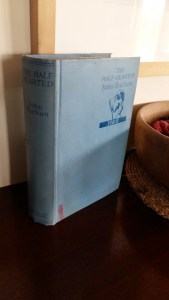
The HalfheartedThe Half-Hearted by John Buchan (ebook)

Set in the closing years of the nineteenth century, The Half-Hearted tells the story of Lewis Haystoun, a young Scottish laird, who finds himself unable to commit wholeheartedly to any course of action.

When he fails to seize an opportunity, he interprets this as a sign of cowardice and departs for the Empire’s dangerous North West Frontier to prove himself.


Recently finished (click on title for review)

TheKing'sDaughterThe King’s Daughter by Stephanie Churchill (ebook, review copy courtesy of the author)

In this gripping sequel to The Scribe’s Daughter, a young woman finds herself unwittingly caught up in a maelstrom of power, intrigue, and shifting perceptions, where the line between ally and enemy is subtle, and the fragile facade of reality is easily broken.

Irisa’s parents are dead and her younger sister Kassia is away on a journey when the sisters’ mysterious customer returns, urging Irisa to leave with him before disaster strikes. Can she trust him to keep her safe? How much does he know about the fate of her father? Only a voyage across the Eastmor Ocean to the land of her ancestors will reveal the truth about her family’s disturbing past. Once there, Irisa steps into a future she has unknowingly been prepared for since childhood, but what she discovers is far more sinister than she could have ever imagined. Will she have the courage to claim her inheritance for her own?
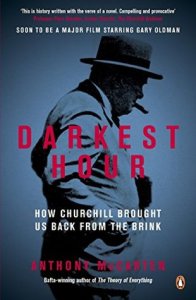
Darkest HourDarkest Hour by Anthony McCarten (paperback)

May, 1940. Britain is at war, European democracies are falling rapidly and the public are unaware of this dangerous new world. Just days after his unlikely succession to Prime Minister, Winston Churchill, faces this horror – and a sceptical King and a party plotting against him. He wonders how he can capture the public mood and does so, magnificently, before leading the country to victory.

It is this fascinating period that Anthony McCarten captures in this deeply researched, gripping day-by-day (and often hour-by-hour) narrative. In doing so he revises the familiar view of Churchill – he made himself into the iconic figure we remember and changed the course of history, but through those turbulent and dangerous weeks he was plagued by doubt, and even explored a peace treaty with Nazi Germany. It’s a scarier, and more human story, than has ever been told.
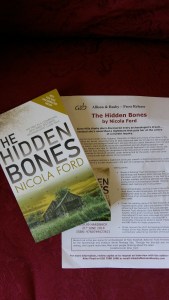
The Hidden BonesThe Hidden Bones (Clare Hills #1) by Nicola Ford (uncorrected proof copy courtesy of Allison and Busby)

The dead rarely leave matters tidy, widow Clare Hills knows that all too well. In search of a new start, Clare reconnects with university friend Dr David Barbrook and is pleased when he asks for her help sifting through the effects of recently deceased archaeologist Gerald Hart. Together they stumble the lost finds from Gerald’s most glittering dig. Hidden from view for decades, and supposedly destroyed in an arson attack, the discovery of the Hungerbourne Barrows archive is every archaeologist’s dream. However, the dream soon turns to a nightmare which puts Clare at the centre of a murder inquiry. (Review to follow 28th June)


What Cathy (will) Read Next
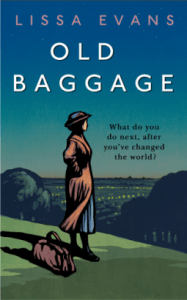
Old BaggageOld Baggage by Lissa Evans (eARC, NetGalley)

What do you do next, after you’ve changed the world?

It is 1928. Matilda Simpkin, rooting through a cupboard, comes across a small wooden club – an old possession of hers, unseen for more than a decade.

Mattie is a woman with a thrilling past and a chafingly uneventful present. During the Women’s Suffrage Campaign she was a militant. Jailed five times, she marched, sang, gave speeches, smashed windows and heckled Winston Churchill, and nothing – nothing – since then has had the same depth, the same excitement.

Now in middle age, she is still looking for a fresh mould into which to pour her energies. Giving the wooden club a thoughtful twirl, she is struck by an idea – but what starts as a brilliantly idealistic plan is derailed by a connection with Mattie’s militant past, one which begins to threaten every principle that she stands for.

The Year of the SnakeThe Year of the Snake by M. J. Trow and Maryanne Coleman (eARC, NetGalley)

Sometimes, a snake is just a snake. And sometimes…

First-century Rome. Senator Gaius Lucius Nerva is taken ill at a dinner party and dies a few days later. His heartbroken wife, Flavia, is told it was a natural death. Calidus, Nerva’s recently freed slave, suspects otherwise. As he embarks upon the funeral ceremonies, Calidus becomes more and more convinced that his master was murdered and begins an investigation, seeking out everyone who had attended the dinner party.

His enquiries lead him to rub shoulders with the ‘great and good’ of Rome; senators, soldiers, even the ruthless and mercurial Emperor Nero. And his former lover, Julia Eusabia, who seems intent on rekindling their romance and luring him away from his wife and daughter. Calidus’ quest is by no means easy or safe as he encounters the darkest and most dangerous people in Rome. But he knows he must keep searching for the person responsible, to bring justice to the master he had loved.

This racy historical whodunnit brings to life the sights, smells and sounds of ancient Rome, with sharp humour and a Christie-style finale to boot.

 

Book Review: Darkest Hour by Anthony McCarten

Darkest HourAbout the Book

May, 1940. Britain is at war. The horrors of blitzkrieg have seen one western European democracy after another fall in rapid succession to Nazi boot and shell. Invasion seems mere hours away. Just days after becoming Prime Minister, Winston Churchill must deal with this horror—as well as a sceptical King, a party plotting against him, and an unprepared public. Pen in hand and typist-secretary at the ready, how could he change the mood and shore up the will of a nervous people?

In this gripping day-by-day, often hour-by-hour account of how an often uncertain Churchill turned Britain around, the celebrated Bafta-winning writer Anthony McCarten exposes sides of the great man never seen before. He reveals how he practiced and re-wrote his key speeches, from ‘Blood, toil, tears and sweat’ to ‘We shall fight on the beaches’; his consideration of a peace treaty with Nazi Germany, and his underappreciated role in the Dunkirk evacuation; and, above all, how 25 days helped make one man an icon.

Using new archive material, McCarten reveals the crucial behind-the-scenes moments that changed the course of history. It’s a scarier—and more human—story than has ever been told.

Format: Paperback (336 pp.)         Publisher: Viking
Published: 28th September 2017   Genre: History, Non-Fiction

Purchase Links*
Amazon.co.uk ǀ Amazon.com ǀ Hive.co.uk (supporting UK bookshops)
*links provided for convenience, not as part of any affiliate programme

Find Darkest Hour on Goodreads


My Review

Subtitled How Churchill Brought England Back from the Brink, the book provides a fascinating insight into one of the most pivotal periods of the Second World War, namely the few weeks in May 1940 when the British Government faced the reality of German advances into Belgium and the Netherlands, the prospect of the capitulation of France, the possible entry into the war of Italy as an ally of Germany and the loss of the British Expeditionary Force pinned down in Dunkirk.

The author provides the reader with a potted history of Churchill’s childhood, school days, military service, career in journalism, marriage to Clementine Hozier and his entry to Parliament. For those interested in learning more about Churchill’s early life and his troubled relationship with his father, Randolph, I can recommend searching out the film Young Winston starring Simon Ward.   The author also provides biographical information about Winston Churchill’s main opponent in the War Cabinet, Lord Halifax.

The key new ground explored in the book is the author’s contention that Winston Churchill, at the urging of Lord Halifax and Neville Chamberlain, did at least consider the terms on which negotiations with Germany for peace might take place. It’s clear he had significant reservations about such a course of action, both for strategic reasons and also because it flew in the face of everything he believed in. Churchill had recognised as early as 1933 the threat that a resurgent Germany might pose and had urged rearmament. At the time, this view was against the sway of public opinion and in Government circles there was greater fear about the spread of Communism than the threat from Hitler. Churchill was proved right in his warnings when on 9th May 1940 the Germans invaded Belgium and The Netherlands.  No wonder then that the idea of peace negotiations never progressed beyond discussion.

Thank goodness that key figures of the time chose to record their thoughts in diaries and journals giving the author access to fascinating insights into the shifting opinions and power struggles within the War Cabinet and wider Government. The reader gets an almost ‘fly on the wall’ view of the meetings, the discussions, the arguments, the motives and the political manoeuvring of the various individuals involved.

The author spends quite a bit of time examining the impact of Churchill’s oratory, dissecting key speeches and the phrases in them that have now become the stuff of legend – ‘I have nothing to offer but blood, toil, tears and sweat’, ‘victory at all costs’, ‘we shall fight on the beaches’. He provides fascinating information about the literary inspirations for some of these speeches and Churchill’s meticulous preparation for them.

McCarten also argues that the idea to co-opt the so-called ‘little ships’ to aid the evacuation of the British Expeditionary Force from Dunkirk (Operation Dynamo) was the brainwave of Churchill himself, an idea for which he has not previously been recognised. The result of the operation was that 330,000 men were evacuated from the beaches of Dunkirk ensuring they were available to defend Britain against a possible invasion.

Among the many things that struck me whilst reading the book was the so-called ‘fog of war’. Today, our military leaders have drones, satellites and instant communication at their disposal. It’s easy to forget what it must have been like to make crucial decisions about the direction of a war based on information that could be both unreliable and/or out of date. This was a time when communication still relied on letters, telegrams or face-to-face meetings.

One can’t really review a book like this without mentioning some of the idiosyncrasies of Churchill the man that it reveals. For example, his preferred breakfast tray which would contain a glass of Scotch and soda between the rack of toast and plate of eggs, his penchant for a two-hour afternoon nap followed by a hot bath from which he would rise clad only in a bath towel or sometimes not even that. Furthermore, one has to marvel at his capacity for alcohol. After the aforementioned whisky and soda at breakfast, ‘a bottle of Pol Roger champagne would be consumed at lunch, and another bottle at dinner, chased by a fine port or brandy digestif into the small hours’.  The author reports that when Churchill was asked once how he managed to drink during the day he replied, “Practice”.

The author describes Churchill when he became Prime Minister as ‘an amalgam of irreconcilable parts: showman, show-off, blow-hard, poet, journalist, historian, adventurer, melancholic…’. But, by golly, if ever there was a case of the right person in the right place at the right time, it was Winston Churchill in 1940.

I found this book absolutely fascinating and would recommend it to anyone interested in this period of European history or the role of leadership in time of crisis.  It has extensive references and also some fabulous photographs of which my favourite is one captioned ‘Londoners listening to Churchill’ which shows people in a pub gathered around the radio.

Darkest Hour is my choice for this month’s theme of the Bookbum Book Club. It also forms part of my From Page to Screen Reading Challenge. Look out for my comparison of the book and the film (for which the author wrote the screenplay) in the next few days.

Follow my blog with Bloglovin

In three words: Compelling, detailed, insightful

Try something similar…Darkest Hour (the film, starring Gary Oldman)


Anthony McCartenAbout the Author

Anthony McCarten’s debut novel, Spinners, won international acclaim, and was followed by The English Harem and the award winning Death of a Superhero, and Show of Hands, all four books being translated into fourteen languages. McCarten has also written twelve stage plays, including the worldwide success ‘Ladies’ Night’, which won France’s Molière Prize, the Meilleure Pièce Comique, in 2001, and ‘Via Satellite’, which he adapted into a feature film and directed, premiered at the 1999 Cannes Film Festival. Also a filmmaker, he has thrice adapted his own plays or novels into feature films, most recently Death Of A Superhero (2011) which premiered at the Toronto International Film Festival. Anthony divides his time between London and Los Angeles.

Connect with Anthony

Website ǀ Goodreads