Throwback Thursday: Grace by Paul Lynch

ThrowbackThursday

Throwback Thursday is a weekly meme created by Renee at It’s Book Talk.  It’s designed as an opportunity to share old favourites as well as books that we’ve finally got around to reading that were published over a year ago.

Today I’m reviewing a book that was on the shortlist for The Walter Scott Prize for Historical Fiction 2018 – Grace by Paul Lynch.   I had intended to read all of the shortlisted books before the winner was announced at the Borders Book Festival in June but I fell two short – this book, and Jennifer Egan’s Manhattan Beach, which I still have to read.

Grace was published in hardback, ebook and audiobook on 11th July 2017 and is now also in paperback.  You can find purchase links below.


GraceAbout the Book

Early one October morning, Grace’s mother snatches her from sleep and brutally cuts off her hair, declaring, ‘You are the strong one now.’ With winter close at hand and Ireland already suffering, Grace is no longer safe at home. And so her mother outfits her in men’s clothing and casts her out. When her younger brother Colly follows after her, the two set off on a remarkable journey in the looming shadow of their country’s darkest hour.

The broken land they pass through reveals untold suffering as well as unexpected beauty. To survive, Grace must become a boy, a bandit, a penitent and, finally, a woman – all the while afflicted by inner voices that arise out of what she has seen and what she has lost.

Format: Hardcover, ebook, paperback (368 pp.)  Publisher: Oneworld Publications Published: 11th July 2017                                           Genre: Historical Fiction

Purchase Links*
Amazon.co.uk  ǀ  Amazon.com  | Hive.co.uk (supporting local UK bookshops)
*links provided for convenience, not as part of any affiliate programme

Find Grace on Goodreads


My Review

It has taken me quite a few weeks to finish Grace and I’ll admit I did struggle with it at times, finding myself skimming the last few chapters.  There always seemed to be another book that was more demanding of my attention or more in tune with my reading mood.  However, I have now finished it and the book is certainly notable for its lyrical, poetic language, imaginative metaphors and at times impressionistic style (most clearly illustrated in the chapter entitled ‘Crow’ which approaches stream of consciousness).

Some examples of the book’s striking descriptive language:
‘The rain comes yoked to a hooded sun, unfastens and falls like a cloak.’
‘Hedgerows huddle along the road and mutter the breeze like watchers.’
‘Rain suddens heavy and tuneful, makes all the earth sing a blind song of itself.’

And this arresting metaphor, as Grace desperately seeks shelter at cottages she passes on the road:
‘Every ear listening for the sound of coughing, for sickness tramps through the snow and leaves footprints and when it knocks at your door it wants to come in, lean over the fire, take a sup of your soup, lie down on the straw, spread itself out, and bring everybody else into its company.’

The book depicts in harrowing detail the intense suffering of the Irish people during what came to be known as the ‘Great Hunger’ or ‘Great Famine’ between 1845 and 1849 when the potato crop failed in successive years.  Each day became a struggle for food, warmth and shelter and people were forced to steal, beg or worse to find sustenance.  Through Grace’s eyes the reader witnesses the dreadful scenes of starvation, disease and death and the appalling contrast between the rich unaffected by food shortages and the poor of the towns or countryside reduced to destitution.

Grace’s brother, Colly, becomes her ever-present conscience, guiding her thoughts and actions with, at times, remarkable insight and always with impish, black humour.   Grace is a story of courage, despair, suffering, cruelty and resilience.  Towards the end of the book, a seemingly miraculous and life changing act of mercy turns out to mask something baser.  However, the concluding pages of the book suggest there may be hope of something better.

For me, Grace was definitely a book to admire rather than to love.   However, I’m aware that there are many readers who have both admired and loved it.  It certainly merits its Goodreads description as ‘an epic coming-of-age novel and a poetic evocation of the Irish famine as it has never been written.’  Furthermore, I can definitely understand how its lyrical language and the nature of the events it depicts would have attracted the admiration of the judges of The Walter Scott Prize for Historical Fiction.  However, I’ll confess that it is my least favourite of all the shortlisted books I’ve read.

Follow my blog with Bloglovin

In three words: Lyrical, harrowing, immersive

Try something similar…The Good People by Hannah Kent (read my review here)


About the Author

Paul Lynch is the prizewinning Irish author of two previous novels, Red Sky in Morning and The Black Snow.   Red Sky in Morning was a finalist for France’s Prix du Meilleur Livre Etranger (Best Foreign Book Prize).  The Black Snow won the French booksellers’ prize, Prix Libr’a Nous, for Best Foreign Novel.  He lives in Dublin with this wife and daughter.

Connect with Paul

Website  ǀ  Facebook | Twitter  ǀ  Goodreads

WWW Wednesdays – 11th July ‘18


WWWWednesdays

Hosted by Taking on a World of Words, this meme is all about the three Ws:

  • What are you currently reading?
  • What did you recently finish reading?
  • What do you think you’ll read next?

Why not join in too?  Leave a comment with your link at Taking on a World of Words and then go blog hopping!


Currently reading

The Lost Letters of William WoolfThe Lost Letters of William Woolf by Helen Cullen (eARC, NetGalley)

Lost letters have only one hope for survival…

Inside the Dead Letters Depot in East London, William Woolf is one of thirty letter detectives who spend their days solving mysteries: Missing postcodes, illegible handwriting, rain-smudged ink, lost address labels, torn packages, forgotten street names – they are all the culprits of missed birthdays, broken hearts, unheard confessions, pointless accusations, unpaid bills and unanswered prayers.

When William discovers letters addressed simply to ‘My Great Love’ his work takes on new meaning. Written by a woman to a soul mate she hasn’t met yet, the missives stir William in ways he didn’t know were possible. Soon he begins to wonder: Could William be her great love?

William must follow the clues in Winter’s letters to solve his most important mystery yet: the human heart.

HoldHold by Michael Donkor (eARC, NetGalley)

Belinda knows how to follow the rules. As a housegirl, she has learnt the right way to polish water glasses, to wash and fold a hundred handkerchiefs, and to keep a tight lid on memories of the village she left behind when she came to Kumasi.

Mary is still learning the rules. Eleven-years old and irrepressible, the young housegirl-in-training is the little sister Belinda never had.

Amma has had enough of the rules. A straight-A pupil at her exclusive South-London school, she has always been the pride of her Ghanaian parents. Until now. Watching their once-confident teenager grow sullen and wayward, they decide that sensible Belinda might be just the shining example Amma needs.  So Belinda is summoned from Ghana to London, and must leave Mary to befriend a troubled girl who shows no desire for her friendship. She encounters a city as bewildering as it is thrilling, and tries to impose order on her unsettling new world.

As the Brixton summer turns to Autumn, Belinda and Amma are surprised to discover the beginnings of an unexpected kinship. But when the cracks in their defences open up, the secrets they have both been holding tightly threaten to seep out.


Recently finished (click on title for review)

Song Cover ImageSong by Michelle Jana Chan (hardcover, review copy courtesy of Unbound and Random Things Tours)

Opening in the mid-nineteenth-century, this dazzling debut novel traces the voyage of Song, a boy who leaves his impoverished family in rural China to seek his fortune. Song may have survived the perilous journey to the colony of British Guiana in the Caribbean, but once there he discovers riches are hard to come by, as he finds himself working as an indentured plantation worker.

Between places, between peoples, and increasingly aware that circumstances of birth carry more weight than accomplishments or good deeds, Song fears he may live as an outsider forever. This is a far-reaching and atmospheric story spanning nearly half a century and half the globe, and though it is set in the past, Song’s story of emigration and the quest for opportunity is, in many ways, a very contemporary tale. (Review to follow.)

Legionary_The Blood RoadLegionary: The Blood Road (Legionary #7) by Gordon Doherty (eARC, courtesy of the author)

81 AD: The Gothic War draws to a brutal climax, and the victor’s name will be written in blood…

The great struggle between the Eastern Roman Empire and the Gothic Horde rumbles into its fifth year. It seems that there can be no end to the conflict, for although the Goths are masters of the land, they cannot topple the last of the imperial cities. But heralds bring news that might change it all: Emperor Gratian readies to lead his Western legions into the fray, to turn matters on their head, to crush the horde and save the East!

The men of the XI Claudia legion long for their homeland’s salvation, but Tribunus Pavo knows these hopes drip with danger. For he and his soldiers are Gratian’s quarry as much as any Goth. The road ahead will be fraught with broken oaths, enemy blades… and tides of blood.

GraceGrace by Paul Lynch (ebook)

Early one October morning, Grace’s mother snatches her from sleep and brutally cuts off her hair, declaring, ‘You are the strong one now.’ With winter close at hand and Ireland already suffering, Grace is no longer safe at home. And so her mother outfits her in men’s clothing and casts her out. When her younger brother Colly follows after her, the two set off on a remarkable journey in the looming shadow of their country’s darkest hour.

The broken land they pass through reveals untold suffering as well as unexpected beauty. To survive, Grace must become a boy, a bandit, a penitent and, finally, a woman – all the while afflicted by inner voices that arise out of what she has seen and what she has lost. (Review to follow.)


What Cathy (will) Read Next

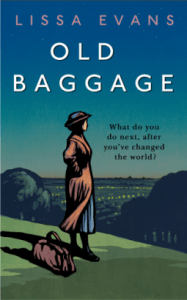
Old BaggageOld Baggage by Lissa Evans (eARC, NetGalley)

What do you do next, after you’ve changed the world?

It is 1928. Matilda Simpkin, rooting through a cupboard, comes across a small wooden club – an old possession of hers, unseen for more than a decade.  Mattie is a woman with a thrilling past and a chafingly uneventful present. During the Women’s Suffrage Campaign she was a militant. Jailed five times, she marched, sang, gave speeches, smashed windows and heckled Winston Churchill, and nothing – nothing – since then has had the same depth, the same excitement.

Now in middle age, she is still looking for a fresh mould into which to pour her energies. Giving the wooden club a thoughtful twirl, she is struck by an idea – but what starts as a brilliantly idealistic plan is derailed by a connection with Mattie’s militant past, one which begins to threaten every principle that she stands for.

The Road to NewgateThe Road to Newgate by Kate Braithwaite (eARC, courtesy of the author)

What price justice?

London 1678.  Titus Oates, an unknown preacher, creates panic with wild stories of a Catholic uprising against Charles II. The murder of a prominent Protestant magistrate appears to confirm that the Popish Plot is real.  Only Nathaniel Thompson, writer and Licenser of the Presses, instinctively doubts Oates’s revelations. Even his young wife, Anne, is not so sure. And neither knows that their friend William Smith has personal history with Titus Oates.

When Nathaniel takes a public stand, questioning the plot and Oates’s integrity, the consequences threaten them all.