
I’m thrilled to be hosting today’s stop on the tour for Warrior of Woden by Matthew Harffy, the fifth book in his exciting The Bernicia Chronicles series set in 7th century Anglo-Saxon Britain.
I interviewed Matthew when the previous book in the series, Killer of Kings, was published. Clearly the experience didn’t put him off too much because I’m pleased to say he has agreed to answer some more of my questions about his latest book. In our Q&A, Matthew talks about how the character of Beobrand has developed over the series, getting himself into the mind-set of the period and the importance of alliteration in book titles!
Be sure to check out the other great book bloggers taking part in the tour (see schedule below) for reviews of and features about Warrior of Woden.
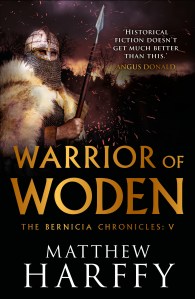 About the Book
AD 642. Anglo-Saxon Britain. Oswald has reigned over Northumbria for eight years and Beobrand has led the king to ever greater victories. Rewarded for his fealty and prowess in battle, Beobrand is now a wealthy warlord, with a sizable warband. Tales of Beobrand’s fearsome black-shielded warriors and the great treasure he has amassed are told throughout the halls of the land.
Many are the kings who bow to Oswald. And yet there are those who look upon his realm with a covetous eye. And there is one ruler who will never kneel before him.
When Penda of Mercia, the great killer of kings, invades Northumbria, Beobrand is once more called upon to stand in an epic battle where the blood of many will be shed in defence of the kingdom. But in this climactic clash between the pagan Penda and the Christian Oswald there is much more at stake than sovereignty. This is a battle for the very souls of the people of Albion.
Format: ebook, paperback (596 pp.) Publisher: Aria Fiction
Published: 1st April 2018 Genre: Historical Fiction
Purchase Links*
Publisher (buy direct and save 25%) ǀ Amazon.co.uk ǀ Kobo ǀ Google Play ǀ iBooks ǀ Amazon.com
*links provided for convenience, not as part of any affiliate programme
Find Warrior of Woden on Goodreads
Interview: Matthew Harffy, author of Warrior of Woden
Without giving too much away, can you tell us about Warrior of Woden?
Warrior of Woden is set six years after Killer of Kings and Beobrand has become more settled in his position of lord of Ubbanford. He has wealth and battle-fame and King Oswald respects and likes him. He has been instrumental in several more victories for the King of Northumbria and Beobrand’s black-shielded warriors are feared throughout Albion. But peace never lasts long in Dark Ages Britain and war is again brewing on the border, as Penda, the King of Mercia, is amassing a great force with which to invade Northumbria. And wherever the threat of battles looms, you know Beobrand won’t be far behind.
This book tells the tale of one of the greatest battles of the age, where the pagan Penda and the Christian Oswald vie for power over the land and the very souls of its people.
Warrior of Woden is the fifth book in your Bernicia Chronicles series. How do you approach meeting the needs of readers who have followed the whole series and those reading Warrior of Woden as a standalone book?
Writing a novel is a unique challenge. Writing a series of books comes with an extra set of difficulties. Readers expect a certain flavour they have come to recognise. They wish to revisit the same characters they have grown to love, or hate. They want some familiarity, but at the same time, they do not wish to be bored. Readers want to be thrilled and excited by new, fresh twists, not to have the same old stories repeated. And then, as you say, there is the issue of new readers. It is always in my mind that a reader might come to the Bernicia Chronicles at any point and so each novel must stand on its own merit, providing a satisfying read as well as adding to the overall series.
Each book has a beginning, middle and end, telling a discreet story against the backdrop of the overarching story of Beobrand’s life. The threads from previous books get mentioned and moved along, but they are not crucial to the understanding of the plot and I hope each book can stand on its own merits. Being part of a series does give the characters an extra depth, I think, which makes them more engaging. The back story is all there to reference without seeming forced at all.
Warrior of Woden takes place six years on from the action in Killer of Kings. How has Beobrand fared in the years since the reader last encountered him?
In Warrior of Woden, Beobrand has grown as a leader of men and as a man. His friendships from previous stories have matured and he has less self-doubt. He has more wealth and is now secure in his position. But with that position comes greater responsibility and in this story Beobrand sees his prowess in battle tested more than ever and his oaths and loyalties stretched to the limit. He leads his friends into the bloodiest battle he has faced yet and, as with all warfare, not everyone returns alive and nobody escapes unscathed.
The passage of time since the action of the previous book has allowed me to start afresh to some degree, creating extra back story, adding new characters, both friend and foe, and providing even more depth to the world Beobrand inhabits.
Is it frustrating or liberating to be writing about a period which has relatively few contemporary sources?
I think on the whole it is liberating. I am sure some writers would hate it. Especially if they NEEDED to know that what they were writing was absolutely accurate. In my case, I am happy to research and, if I cannot find an answer to something, to take an educated guess. I see this as the role of the novelist, but I think there are some historical fiction writers who would not enjoy that leap into the realms of pure imagination, or at least would feel uneasy about the amount of artistic license I am often forced to take. As long as the stories feel authentic, I am happy. Historical accuracy is for historians. Novelists expose the imagined truth in history. The lack of detailed contemporary sources gives me a freedom that is not available to writers from other periods in history that have richer documented evidence of events.
Which scenes in Warrior of Woden did you find most enjoyable or challenging to write, and why was this?
When starting each novel, I know there will be certain key, pivotal scenes. They are often the most difficult to write, as they tend to be when story threads reach their climax, characters die, and that sort of thing. I write chronologically, starting at the beginning and going through to the end without skipping any sections on the way, and as I approach some scenes I find myself getting nervous or excited about them.
The opening scene of the prologue of Warrior of Woden came to me almost fully formed in my mind, and provided a great hook for the rest of the story. I can’t tell you which of the scenes caused me the greatest challenge without giving away spoilers. But suffice to say there was death involved!
What do you think is the key to creating an authentic picture of a particular historical period?
Firstly, you have to research and avoid obvious anachronism. But after that, I think it is about trying to get yourself in the mind-set of the people of the time. What interested them? What kept them awake at night? Was it the same sort of things we worry about today? To some extent I think people would have had the same concerns. Were their children safe and healthy? Was a man’s wife in a bad mood with him? Was there enough food? Did the roof leak? But there would be many other things that are alien to our way of life now. Would the gods accept my sacrifice? Would the crops fail? Had I fallen out of favour with my lord? Could I afford a new slave? Was my sword sharp and byrnie strong enough to protect me? Balancing the fundamentally human aspects of the characters with specifically historical concerns really helps readers to connect with them.
Another important aspect of making a period seem authentic is to think of the language used, and to only use metaphors and similes that would mean something to the people of the time. Someone could “strike as quickly as an adder”, for example, but not “feel their skin prickling with electricity”. Of course, electricity existed, but nobody knew what it was or would speak or think of it in those terms. As an example, I decided from the beginning of the series that I would not mention periods of time such as seconds, minutes and hours, as I thought it was unlikely that everyday people would use those measurements. They had no clocks, after all! Hopefully, this type of omission in the language used, adds an overall feeling of authenticity and being different from now.
If the Bernicia Chronicles were to be made into a TV series (and wouldn’t that be wonderful), who would you like to see play Beobrand?
That would be wonderful! I really have no idea who I would like to play Beobrand. And let’s face it, if Hollywood came knocking, just like Lee Child with the Jack Reacher movie adaptations, I’d take the money and allow them to cast whoever they liked in the role – even someone as unlikely as Tom Cruise!
Is there another historical period you would be interested to write about?
I would love to write a novel set in nineteenth century America. The western frontier of the late nineteenth century really interests me and has a lot in common with seventh century Britain in that a bellicose people come in from the east and push the native population into the west.
The Serpent Sword, Blood and Blade, The Cross and the Curse, Killer of Kings, Warrior of Woden – you clearly have a liking for alliteration! At what point in the writing process do you come up with the title for a book?
I like the alliterative titles as they evoke the oral tradition of story-telling of the Anglo-Saxons. However, I have to say it has proved to be something of a rod for my own back, as each title gets more difficult! I tend to come up with the title after I have created the plot and I am some way into the writing process. Once the story is solid in my mind, I can think of titles and I find that after I have a title in place it helps me to focus on the story and honing it to fit the themes conjured up by the title.
What are you working on next?
I am now writing book six of the series. And I have already come up with the title: Storm of Steel. It will be released in spring/summer 2019.
Thanks, Matthew, for those fascinating answers to my questions. I’m glad to see you’re continuing with the alliterative titles!
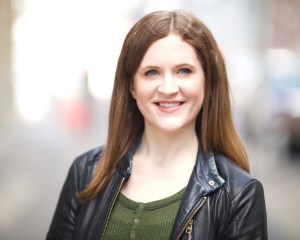
 About the Author
Matthew grew up in Northumberland where the rugged terrain, ruined castles and rocky coastline had a huge impact on him He now lives in Wiltshire, England, with his wife and their two daughters.
Connect with Matthew
Website ǀ Blog ǀ Facebook ǀ Twitter ǀ Goodreads

 About the Book
 About the Author

 What Cathy Read Next...