
Today I am delighted to welcome Jeff Russell, author of The Dream Shelf to What Cathy Read Next. Jeff has kindly agreed to answer some questions about his book, its inspiration and his approach to writing.
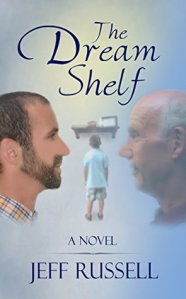 About the Book
No pictures, no past and yet his dreams were left on the shelf. A book, a toy, a framed quote and a plaster bust represented the places Sam’s father wanted to see and things he wanted to do. But Robert Archer refused to discuss his background and when he died unexpectedly Sam was left with the bitter regret of a lost opportunity to learn more about his dad. Things change with the discovery of a hidden yearbook, a list of names and a government document. Sam’s interest in his father’s life becomes a surreptitious tale that ignites a passion to know what happened to him and why his secrets could not be shared. He embarks on a quest for ‘his story’, one with both the promise of closure and the threat of learning more than he wants to know. The trail leads to Gus, a WWII veteran whose cryptic ramblings suggest a horrific plan to end the war in Germany, and his daughter Karen, who is torn between helping Sam and protecting her father. Together they learn the dark secret behind the Dream Shelf, the high cost of integrity and the lessons a father left behind for his son.
Purchase links*
Amazon.co.uk
Amazon.com
Barnes & Noble
*links provided for convenience not as part of any affiliate programme
Q&A: Jeff Russell, author of The Dream Shelf
Without giving too much away, can you tell me a bit about The Dream Shelf?
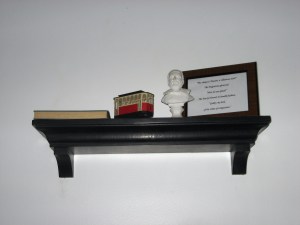
The story addresses the inherent human need to feel secure, specifically the security of knowing who we are as individuals. Robert Archer was a single parent who sacrificed everything to ensure that his son Sam had the best possible chance for success in life. Sam recognizes and appreciates that love but is deeply troubled by the fact that Robert’s life prior to 1948 is a closely guarded secret. Without knowing how his father became the person he is, Sam’s own story is incomplete and when Robert suddenly dies, Sam is left believing his questions will never be answered. All that remains is a small shelf of knick-knacks, simple items that Sam once believed represented his father’s unfulfilled dreams. A chance discovery rekindles his hope to uncover his father’s hidden past and the quest is on. As the story unfolds Sam comes to realize that the items on the shelf were actually clues to Robert’s life and lessons he hoped to pass down to his son.
(Jeff has shared this photo of the actual Dream Shelf from the book, just as Sam would have viewed it as a young boy.)
Where did you get the idea for the book?
I am drawn to puzzles and curious titbits of history. This story gave me a chance to combine the two, weaving a tale around true pieces of the past – including the American Civil War and WWII – and creating puzzles to let readers decipher for themselves what actually happened to Sam’s father. When a reader comes to me and says “I never knew that happened. That’s amazing!” I know they’ve experienced that same excitement.
How did you approach the research for The Dream Shelf? Do you enjoy the process of research?
Research is half the fun of writing; it lets me experience the thrill of discovery. And history provides plenty of factual material to work with. All I need to do is pick a timeframe and search for information relative to a specific scenario or dilemma in the story.
What was the biggest challenge you encountered when writing The Dream Shelf?
One of the items on the Dream Shelf is a framed literary quote. I wanted to use a line from a famous author’s poem (to give my story a sense of credibility) but the complication of getting permission turned out to be a huge drain on my time. I dropped that idea and instead wrote my own poem. In the end it fit much better into the story and I’m quite proud of the poem.
I know that one of your childhood literary heroes was Jules Verne. What contemporary writers do you admire?
I realize this will sound blasphemous among the legions of writers but I don’t have a favourite contemporary author. I’ve learned that all writers are my teacher, each author has some gift or talent I would like to emulate and for that reason I read as many different authors as I can. Some I like more than others but once I’ve read one work by them I find that subsequent works have less new lessons to share and so I move on to a different author. I should point out also that, with the exception of Afterlight – which is the sequel to Cab’s Lantern – all my stories are unique. I don’t stick with a particular theme or dilemma, hence reading multiple authors makes it easier to find new inspiration.
You say your characters are ‘ordinary people facing extraordinary circumstances’. What is it about this concept that inspires you?
Some readers want to picture themselves as having unlimited physical, financial, intellectual or sexual resources and gravitate towards stories that let them experience those pleasures. But there are others (myself included) who are satisfied being ‘simple old me’ and would like the occasional adventure of facing an unusually challenging situation and having nothing to fall back on other than a cool head and sharp wits. Those readers are my target audience. Credibility is key here. For a reader to truly feel that they are caught in a tense situation there must be no suspension of belief.
Have you had any real life adventures that you’ve used (or plan to use) as a basis for your writing?
Nothing exciting, I’m afraid. I’ve done a lot and seen a lot but the story of my life would have less plot than a dictionary. That said, parts of my past have resurfaced in my characters. As a result I have lived great adventures through them and for that I will always be grateful.
What is your favourite and least favourite part of the writing process?
Creating characters, scenes and dilemmas and then fitting them together is the favourite part. I believe that the creative process is the driving force that keeps most authors glued to the keyboard. Proof-reading is my least favourite part… by a long shot. I know the plot, characters and dialog so well that I race ahead, missing typos and other blunders in the process. That’s where beta-readers become critical.
Do you have a special place to write or any writing rituals?
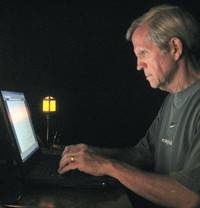
Ideas come to me throughout the day but I save them for the following morning, long before the sun rises. Then I sit at a small desk in a quiet room and start working those elements into the story. It seems I need to be away from that desk to find the inspiration but must be sitting at my computer to start composing. And this only works early in the morning; by the end of the day my brain is too frazzled to be creative.
What are you working on next?
My current work in progress deals with the fear of growing old alone. The protagonist, who is faced with having to choose between two unattractive options regarding how he will spend the rest of his life, encounters a group of WWII vets who meet each day for coffee. By talking to them and sharing their experiences he hopes to find a solution to his own quandary. I am drawn to this project because that group of vets actually exists. I meet with them frequently and some have volunteered their stories for my book. Hopefully this will let their stories live on.
Thank you, Jeff, for providing such fascinating answers to my questions.
What would be on your Dream Shelf? Jeff and I would love to know…share on Twitter @CabsLantern, hashtag #DreamShelf
 About the Author
Jeff: I am a tale-spinner. My childhood heroes were Jules Verne and Victor Appleton II, architects of fantastic adventures. Hemingway stepped in when I discovered that the trials and triumphs of real people – those with limited physical and financial resources – were even more intriguing than science fiction. Today I try to follow that example with my own characters. They are the ‘you and me’ of the world, ordinary people facing extraordinary circumstances, beaten down perhaps and yet determined to succeed. Invariably they find adventure, romance and self-fulfilment, as should we all. When not absorbed in the pages of some new author or hammering away at my latest manuscript I can be found living and running in Stowe, VT. Visit my website at www.CabsLantern.com and feel free to drop me a line at JeffRussell@CabsLantern.com. Happy reading!
Other ways to connect with Jeff
Twitter https://twitter.com/CabsLantern
Goodreads https://www.goodreads.com/author/show/7232345.Jeff_Russell

 About the Book
 Book Facts
 About the Author

 What Cathy Read Next...