Blog Tour/Q&A: Day of the Dead by Mark Roberts

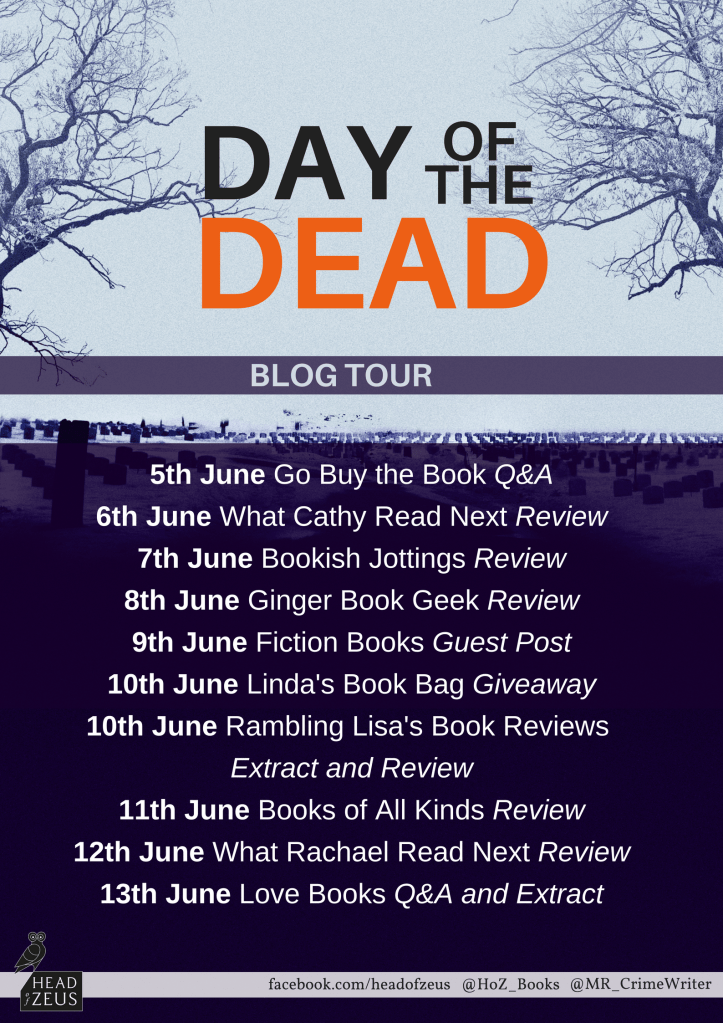
DayoftheDeadTourBanner

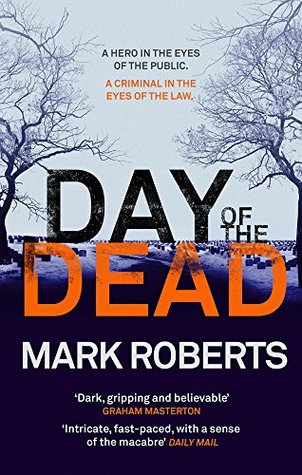
I’m delighted to be today’s host on the blog tour for Day of the Dead by Mark Roberts, the latest crime mystery featuring DCI Eve Clay.  I’m also excited that Mark has agreed to answer some questions about Day of the Dead, the inspiration for it and his approach to writing.
Follow my blog with Bloglovin


DayoftheDeadAbout the Book

Publisher’s description: Vindici is a hero to many. He is also the nation’s most dangerous criminal… The man who calls himself Vindici broke out of prison last year. Now he’s filmed himself torturing and killing paedophiles in Liverpool’s affluent suburbs. Half the city are celebrating: the streets are safer for their children. But for DCI Eve Clay and her team at the Merseyside Police, it’s a nightmare. Their job is to solve the crimes and lock up the killer – hard enough without being despised by the public they are trying to protect. And now, just when they think they’ve cracked the case, they receive a photo of Vindici, at a Day of the Dead parade in Mexico. So if Vindici is 5,000 miles away, who are they hunting in Liverpool? DCI Eve Clay must draw on all her cunning to unmask a killer who is somehow always one step ahead…

Book Facts

Format: Hardcover                   Publisher: Head of Zeus             No. of pages: 464
Publication: 4th May 2017       Genre: Crime, Mystery

To purchase Day of the Dead from Amazon.co.uk, click here (link provided for convenience, not as part of any affiliate programme)
Find Day of the Dead on Goodreads


Interview: Mark Roberts, author of Day of the Dead (Eve Clay #3)

Mark, welcome to What Cathy Read Next.  Day of the Dead is the third book in your DCI Eve Clay series. What are the challenges of writing a series compared to a standalone novel?

In writing a series, one has to be consistent with the journey taken by all the recurring characters. For instance, DCI Eve Clay, the lead character, has a son. With each book he ages a year. Also, in unfolding Eve’s back story of her childhood, when she thinks back to her early life and how that impacts on the present as new information is revealed, everything has to tie up and be consistently interlinked. In managing the challenges of consistency across a series, it presents opportunities to develop each and every character in this way: as in life as in fiction. We are all the same people we were a year ago, but we have changed because experience makes us change, and so it is with characters in a series of novels

Without giving too much away for readers who haven’t yet discovered the series, can you tell us a bit about Day of the Dead?

A paedophile has been murdered in his home. A week later, another paedophile is murdered in his home and his wife has been tortured and had her eyelids hacked off. DCI Clay suspects it is either the work of Justin Truman aka Vindici, a serial killer who targeted paedophiles in the south of England years earlier and who has escaped from prison or the work of a copy cat killer. For once the public are not behind Clay and her team and are, in fact, openly hostile to the investigation. And to make matters worse for Clay she suspects someone on the inside of Merseyside Constabulary is feeding information to the killer. It is her most complex case to date.

The two earlier DCI Eve Clay books were set in Liverpool. What made you decide to inject an international flavour into Day of the Dead?                                                             

I’m proud of Liverpool for many reasons but top of my list is the fact that as it has been a major port, we’ve had the world come to us for a long time. It is a really multi-cultural society and we have links all across the world. I wanted to reflect that side of Liverpool. Also, the Mexican Day of the Dead festivities are fascinating. I was intrigued by the complex image system and wanted to explore the meaning behind the rituals.

How has Eve developed as a character over the series?

She has learned more about herself and those around her. Eve becomes more passionate about her family and her work with each new book. And with this growing passion, she becomes more vulnerable. I wanted to have a lead character who detected not only crimes but also learns about her mysterious childhood. As her self-awareness grows, she learns more about the world around her, and her vision of all situations becomes more complex and multi-dimensional.

You’ve also written two books featuring DCI Rosen (The Sixth Soul and What She Saw) set in London. What prompted you to start a new series featuring a new central character?

I wanted to write a female lead detective in a city I know that I both love and have an in-depth knowledge of. I often go exploring and find new places that I haven’t seen before. With each new Eve Clay novel, I learn more about Liverpool and apply this to the novels. We have a wealth of atmospheric and interesting places like the Williamson Tunnels, the two Cathedrals, the Littlewoods Building. I could go on.

How do you approach the research for your books? Do you enjoy the process of research?

I love reading and I love researching. For Day of the Dead I did extensive research on the Mexican Festival. For Dead Silent, I had to research King Psamtik I (Egyptian king five centuries BC). I can’t go further on that one as it would give too much away. I work full time as a teacher in a special school and have spent the last fourteen years with disabled teenagers. That gave me a great insight into how to portray people with learning difficulties. For Blood Mist I had to go fourteen metres underground into the Williamson Tunnels. Each new book demands new research. Thankfully. For Black Sun my current work, I went to the Mortuary at the Royal Liverpool University Hospital, and will be going back again no doubt. At the mortuary I received massive help from Barbara Peters, the manager, and her team.

Do you have a special place to write or any writing rituals?

I think constantly about my writing, developing and reshaping material as I move through my daily life. When I get home from school, I set about the physical task of writing in my study. I have monthly targets that I have to achieve through daily and weekly targets. I don’t listen to music, I just stay at the laptop until I hit my daily target. Saturdays and Sundays are big target days, as are the school holidays. I think of the actual physical process writing as being the end of a much longer conscious and subconscious journey.

I do a lot of work when I am running along Otterspool Promenade, on the banks of the River Mersey heading out for the Irish Sea. Also I swim each day and my mind goes into improvisational mode when I’m in the water. Often, I will wake up at two in the morning and head to my study to try out some idea that has seized me somewhere between waking and sleeping. I believe in Max Ernst’s view of creativity as being one eye open and one eye shut. Ernst also said, ‘When an artist finds himself he is lost…’. Hence, I never carry maps or a torch as my ambition is to remain permanently lost.

What is your favourite and least favourite part of the writing process?

I love the whole process. There is nothing I dislike about it.

Which other writers do you admire?

Samuel Beckett, Thomas Harris, Edgar Allan Poe (boyhood hero), Captain Beefheart (amazing lyrics), Dostoyevsky, Gitta Sereny, Graham Masterton, Jimmy McGovern, Joyce Carol Oates, Franz Kafka, Colin Schindler…

What are you working on next?

The new book is called Black Sun. It is set in Liverpool and has DCI Eve Clay as the lead character. As it’s a work in progress, I can’t say much more than that because it would feel like walking on virgin snow.

Thanks, Mark, for those fascinating answers and for the good news that there will be another case for Eve Clay coming soon!

MarkRobertsAbout the Author

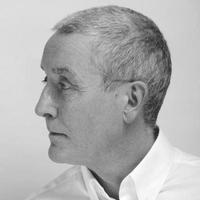
Mark Roberts was born and raised in Liverpool. He was a teacher for twenty years and now works with children with severe learning difficulties. He is the author of What She Saw, which was longlisted for a CWA Gold Dagger.


Connect with Mark
Twitter                      Facebook                  Goodreads

Connect with Head of Zeus
Website                    Twitter                      Facebook                 Instagram
DayoftheDeadTourBanner

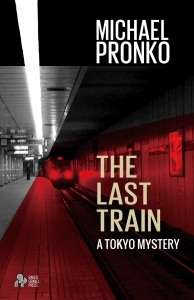
The Last Train by Michael Pronko

TheLastTrain1Today’s guest on What Cathy Read Next is Michael Pronko, author of the Tokyo-set thriller, The Last Train. I’m delighted that Michael has agreed to mark publication day of his book by answering some questions about the inspiration for The Last Train and his approach to writing.

‘An absorbing investigation and memorable backdrop put this series launch on the right track.’ (Kirkus Reviews)

Follow my blog with Bloglovin


About the Book

Detective Hiroshi Shimizu investigates white collar crime in Tokyo. He’s lost his girlfriend and still dreams of his time studying in America, but with a stable job, his own office and a half-empty apartment, he’s settled in.  When an American businessman turns up dead, his mentor Takamatsu calls him out to the site of a grisly murder. A glimpse from a security camera video suggests the killer was a woman, but in Japan, that seems unlikely. Hiroshi quickly learns how close homicide and suicide can appear in a city full of high-speed trains just a step—or a push—away. Takamatsu drags Hiroshi out to the hostess clubs and skyscraper offices of Tokyo in search of the killer. She’s trying to escape Japan for a new life by playing a high-stakes game of insider information. To find her, Hiroshi goes deeper and deeper into Tokyo’s intricate, ominous market for buying and selling the most expensive land in the world. Hiroshi’s determined to cut through Japan’s ambiguities—and dangers—to find the murdering ex-hostess before she extracts her final revenge—which just might be him.

Book Facts

  • Format: ebook
  • Publisher: Raked Gravel Press
  • No. of pages: 348
  • Publication date: 31st May 2017
  • Genre: Thriller, Crime

Purchase links*
Amazon.com
Barnes & Noble 
Amazon.co.uk
*links provided for convenience, not as part of any affiliate programme

Find The Last Train on Goodreads 


Interview: Michael Pronko, author of The Last Train

Without giving too much away, can you tell me a bit about The Last Train?

The novel is set in Tokyo and pits novice detective Hiroshi against Michiko, a savvy, skillful young woman. She decides to take back what’s owed her by learning how to cash in on insider information. Hiroshi teams up with ex-sumo wrestler Sakaguchi to follow her through Tokyo’s maze of skyscrapers, wastelands, sacred temples and odd hideaways. It’s more ‘whydunit’ than ‘whodunit’, and very much a mystery-thriller.

What was the inspiration for the book?

Tokyo’s a very inspiring place. In a normal day, I come across so many things that make me want to write–torn-down buildings, new neighbourhoods, advertisements, odd news items. I find the multitudes of people—each a novel in themselves—to be very inspiring. For this novel, I was thinking about the current prime minister’s coined term, “womenomics,” which was used to describe his plan to bring women into the economy. That was more slogan than policy, as it turned out, so I wanted to take that a step further to see what would happen if a smart, strong woman decided to engage with the male-dominated world of high-priced real estate.

You’ve published collections of essays about Tokyo but what made you decide to venture in the world of fiction?

I still love writing essays about Tokyo, but fiction opens up more possibilities for bigger connections. In fiction, you can see through another character’s eyes, while non-fiction tends to frame my own reactions, insights and language more snugly. Fiction offers a bigger canvas to paint on, which is both freeing and a little daunting. When I was younger, I wrote much more fiction, but non-fiction took over for several years as I wrote for different magazines and newspapers. So, it’s maybe more of a return than a new venture. Anyway, I love both. The internal struggle is the same both ways.

What is it about Tokyo that made you choose it as the setting for your book?

I’ve lived here for 20 years, so I know it better than anywhere else. Little by little, Tokyo’s become home. I think Tokyo is one big mystery, so it really begs to be written into fiction. It’s a complicated place and very exciting, disturbing and irritating all at once. There is just so much going on, and so much energy. Of course, it’s easy to remain on the surface of its vitality, but in the novel, I wanted to look beneath the surface. The giant skyscrapers and constant construction are amazing, but there’s a lot going on behind the go-go big-city bright-lights, and a lot of it not so good.

Tokyo

The Last Train takes the reader into the world of high finance, insider dealing and the Tokyo property market.  What research did you have to undertake?

I would say it’s a gradual accumulation of knowledge rather than research per se. Years of it. Most of the issues in the novel are not researchable, because it’s not something people talk about openly. I wrote editorials for ten years, which is a real education. I talk with people a lot, at bars or wherever, and with former students and friends. All of them have told me a lot about what they do. The novel’s settings are real places I know and go regularly. When writing, I revisit those places like Roppongi. It’s important being there and soaking it in actively and unconsciously. I take photos to see better and remember. But it’s also like a couple hundred photos and years of visits comes out to a short introductory paragraph!

What was the biggest challenge you encountered when writing The Last Train?

Writing about another culture is difficult because even after all the years living here, there are still aspects of the culture that are easy to misconstrue. Especially because many things are left unspoken in Japan, especially shameful things. My “outside” standpoint gives me a different sort of objectivity to see aspects of Japan that Japanese might not notice, so I have to go with that. It’s also hard writing women characters. Most of my university students are women, so listening to their stories, good and bad, gives me an idea of what they experience and how they feel about things. The third challenge was putting Tokyo into a very few words. It’s a big place.

Do you have a special place to write or any writing rituals?

I have a great space at home looking out on my back garden, so that’s very special and very productive. I start writing as early as I can in the morning and I like to have music playing when I write. I’m always fiddling with the right music to propel my thoughts and words for a specific scene or a feeling I’m trying to convey. But at other times, silence is productive. I also write on the train, or rewrite. It’s a bit embarrassing with other people on a crowded train staring at me scrawling changes onto a folded piece of paper as fast as I can before the stop where I need to change trains. But that makes me work in quick, vigorous strokes. And then, as I walk through the crowd, I rewrite in my head.

Which other writers do you admire?

I read a lot of mysteries and thrillers, but I’m not a fan of any single author. I like older noir novels, classic mysteries, Japanese and Chinese mystery writers. I’m always stunned at almost every writer’s unique skill fashioning prose and engineering stories. I try to learn from all prose writers whether I admire them or not. I teach literary fiction at university, Hemingway, Fitzgerald, Cormac McCarthy, Vonnegut, Kerouac. I teach classes in poetry and song lyrics, so I always admire that for rhythm, imagery and concision. Of Japanese writers, Kobo Abe is the one that always knocks me out the most. I read everything I can, and it’s rare I don’t admire something in a writer’s work, if not always the whole thing.

If The Last Train was to be made into a film, who would be your choice of director and lead actors?

If I could, I’d maybe go back to the actors of Japanese 1950s films, Toshiro Mifune, Takashi Shimura, Ken Takakura, Tatsuya Nakadai. I see current actors like Takeshi Kaneshiro, Ryuhei Matsuda (as the punk), Yosuke Eguchi, Hideaki Ito fitting roles. Jun Kunimura (as the building owner) and Koji Yakusho and Ren Osugi are always great. Shinichi Tsutsumi would fit Detective Hiroshi perfectly. Lead actress is harder. Miki Nakatani, Koyuki, Ryoko Shinohara are tough in many of their roles, very strong women. As for director, tough call between a Japanese and non-Japanese director. Directors bring their own style, so it’s tricky. What about a blend of Ridley Scott and Beat Takeshi or Rokuro Mochizuki? Anyway, that’s all a real stretch!

What are you working on next?

I have two more up and working in the same series, Japan Hand, which delves into the relation between Japan and the American military bases and Thai Girl in Tokyo, which has two great women characters finding their way through the dangers of Shibuya’s underground nightlife. Those are set for release over the next year and a half. I’ll do more non-fiction after that, or kind of concurrently, a non-fiction book on Japanese “things” like bamboo, pottery, rock gardens. I have a couple of stand-alone thrillers in mind, too. Tokyo’s so infinite story-wise!

Thank you, Michael, for those fascinating answers. I’ve got a feeling The Last Train is going to get readers hooked for future books in the series.


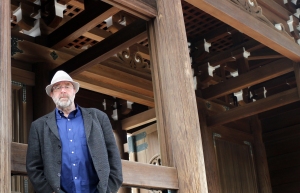
MichaelPronkoAbout the Author

Michael says: I have lived, taught and written in Tokyo for twenty years, but I was born in Kansas City, a very different world from Tokyo. After graduating from Brown University in philosophy, I hit the road. I travelled around the world for two years working odd jobs, and finally went back to school. After a Master’s in Education, I got a call from Beijing offering me a teaching position. I took it. I lived in Beijing for two years, teaching English, travelling the country and writing. I was lucky enough to meet my wife there.  I spent more time traveling, teaching English and finishing two more degrees, Comparative Literature in Madison, Wisconsin and a PhD in English at the University of Kent at Canterbury, writing about film adaptations of Charles Dickens’ novels.

Now, I live with my wife in western Tokyo and work as a professor of American Literature at Meiji Gakuin University. I teach seminars in contemporary novels and film adaptations, and classes in American indie film and American music and art. After talking with my students about Jackson Pollock, Bessie Smith, or Kurt Vonnegut, I head out to wander through Tokyo. The contrasts, and confluences, always put ideas for writing into my head. I have published three award-winning collections of essays: Motions and Moments: More Essays on Tokyo (Raked Gravel Press 2015), Tokyo’s Mystery Deepens (Raked Gravel Press 2014), and Beauty and Chaos: Essays on Tokyo (Raked Gravel Press 2014). I have also published books in Japanese and two textbooks in both English and Japanese. I currently run my own website Jazz in Japan (www.jazzinjapan.com). I also continue to publish academic articles and help run a conference on teaching literature (www.liberlit.com).

Connect with Michael

Website  
Twitter
Facebook
Goodreads