
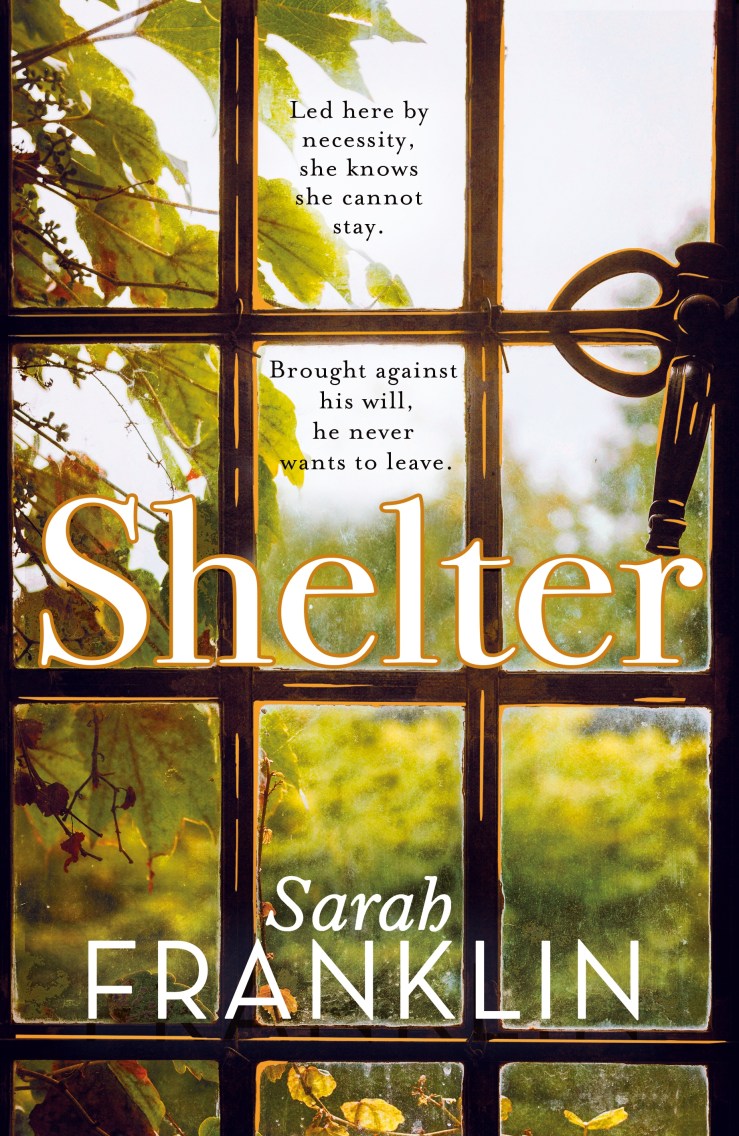
Today I’m thrilled to welcome Sarah Franklin to What Cathy Read Next and bring you a fascinating interview about her debut novel, Shelter. You can read my review of this wonderful book here.
 About the Book
Early Spring, 1944. In a clearing deep within an English forest two lost souls meet for the first time. Connie Granger has escaped the devastation of her bombed out city home. She has found work in the Women’s Timber Corps, and for her, this remote community must now serve a secret purpose. Seppe, an Italian prisoner of war, is haunted by his memories. But in the forest camp, he finds a strange kind of freedom. Their meeting signals new beginnings. In each other they find the means to imagine their own lives anew and to face that which each fears the most. But outside their haven, the world is ravaged by war and old certainties are crumbling. Both Connie and Seppe must make a life-defining choice which threatens their fragile existence. How will they make sense of this new world, and find their place within it? What does it mean to be a woman, or a foreign man, in these days of darkness and new light? A beautiful, gentle and deeply powerful novel about finding solace in the most troubled times, about love, about hope and about renewal after devastation. It asks us to consider what makes a family, what price a woman must pay to live as she chooses, and what we’d fight to the bitter end to protect.
Book Facts
| Format: | Hardback | Publisher: | Bonnier Zaffre | Pages: | 432 |
| Publication: | 27th July 2017 | Genre: | Historical Fiction |
Purchase Links*
Amazon.co.uk ǀ
*links provided for convenience, not as part of any affiliate programme
Find Shelter on Goodreads
Interview with Sarah Franklin, author of Shelter
Sarah, without giving too much away, can you tell us a bit about Shelter?
Shelter is the story of Connie Granger, a Coventry factory worker in World War Two who is forced by circumstance to find work as a ‘lumberjill’. She’s determined to stay for a short while and then move on to the more exotic, glamorous life she thinks is around the corner. Connie’s matched up for tree felling duties with Seppe, an Italian Prisoner of War who’s held at a nearby camp and let out into the woods for war work. Unlike Connie, Seppe, although he’s a prisoner, is finding the only true peace he’s ever known in the woods. The story’s about what happens to each of them and to the local people they get to know. On a broader level it’s about differing perceptions of freedom and captivity, and about what self-determination can look like depending on where you stay.
Where did you get the inspiration for the book?
I grew up in the Forest of Dean, and adore the place. In 2010, David Cameron announced plans to sell off various forest lands around the UK and I was absolutely shocked by the idea that something I’d always considered common ground could be sold from under us. It got me thinking about the situation in the Second World War, when officials in London decided (a) to send numerous disparate populations (evacuees, war workers, POWs) to the Forest for safety, thus completely upending life there for people who’d lived there for generations and (b) that the very forest land they’d decided was a sanctuary needed to be cut down in the name of ‘protecting the country’. It struck me as a situation full of tension, and perhaps a less familiar part of Britain’s war story.
Although you have written non-fiction and short stories, Shelter is your debut novel. Can you tell us a bit about your writing journey?
I’m one of those who always fiddled with writing – as a kid, I somewhat obnoxiously wrote a book of short stories and requested that my teacher read these at story time rather than the more boring things she was reading. I wrote various things for school magazines and the requisite bad teenage poetry and then somehow lost my nerve in my twenties – a classic case of ‘people like me don’t do things like that’. In my early thirties I moved to Seattle and wrote non-fiction for the papers there, which resulted in making that easier to do later on in Ireland and then England. Seven years later we were back in England and I was just *sick* of hearing myself say I really would write a novel one day. So I told myself to just get on with it. Basically the fear of never having done it became greater than the fear of not doing it.
How did you approach the research for the book? Do you enjoy the process of research?
I’m an unashamed nerd and I *love* research – my other job is as a university lecturer so it’s quite an ingrained habit. I read many, many local histories of the ‘lumberjills’ and the POWs and talked to people who’d been around then – something you can still just about do with WW2. Once I started to understand what I didn’t know, I spent time in the archives of the Imperial War Museum and the Dean Heritage Museum reading living histories of people who’d done these jobs.
What was the most surprising fact you came across during your research?
The sheer scale of the POW camps in the UK still takes me aback. 400,000 Italian and German POWs were held in more than 500 camps all around Britain – basically, everyone would have been near one. I was also surprised (and pleased!) by just how relaxed the whole thing seemed – prisoners really were allowed quite a degree of freedom to wander around. It’s heartening to think of Britain receiving so many people who were the actual enemy and then doing so with such care and humanity.
What was the biggest challenge you encountered when writing the book?
I had so many rigid timelines that were sometimes tricky to balance with my urge to make things up. We needed to be aware of the British war effort, what was happening in Germany, what was happening in Italy, and one other quite unmoveable timeline that would be too much of a spoiler to reveal. But in a way that’s a nice problem to have.
Reading the book, I felt the forest was almost a character in its own right. Is that something you consciously intended?
Ha – I’m really glad to hear that. I think, because the forest was my starting point, and I know it so well, there was never any doubt in my mind that we needed to know what happened to it, too. And because a forest is so organic, it’s a fantastic way to show how things change and yet are in some ways completely immutable, and how the effects of war in Britain didn’t just decimate cities, but had a really profound effect on rural communities, too.
If Shelter was to be made into a film, who would be your choice of actors to play Connie and Seppe?
Seppe has always partly been Ben Whishaw in my mind, even though he’s not Italian. Connie needs to be someone with spirit who isn’t afraid of the outdoors – Jennifer Lawrence in her Winter’s Bones guise would be amazing. Amos could be played by John Thaw, not least for the Goodnight, Mr Tom connections, though obviously that’s impossible…
Which other writers do you admire and why?
So, so many. In terms of people who’ve written beautifully about the Second World War, I adore the work of Jason Hewitt, whose novels take you to parts of the war you have no idea about and are just exquisitely written. Lissa Evans, whose novel Their Finest Hour and a Half was recently made into a film, has an incredible knack of making you howl with laughter and then pulling the rug out from under and showing you the huge poignancy of the scene. I read probably as much non-fiction as fiction, and the non-fiction book I’m currently raving about to anyone who stands still enough is Lynsey Hanley’s Respectable, an examination of social mobility which I honestly think everyone in Britain should read. Hanley’s an academic who previously worked for Heat magazine and the combination is exactly what the topic needs – it’s an immaculately-researched piece of social commentary that reads like a thriller.
What are you working on next?
It’s still very much in the early stages; a novel about two women from very different backgrounds who end up sharing a house together in a small town, and the tensions this brings. It’s a theme about going away and coming back, about class and about expectation and what this does for everyone involved. And it’s back in the Forest of Dean, because I love it so much.
Thank you, Sarah, for such fascinating answers. As someone who adored Shelter, it’s great to find out more about the inspiration behind it. I shall definitely be looking out for your next book…
 About the Author
Sarah Franklin grew up in rural Gloucestershire and now lives with her family between Oxford and London. She has written for the Guardian, Psychologies magazine, The Pool, the Sunday Express and the Seattle Times. Her creative non-fiction has been published in anthologies in the USA and appeared on radio affiliates there. Sarah is founder and host of popular Oxford literary night, Short Stories Aloud, a Senior Lecturer at the Oxford International Centre for Publishing Studies, and a judge for the Costa Short Story Award. She was awarded a mentorship under the Jerwood/Arvon scheme to work on her debut novel, Shelter, which will be published by Bonnier Zaffre in July 2017.
Connect with Sarah
Twitter ǀ


 About the Book

 About the Author
 What Cathy Read Next...