
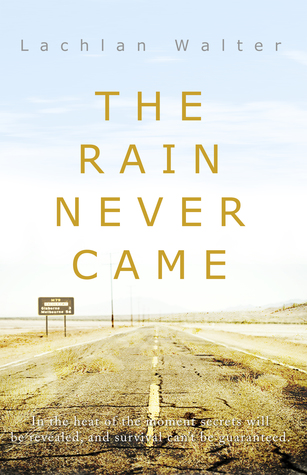
Today’s guest on What Cathy Read Next is Lachlan Walter, author of The Rain Never Came, an intriguing story set in a drought-stricken Australia. I’m delighted that Lachlan has agreed to answer some questions about the book, its inspiration and his approach to writing.
 About the Book
In a thirsty, drought-stricken Australia, the country is well and truly sunburnt. As the Eastern states are evacuated to more appealing climates, a stubborn few resist the forced removal. They hide out in small country towns – where no one would ever bother looking. Bill Cook and Tobe Cousins are united in their disregard of the law. Aussie larrikins, they pass their hot, monotonous existence drinking at the barely standing pub. When strange lights appear across the Western sky, it seems that those embittered by the drought are seeking revenge. And Bill and Tobe are in their path. In the heat of the moment secrets will be revealed, and survival can’t be guaranteed.
| Format: | Paperback/ebook | Publisher: | Odyssey Books | Pages: | |
| Publication: | 25th May 2017 | Genre: | Post Apocalyptic |
Purchase Links*
Amazon.co.uk ǀ Amazon.com ǀ Barnes & Noble ǀ Publisher
*links provided for convenience, not as part of any affiliate programme
Find The Rain Never Came on Goodreads
Interview: Lachlan Walter, author of The Rain Never Came
Without giving too much away, can you tell us a bit about The Rain Never Came?
In terms of plot, The Rain Never Came is about a thirsty, drought-stricken future Australia in which the eastern states have been evacuated to more appealing climates. A stubborn few resist this forced removal, hiding out in small country towns where no one would ever bother looking. But no one can hide forever…
In terms of heart, The Rain Never Came is actually about two classically ‘Australian’ mates trying to take the end of the world in their stride. And it’s about friendship and community, independence and practicality, larrikinism and egalitarianism, the things that we fight for and the things we let go of. And in the end, it’s about the ties that bind and the length that these ties will stretch.
How did you get the idea for the book?
Some years ago, I moved back to my hometown at the tail end of Australia’s Millennium Drought, a ten-year drought that devastated much of the country’s south-east. My hometown is the actual town of Newstead, the main setting of The Rain Never Came – it’s a small country town, deep in the bush, and like everywhere else it was suffering from the ravages of the dry.
Life there was strange indeed – communities were fraying as those who depended on water for their livelihood began walking off their farms, abandoning the land and moving to the city; water theft had become a common occurrence; our 20th-century technology meant nothing against nature. It seemed as if the past had returned; a world of hard work, dust and thirst. And yet we were surrounded by the trappings of 21st-century life. More than anything else, this hybrid world to me seemed like the beginning of some post-apocalyptic world from the pages of science fiction, and I knew that one day I just had to make it so.
The Rain Never Came is your first novel. Can you tell us a bit about your writing journey?
I’ve loved books and stories ever since I learned to read, but I didn’t really start writing until late high school: poems and short fiction, some of it the usual teenage dross, some of it not too bad. I kept at it through my early twenties, submitting things here and there but never taking it that seriously. One day, I just stopped.
Almost a decade later, I returned to university to finish a Bachelor’s Degree that life had interrupted. At this point, the idea for The Rain Never Came had already come to me, but turning it into a book seemed like a fantasy. However, as I progressed through my degree and into my honours year, I took more and more writing classes and rediscovered my passion and enthusiasm for writing. I practised and practised, writing a lot of crap to get to the good stuff. Then the opportunity arose to do a PhD, which would encompass writing a novel and a piece of literary criticism. I leapt at it, realising that here was the perfect environment to bring The Rain Never Came to life.
Much perseverance and stubbornness has finally paid off.
You are a reviewer and critic but what’s been your experience so far of being on the receiving end of reviews?
I haven’t actually perceived that many reviews yet – The Rain Never Came hasn’t been out very long – and those I have received have been quite positive. I’m prepared for the negatives, however – nothing is perfect, especially something as personal as a story. Luckily, I’ve also got a pretty thick skin. The writer’s lot has given me this. You can’t let rejection letter after rejection letter stop you from writing. You just have to have confidence, perseverance and an honest eye, and realise that you can always get better.
It helps if you remember that taste is in the eye of the beholder. Even better is making sure that you do the best job that you can, and resisting any urges to grow complacent or lazy with your work. We write for the love of writing and literature, books and stories. There’s no point in phoning in that love.
The focus of your PhD was post-apocalyptic fiction. What do you think makes this genre so attractive to authors, and to readers?
I think that for writers and readers alike, post-apocalyptic fiction appeals to some dark part of us, a part buried deep in our reptilian brain stem, a part that longs for a life free of our contemporary distractions and problems, that relishes the idea of the symbols of our civilisation, along with its monuments and idols, reduced to wreck and ruin. It’s no coincidence that much of the iconography of post-apocalyptic fiction consists of landmarks that are globally recognisable, despite the devastation inflicted upon them: the Statue of Liberty, the Eiffel Tower, the Taj Mahal, the Pyramids of Giza, the Sydney Harbour Bridge.
And then there’s the fact that we live in an increasingly uncertain age, in which the end of the world feels like it just might be on the horizon, a cyclic cultural occurrence that has repeated itself numerous times throughout human history. Right now, the heralds of the apocalypse are many: climate change, overpopulation, fundamentalism, isolationist tribalism, vast inequality, terrorism, delusional zealots controlling nuclear-armed countries. At times like these – times of great change, instability, hopelessness and anxiety – I think that some people fantasise about an enormous event that would allow society and civilisation to begin again, this time in a more fair and just way.
It seems to me the situation envisioned in The Rain Never Came, and people’s different responses to it, support the idea of a ‘thin veneer of civilization’. Is this an idea that interests you?
I think that for some people, civilisation really is only skin deep, and that these people only ‘behave’ because they have to, and that they’ll seize any opportunity and/or circumstance in which they can indulge their barbaric side. As well, I think that many people would, rightly or wrongly, give up their civilised sides when it came to life or death. But to assume that everyone would act this way is to take a very dim view of humanity, and to wallow in pessimism and misanthropy. Not all of us are bad or selfish, even when things get hard. For some people, dire straits only make their humanity shine; something history has proven time and time again.
Did the characters of Bill Cook and Tobe Cousins change at all during the writing process or did they arrive in your mind pretty much fully formed?
The core relationship between Bill and Tobe existed from the moment I had the idea for The Rain Never Came: two classically ‘Australian’ mates standing side-by-side at the end of the world. But as individuals, Bill and Tobe constantly evolved as I fleshed out their world and explored the dynamic and history between them. They changed dramatically as the story progressed, as they became more ‘real,’ and as the history between them became an essential part of the narrative.
These changes often surprised me. But then, a well-rounded character should sometimes surprise both the reader and the writer. For the writer, their personalities and psychologies should direct how they’re written; rather than being shoehorned into an action or decision for the sake of plot, the actions and decisions they make should come from within them, from their individual personalities and psychologies. For the reader, a character should be surprising because that’s what people are like – at times, we’ve all been contradictory, impulsive, unthinking, inconsistent or just acted out of character.
Are there any Australian colloquialisms in the book you think readers in other parts of the world may struggle with?
I hope not… But in all seriousness, I believe that context is key when it comes to understanding colloquialisms – we should be able to understand them without needing to refer to a glossary, something that most astute readers have a handle on. In the case of The Rain Never Came, most of the colloquialisms have either been encountered before through Australia’s internationally successful films – think of how Crocodile Dundee and the Mad Max series introduced the world to phrases like ‘she’ll be right’ and ‘fang it’ – or else they should be easily interpretable, given the context. After all, one person’s ‘g’day’ is just another person’s ‘howdy.
Which other writers do you admire, and why?
Being a fan and writer of science fiction and its subgenres, most other writers I admire tend to come from the same field. I do, however, prefer those writers who have a singular “voice” and focus on the emotional states of their characters, and on their characters’ psychological development. These kinds of writers normally use their big science fiction ideas as a frame to support an exploration of these states and developments, rather than as an end unto themselves.
I’m talking about people like JG Ballard, Kurt Vonnegut, Debra Biancotti, Steven Amsterdam and Margaret Atwood. Their work, while full of big ideas, is memorable more for the way they make us feel, rather than the way the make us think. Outside the umbrella of science fiction, I admire people who do the same kind of thing, and possess a similarly singular voice and focus on the emotional and psychological states of their characters: Charles Bukowski, William Kotzwinkle, Katherine Dunn, Franz Kafka and Peter Carey.
What are you working on next?
I don’t think anyone creative can ever have too many projects on the go. The trick is in knowing which one to focus on, something I’m not very good at yet. And so right now I have a pretty decent second draft of a book-length story cycle that takes a serious look at giant monsters of the Godzilla/King Kong kind, and I’ve also made a start on two other books: a post-apocalyptic western, and a zany piece of metafictional science fiction. Did I really just use the word zany?
Thank you, Lachlan, for those fascinating, insightful answers. It’s really made me excited to read the book and I’m sure I won’t be the only one.
 About the Author
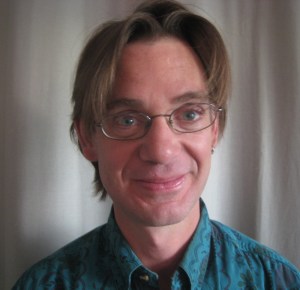
Lachlan Walter is a writer and nursery hand (the garden kind, not the baby kind), and has completed a PhD in the relationship between Australian post-apocalyptic fiction and national identity. His debut novel The Rain Never Came has just been released by Odyssey Books, and he also writes science fiction criticism for Aurealis magazine and reviews for the independent ‘weird music’ website Cyclic Defrost. He loves all things music-related, the Australian environment, overlooked genres, and playing in the garden.
Connect with Lachlan
Facebook ǀ Twitter ǀ Goodreads ǀ Website


 About the Book
 About the Author

 What Cathy Read Next...