
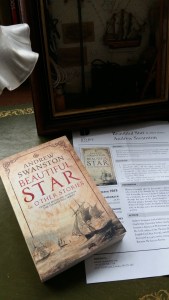
 I’m thrilled to be hosting today’s stop on the blog tour for Beautiful Star & Other Stories by Andrew Swanston. Andrew is the author of the exciting Thomas Hill series (The King’s Spy, The King’s Exile and The King’s Return) set in the English Civil War. Incendium, the first in a new series set in the 1570s featuring lawyer and spy Christopher Ratcliff, was published in February 2017 (as A. D. Swanston).
As well as my review of Beautiful Star & Other Stories, I’m delighted to bring you a fascinating interview with Andrew. Among other things, he talks about the most productive time for writing, the importance of detail to create historical authenticity and the benefits of ‘feet on the ground’ research.
 About the Book
History is brought alive by the people it affects, rather than those who created it.
In Beautiful Star we meet Eilmer, a monk in 1010 with Icarus-like dreams; Charles II, hiding in 1651, and befriended by a small boy; and Jane Wenham, the Witch of Walkern, seen through the eyes of her grand-daughter. This moving and affecting journey through time brings a new perspective to the defence of Corfe Castle, the battle of Waterloo, the siege of Toulon and, in the title story, the devastating dangers of a fisherman’s life in 1875.
In Beautiful Star & Other Stories Andrew Swanston brings history to life, giving voices to the previously silent – the bystanders and observers, the poor and the peripheral – and bringing us a rich and refreshing perspective on the past.
Format: Paperback (256 pp.) Publisher: The Dome Press
Published: 11th January 2018 Genre: Historical Fiction, Short Stories
Purchase Links*
Amazon.co.uk ǀ Amazon.com
*links provided for convenience, not as part of any affiliate programme
Find Beautiful Star & Other Stories on Goodreads
Interview with Andrew Swanston
The stories in Beautiful Star involve both real and imaginary characters. Which do you find the more difficult to write?
Interesting question. Imaginary characters are easier in that, within the historical framework of the story, they can do and say and think and look like whatever one wants them to. Real characters are easier in that they bring their personalities and their stories with them. Mixing the two is the most difficult task and what I like best.
What do you like about the short story format? What are its challenges?
In Beautiful Star, Julia Paterson tells her friend Willy Miller that flowers are neither wild nor tame, they are just flowers. So it is, for me, with stories – some longer, others shorter, but all just stories with plots and characters, beginnings, middles and endings. As a boy I loved the Sherlock Holmes stories. Strong characters, fast-moving plots, atmospheric but not very descriptive. Excellent examples of the art.
I’m sure that asking which of the stories in Beautiful Star you like best would be like asking you to choose a favourite child. Instead, I’ll ask which was the ‘naughtiest child’- the story you found most challenging to write, and why?
I think ‘A Witch and a Bitch’ was the most difficult because in making Jane Wenham’s imaginary grand-daughter the narrator I had to try to imagine the feelings of a teenage girl seeing her grandmother absurdly condemned to death in cruel circumstances three hundred years ago.
If you could be transported back in time to a period of history when and where would it be?
The seventeenth century – a time of conflict and change – has always appealed to me, which is why I wrote the Thomas Hill stories. During the War of the Three Kingdoms, I would have been a royalist and would have hoped to survive until the Restoration when the king and his court set a splendid example of debauchery and excess. Lovely.
You’ve written books set in the English Civil War (the Thomas Hill series), the Battle of Waterloo and, in your latest book Incendium, the reign of Elizabeth I. What attracts you to a particular historical period?
I am most interested in how major events such as the massacre of the Huguenots, the execution of Charles I or the return of Napoleon from Elba would have affected the daily lives of the people of the time. What would they have been thinking? Catholic retaliation in London, a republican tyranny, a French invasion? Poverty, starvation, disease?
What do you think is the key to creating an authentic picture of a particular historical period?
Detail, detail and more detail. Food, clothes, money, transport, anything and everything that enables the reader to ‘see’ a picture without its having to be described.
How do you approach the research for your books? Do you enjoy the process of research?
I love the research, especially meeting and talking to experts, who, without exception, I have found to be generous and supportive. I also love libraries, most of all The British Library. Best of all, though, is what I call ‘tramping the streets’ – visits to Malmesbury, Romsey, Waterloo, Stationers’ Hall, St Monans and elsewhere, often accompanied by my willing assistant (wife).
Do you have a special place to write or any writing rituals?
I write in my little study, usually with the door closed. That tells everyone that I am working and should only be disturbed if war has been declared. I have no particular rituals but am most productive in the pre-drinks hours of three to six.
What other writers of historical fiction do you admire?
At the head of a long and distinguished list of ‘auto-buys’ are C J Sansom, Robert Harris and Rory Clements. There are many others. [I agree. Those are some of my favourites too!]
What are you working on next?
The sequel to Incendium, set in 1574. I would very much like also to write another collection of shorter stories.
Thank you, Andrew, for those fascinating answers to my questions. Now, read on for my review of Beautiful Star & Other Stories….
My Review
In Beautiful Star, the author has taken what might have been considered footnotes in history and fashioned them into compelling, character-driven stories. I felt the stories really came alive when the author unleashed his writer’s imagination to conjure up the sights, sounds and smells of the period and to populate the historical fact with believable characters.
I simply devoured the stories in Beautiful Star and found something to enjoy, wonder at or be intrigued by in each of them.
In the title story, ‘Beautiful Star’, set in a Fife fishing village in 1875, the reader gets a wonderful insight into the lives of the fishermen and their families. There is fascinating detail about the craft of ship building (including the local boats known as Fifies), the seasonal nature of life in the village driven by the movement of shoals of fish and the colourful itinerant workers who flock to St Monans during ‘the Drave’, when the herring shoals congregate in the Forth of Fife. My favourite amongst these were the ‘fisher lassies’, who arrive to gut, sort and pack the herring. Spending most of their time up to their elbows in fish guts and salt, the leisure time of these tough, hardworking women is spent knitting, often while going for an evening stroll.
The fisherman prove to be superstitious folk with intriguing customs like starting every voyage with dry feet (prepare to be amazed by how this is achieved). But then, if you were setting sail in small boats for long periods of time then you’d probably be superstitious as well. In fact, the dangers of the sea and the potential impact on individual families and the whole village of disaster become all too clearly revealed. The story may be set in 1875, before satellite tracking and modern safety rules, but it still made me think of fisherman today and the perils they face on the open sea.
In ‘The Flying Monk’ we learn that experimentation with manned flight goes back further than you might think and did not start with the Wright Brothers. The protagonist of this story, a monk called Eilmer, also witnesses two sightings of Halley’s Comet. Such astronomical events were often viewed as harbingers of disaster. Observing the comet in 1066, the author has Eilmer remark, ‘It is a sign from God. Mark it well and be prepared. England’s enemies will come soon.’ He wasn’t wrong, was he?
A few highlights from other stories. In ‘HMS Association’, set in 1708, instinctive, local knowledge of the sea is dismissed resulting in tragedy, emphasising the limitations of navigation in inclement weather at the time. In ‘A Witch and a Bitch’, set in 1730, there is a reminder of how accusations of witchcraft were often directed at women viewed as ‘different’. As the accused woman remarks, “If they want to hang me, they will. An old woman on her own, they’ll find reasons enough if they choose.” In ‘The Castle’, set in the latter part of the English Civil War, the chatelaine of Corfe Castle steadfastly tries to carry out a vow made to her dead husband to defend the castle from Parliament’s forces. In the end, her future is determined by a man who thinks he knows better what’s good for her. No change there then. I particularly liked ‘A Tree’ set in 1651, probably the most impressionistic of the stories. In it, events of the Restoration are seen through the eyes of a 7-year-old boy who has a chance encounter with a mysterious stranger whilst perched in a tree.
The book’s description states that ‘history is brought alive by the people it affects’. I think the final story in the collection, ‘The Button Seller and the Drummer Boy’, set at the Battle of Waterloo, illustrates this really well. It’s easy to forget that war, as well as bringing death and destruction, is also a source of business opportunity for some. Such is the case for our button seller, whose travels through France and Belgium in search of orders for his company’s buttons for military uniforms, brings him to the site of the battle as it rages. He is confronted by the realities of war; that smart uniforms bearing the correct regimental buttons mean nothing in the face of bullets, sabres and cannon fire and will ultimately end up being valued only by those plundering bodies.
I really loved Beautiful Star & Other Stories and would recommend the collection for any lover of history (I think it might even convert some people who think history is dull) and those for whom the lives of the people who fought in a battle are more interesting than the battle itself. I really hope Andrew is true to his answer to my final interview question and writes another collection soon.
My grateful thanks to The Dome Press for my review copy, in return for my honest and unbiased review.
In three words: Fascinating, intimate, thought-provoking
Try something similar…The Path of the King by John Buchan
 About the Author
Andrew read a little law and a lot of sport at Cambridge University, and held various positions in the book trade, including being a director of Waterstone & Co and Chairman of Methven’s plc, before turning to writing. Inspired by a lifelong interest in early modern history, his Thomas Hill novels are set during the English Civil War and the early period of the Restoration. Andrew’s novel Incendium was published in February 2017 and is the first of two thrillers featuring Dr. Christopher Radcliff, an intelligencer for the Earl of Leicester, and is set in 1572 at the time of the massacre of the Huguenots in France.
Connect with Andrew
Website ǀ Facebook ǀ Twitter ǀ Goodreads


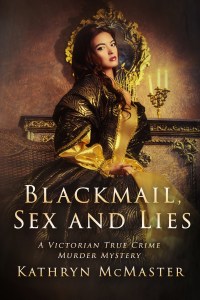
 Why not enter my giveaway with a chance to win your own ebook copy of Blackmail, Sex and Lies. To enter, click
  About the Book
 About the Author

 What Cathy Read Next...