#BookReview Storyland: A New Mythology of Britain by Amy Jeffs

StorylandAbout the Book

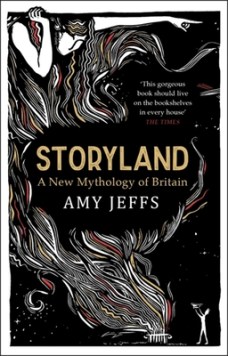
Soaked in mist and old magic, Storyland is a new illustrated mythology of Britain, set in its wildest landscapes.

It begins between the Creation and Noah’s Flood, follows the footsteps of the earliest generation of giants from an age when the children of Cain and the progeny of fallen angels walked the earth, to the founding of Britain, England, Wales and Scotland, the birth of Christ, the wars between Britons, Saxons and Vikings, and closes with the arrival of the Normans.

These are retellings of medieval tales of legend, landscape and the yearning to belong, inhabited with characters now half-remembered. Told with narrative flair, embellished in stunning artworks and glossed with a rich and erudite commentary.

We visit beautiful, sacred places that include prehistoric monuments like Stonehenge, mountains such as Snowdon and rivers including the story-silted Thames in a vivid collection of tales of a land steeped in myth. It Illuminates a collective memory that still informs the identity and political ambition of these places.

In Storyland, Jeffs reimagines these myths of homeland, exile and migration, kinship, loyalty, betrayal, love and loss in a landscape brimming with wonder.

Format: Paperback (400 pages)              Publisher: Quercus
Publication date: 27th September 2022 Genre: Nonfiction

Find Storyland: A New Mythology of Britain on Goodreads

Purchase links
Bookshop.org
Disclosure: If you buy a book via the above link, I may earn a commission from Bookshop.org, whose fees support independent bookshops

Hive | Amazon UK
Links provided for convenience only, not as part of an affiliate programme


My Review

Storyland was the June pick for the book club hosted by the Reading branch of Waterstones. Despite the praise it has garnered elsewhere, including being shortlisted as a Waterstones Book of the Year, the response from all book club members was overwhelmingly lukewarm. In fact, I was probably the least lukewarm of us all.

The format of the book, in which the author’s retelling of a myth is followed by details of its historical sources, wasn’t popular. Many would have preferred just the myths with the historical detail in a separate section at the end of the book (or omitted altogether). I was in the minority as I actually liked finding out the sources behind each myth. Having said that, many of the stories rely heavily on a limited number of sources, few of which are contemporary.  The occasional sections describing the author’s visits to sites mentioned in the stories were interesting. Quite a few of the book club members hadn’t realised there was a map on the inside flap of the book’s cover and some of those who had didn’t find it that useful. Personally, I think it did help to situate the stories given the use of ancient and unfamiliar names for some of the areas of Britain.

In the Prologue the author writes, ‘You are entering a work of legend, based on medieval tales of Britain’s foundation and settlement that bear only a passing resemblance to “true” history’. This was part of our difficulty with the book because some of the myths were so unfamiliar to us it was difficult to discern the degree of invention the author had brought to the retelling.  My favourite parts of the book were the first section in which the author details the various myths surrounding the first arrivals from the East (including giants) on the islands we now know as Britain and Ireland. Pretty much everyone liked the stories featuring Merlin, perhaps because we felt on more familiar ground. (Interestingly, the story involving Merlin’s prophecy of the manner of his death turns up in the invented ‘Book of Conach’ featured in James Robertson’s News of the Dead, the winner of this year’s Walter Scott Prize for Historical Fiction.) Many other stories felt repetitive, just a series of kings with strange names killing other kings with strange names in order to usurp their thrones or seek revenge. In the main, women are valued merely for their beauty, their fertility, their status as the daughters of kings or nobles and are often the victims of trickery.

As I mentioned above, the book has received very positive reviews and we did spend time discussing what it was we were all missing, without coming to any firm conclusion! The consensus was that reading the book had felt like hard work and the author’s obvious passion for her subject hadn’t translated into an enjoyable reading experience. Despite our reservations, everyone agreed the striking linocut illustrations that accompany the text are wonderful and, in fact, would make an attractive book in their own right.

In three words: Detailed, creative, scholarly

Try something similar: The Golden Bough by James George Frazer (book club member recommendation)

Follow this blog via Bloglovin


Amy JeffsAbout the Author

Amy Jeffs is an artist and art historian specialising in the Middle Ages. In 2019, she gained a PhD in Art History from Corpus Christi College, Cambridge, having studied for earlier degrees at the Courtauld Institute of Art and the University of Cambridge.

During her PhD Amy co-convened a project researching medieval badges and pilgrim souvenirs at the British Museum. She then worked in the British Library’s department of Ancient, Medieval and Early Modern manuscripts. Storyland is her first book. (Photo: Twitter profile)

Connect with Amy
Twitter

#BookReview Portable Magic by Emma Smith

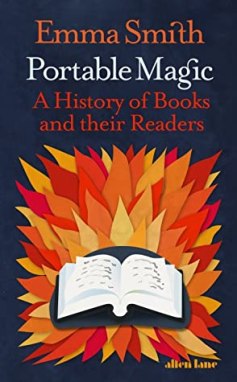
Portable MagicAbout the Book

Most of what we say about books is really about the words inside them: the rosy nostalgic glow for childhood reading, the lifetime companionship of a much-loved novel. But books are things as well as words, objects in our lives as well as worlds in our heads. And just as we crack their spines, loosen their leaves and write in their margins, so they disrupt and disorder us in turn. All books are, as Stephen King put it, ‘a uniquely portable magic’. Here, Emma Smith shows us why.

Portable Magic unfurls an exciting and iconoclastic new story of the book in human hands, exploring when, why and how it acquired its particular hold over humankind. Gathering together a millennium’s worth of pivotal encounters with volumes big and small, Smith reveals that, as much as their contents, it is books’ physical form – their ‘bookhood’ – that lends them their distinctive and sometimes dangerous magic. From the Diamond Sutra to Jilly Cooper’s Riders, to a book made of wrapped slices of cheese, this composite artisanal object has, for centuries, embodied and extended relationships between readers, nations, ideologies and cultures, in significant and unpredictable ways.

Exploring the unexpected and unseen consequences of our love affair with books, Portable Magic hails the rise of the mass-market paperback, and dismantles the myth that print began with Gutenberg; it reveals how our reading habits have been shaped by American soldiers, and proposes new definitions of a ‘classic’ – and even of the book itself. Ultimately, it illuminates the ways in which our relationship with the written word is more reciprocal – and more turbulent – than we tend to imagine.

Format: Hardback (352 pages)      Publisher: Allen Lane
Publication date: 28th April 2022 Genre: Nonfiction

Find Portable Magic: A History of Books and their Readers on Goodreads

Purchase links
Bookshop.org
Disclosure: If you buy a book via the above link, I may earn a commission from Bookshop.org, whose fees support independent bookshops

Hive | Amazon UK
Links provided for convenience only, not as part of an affiliate programme


My Review

Portable Magic is a fascinating, in-depth examination of books as physical objects, from their earliest incarnation as collections of scrolls or wax tablets to modern paperbacks and, yes, ebooks.  The blurb gives you an idea of the breadth of the book’s subject matter and this review would itself be as long as a book if I mentioned everything of interest I found within its pages. Therefore, I’ve confined myself to picking out a few things that caught my eye in various chapters.

  • Precursors to the paperback were softback editions designed especially for the armed forces that would fit neatly into the pocket of a uniform
  • Annuals and highly decorated gift books were the first commercial products designed to be given away by the purchaser
  • Book tokens emerged to alleviate the ‘stress’ of choosing books as gifts
  • ‘Shelfies’ have a long history with figures such as Madame de Pompadour being depicted holding books or with books in the background. Marilyn Monroe was famously photographed holding a copy of James Joyce’s Ulysses that it looks like she’s a fair way through.
  • There is ‘a gestural vocabulary’ associated with handling books, e.g. turning pages from the corner far edge, using a finger or marker to refer to different points, flexing a spine to make it stay open.
  • Book burning has taken place for purposes other than censorship including as part of waste management, at the hands of a book’s author, for publicity or as part of a ritual.
  • As the case of Lady Chatterley’s Lover showed, efforts to ban books are often good for sales.
  • Books can have a talismanic quality. During the First World War, steel covered Bibles designed to be carried in the breast pocket were widely advertised as gifts for servicemen.
  • Bibliomancy is the act of opening a book at random for prophetic wisdom.
  • When we read a book, thousands of microscopic particles of our DNA rub off on its pages. ‘Inside each book, there is a miniscule, uncatalogued but carefully preserved library of its human handlers.’
  • E-readers, the author argues, want to be books. ‘Text is presented in vertical orientation (an e-reader is portrait, rather than landscape, in format), pages are flipped from right to left to move sequentially through the text and there is a facility to bookmark or underline particular passages.’

Those of us for whom books play a significant part in our lives will surely identify with the following passage. ‘We are all made up of the books we have loved and, more, of the books we have owned, gifted, studied, revered, lived by, lost, thrown aside, dusted, argued over, learned by heart, borrowed and never returned, failed to finish and used as doorstops or to raise a computer monitor.’

The fact that nearly fifty pages are taken up with notes and index demonstrates that Portable Magic is the product of extensive research. Although there were one or two points where there was perhaps a little too much detail, I found Portable Magic an absolutely fascinating read.

I received an advance reader copy courtesy of Allen Lane via Readers First.

In three words: Informative, erudite, expansive

Follow this blog via Bloglovin


About the Author

Emma Smith was born and brought up in Leeds, went unexpectedly to university in Oxford, and never really left. She is now Professor of Shakespeare Studies at Hertford College and the author of the Sunday Times bestseller This Is Shakespeare. She enjoys silent films, birdwatching, and fast cars.

Connect with Emma
Twitter