
 About the Book
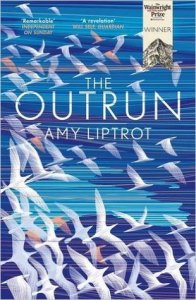
At the age of thirty, Amy Liptrot finds herself washed up back home on Orkney. Standing unstable on the island, she tries to come to terms with the addiction that has swallowed the last decade of her life. As she spends her mornings swimming in the bracingly cold sea, her days tracking Orkney’s wildlife, and her nights searching the sky for the Merry Dancers, Amy discovers how the wild can restore life and renew hope.
Format: Paperback (286 pages) Publisher: Canongate Books
Publication date: 2018 [2016] Genre: Memoir
Purchase Links*
Amazon.co.uk | Amazon.com | Hive (supporting UK bookshops)
*links provided for convenience, not as part of any affiliate programme
Find The Outrun on Goodreads
My Review
The author describes in unflinching detail the impact of alcoholism on all aspects of her life and the harmful and reckless behaviour she engaged in as a result. Having reached the lowest of low points, she shows remarkable courage in embarking on a treatment programme and taking the first difficult steps to sobriety.
Returning to Orkney where she grew up (from where she had originally fled in search of a more exciting life in London) the author slowly starts to rebuild her life. The really interesting and engaging aspect of the book is the connections she makes between her observations of the natural world around her and her recovery process. For example: ‘When I first came back to Orkney I felt like the strandings of jellyfish, laid out on the island rocks for all to see. I was washed-up: no longer buoyant, battered and storm-tossed.’
Testing herself still further, she moves to one of the remote islands off Orkney – Papay – and becomes involved in the life of its small community of hardy souls. She discovers an interest in astronomy, wild swimming, snorkelling, folklore and the birds and other creatures that make the island and the sea that surrounds it their home. Or, as the author puts it, ‘In these two years I have put my energy into searching for elusive corncrakes, Merry Dancers and rare cloud; into swimming in cold seas, running naked around stone circles, sailing to abandoned islands, flying on tiny planes, coming back home’.
The message I took from the book is that, even at one’s lowest point, there is always the possibility of something better. I found that both moving and inspiring. I’ll leave you with a few quotes that will, I hope, give you a sense of this.
‘Since I got sober, I sometimes find myself surprised and made joyful by normal life… Life can be bigger and richer than I knew.’
‘Recovery is making use of something once thought worthless. I might have been washed-up but I can be renewed.’
The Outrun is the third book on my reading list for Nonfiction November.
In three words: Unflinching, honest, inspiring
Try something similar: The Salt Path by Raynor Winn
About the Author
Amy Liptrot has published her work with various magazines, journals and blogs and she has written a regular column for Caught by the River out of which The Outrun emerged. As well as writing for newspapers including the Guardian and the Observer, Amy has worked as an artist’s model, a trampolinist and in a shellfish factory. The Outrun was awarded the 2016 Wainwright Prize and the 2017 PEN Ackerley Prize and was shortlisted for the 2016 Wellcome Prize and the 2017 Ondaatje Prize.
Connect with Amy
Website | Twitter



 What Cathy Read Next...