
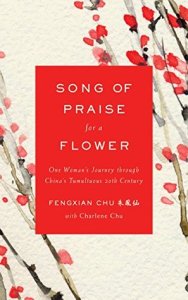
 About the Book
For nearly two decades, this manuscript lay hidden in a Chinese bank vault until a long-lost cousin from America inspired 92-year-old author Fengxian Chu to unearth it.
Song of Praise for a Flower traces a century of Chinese history through the experiences of one woman and her family, from the dark years of World War II and China’s civil war to the tragic Great Leap Forward, Cultural Revolution, and beyond. It is a window into a faraway world, a sweeping epic about China’s tumultuous transformation and a harrowing yet ultimately uplifting story of a remarkable woman who survives it all and finally finds peace and tranquillity.
Chu’s story begins in the 1920s in an idyllic home in the heart of China’s rice country. Her life is a struggle from the start. At a young age, she defies foot-binding and an arranged marriage and sneaks away from home to attend school. Her young adulthood is thrown into turmoil when the Japanese invade and ransack her village. Later her family is driven to starvation when Mao Zedong’s Communist Party seizes power and her husband is branded a ‘bad element.’ After Mao’s death in the 1970s, as China picks up the pieces and moves in a new direction, Chu eventually finds herself in a glittering city on the sea adjacent to Hong Kong, worlds away in both culture and time from the place she came from.
Format: eBook, paperback (488 pp.) Publisher:
Published: 21st November 2017 Genre: Memoir, History, Non-Fiction
Purchase Links*
Amazon.co.uk ǀ Amazon.com
*links provided for convenience, not as part of any affiliate programme
Find Song of Praise for a Flower on Goodreads
My Review
Sometimes you read a book that puts everyday petty concerns into perspective. Song of Praise for a Flower is such a book.
The subtitle ‘One Woman’s Journey through China’s Tumultuous 20th Century’ barely does justice to the remarkable story of Fengxian Chu contained within the book. It’s a story that her cousin, Charlene Chu, helped translate from manuscript into book form, adding historical and cultural context where necessary but never losing Fengxian’s powerful narrative voice.
Fengxian’s story takes the reader on a journey from the constraints of a traditional Chinese upbringing through separation, bereavement, ostracism, poverty, near starvation, physical hardship and cruelty – some at the hands of individuals and even family members, some at the hands of the state. Such is the suffering depicted, that at times it is definitely not an easy read.
However, it’s also compelling as a story of determination, fortitude, love and triumph over adversity. It’s also a source of great wisdom:
- ‘One important lesson I have learned is that happiness does not fall from the sky; it is earned through painstaking effort.’
- ‘Age gives us wisdom, but it doesn’t always give us answers.’
- ‘Life can be a song or a whine. I prefer to sing.’
Along the way, the reader learns much about Chinese culture, customs and ways of thinking and the events of a period of extraordinary political and cultural change in China’s history. Probably the aspect I found most difficulty with was Fengxian’s seemingly fatalistic attitude to life. Even when poverty results in family bereavement, she ascribes this to ‘bad fate’, believing ‘good fate’ would have seen the bereaved born into a wealthier family. To me, this seemed to contradict some of Fengxian’s belief in the importance of effort in attaining happiness.
How Fengxian survived what she did and lived to tell the tale is both amazing and inspiring. In her dedication, Fengxian writes: ‘It is my own belief that one of the most priceless possessions one has in this world is his or her story. Each life is a drama. Some scenes are sweet and joyful, others tragic and sad. But what is most important is one’s performance…reaction in the face of adversity, and…willingness to participate.’
Judge for yourself by reading an excerpt from the book here.
I was introduced to the opportunity to read this book thanks to Penny at Author Marketing Expert and received a review copy courtesy of its co-author, Charlene Chu. Song of Praise for a Flower was a book I read for the Nonfiction November reading challenge.
In three words: Inspiring, dramatic, uplifting
Try something similar… (fiction) The Good Earth by Pearl S. Buck or (nonfiction) The Inn of the Sixth Happiness [original title: The Small Woman] by Alan Burgess
About the Author – Fengxian Chu
Raised in Hunan Province, China, Fengxian Chu spent most of her life living and working on a farm. She attended college briefly, but her education was interrupted when the Japanese army invaded her village in the 1940s. A writer and poet from a young age, she is unique among her generation of rural Chinese women, the majority of whom never attended school and are illiterate. Song of Praise for a Flower is Fengxian’s first work to be published, and among the only known first-person accounts from a woman of her generation about life during China’s turbulent past century. Now in her 90s, she enjoys gardening and spending time with her children, grandchildren, and great grandchildren. She resides in Shenzhen, China.
 About the Author – Charlene Chu
Co-author Charlene Chu, Fengxian’s first cousin, grew up in the United States and wrote the English rendering of Song of Praise for a Flower. A financial analyst well-known for her work on China’s economy and financial sector, she is quoted widely in the Wall Street Journal, Financial Times, Bloomberg, Business Insider and other media outlets. She holds an MBA and MA in International Relations from Yale University. Song of Praise for a Flower is her first book. Charlene splits her time between Washington, DC and Hong Kong. (Photo credit: Goodreads author page)
Connect with Charlene

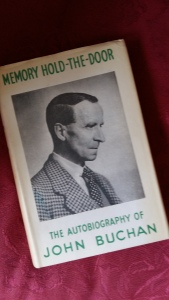 What follows is an introduction to the book. It is also an excuse to show a picture of my lovely 1964 edition of the book complete with dust jacket*. I will be posting my review of the book later in the month.
 What Cathy Read Next...