
I recently read Edith Wharton’s The House of Mirth and glimpsed just a little of the complexities of navigating a path through the upper echelons of American society in the so-called Gilded Age. So I was thrilled when the opportunity arose to learn about the fact behind the fiction and join the blog tour for Julie Ferry’s The Million Dollar Duchesses. Subtitled How America’s Heiresses Seduced the Aristocracy, you can read my review of this fascinating book below.
Do check out the tour schedule at the bottom of this post for details of the other great book bloggers taking part in the tour.
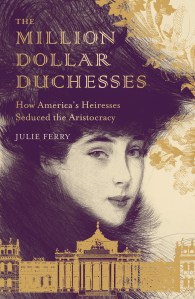 About the Book
‘The American girl has the advantage of her English sister in that she possesses all that the other lacks…’ – Titled Americans
On 6th November 1895, the young and brilliant heiress Consuelo Vanderbilt wedded the near-bankrupt Charles Spencer-Churchill, 9th Duke of Marlborough. A dazzling yet miserable match was made – one which glittered above all others for high society’s unofficial marriage brokers who, in a single year, initiated and manipulated a series of spectacular transatlantic pairings. Injecting millions of dollars into the ailing aristocracy; fame, money, power and prestige were all at play.
Characterised by scandal, illicit affairs, spurned loves and unexpected deaths, The Million Dollar Duchesses reveals the machinations which led to these most influential matches between America’s heiresses and Britain’s elite. The Gilded Age was a tumultuous period for society’s most eligible.
(The book was previously published under the title The Transatlantic Marriage Bureau)
Format: Paperback (320 pp.) Publisher: Aurum Press
Published in UK: 3rd May 2018 Genre: Non-Fiction, History
Pre-order/Purchase Links*
Amazon.co.uk ǀ Amazon.com ǀ Hive.co.uk (supporting UK bookshops)
*links provided for convenience, not as part of any affiliate programme
Find The Million Dollar Duchesses on Goodreads
My Review
The Million Dollar Duchesses focuses on the events of a single year – 1895 – in which a number of transatlantic marriages took place between wealthy American heiresses and not so wealthy but titled British aristocrats. Unfortunately for the participants, very few were love matches but more akin to business transactions, negotiated by a select band of very influential society ladies, including the redoubtable Alva Vanderbilt, Consuelo Manchester and Minnie Paget.
Manoeuvring young American heiresses into situations where they could encounter potential marriage partners was a strategic operation. ‘All of London society was a convoluted and never-ending performance. The unremitting rounds of formal functions were littered with the great and the good of the aristocracy, whom Minnie saw simply as props to be manoeuvred into the best position to produce a breathtaking show.’ It was also a lucrative, albeit clandestine, business for these society ‘matchmakers’, who would be rewarded with gifts or might have their dressmaker’s or milliner’s accounts settled by grateful relatives.
I came across some fascinating nuggets of information in the book, such as the fact that those fortunate enough to have the Prince of Wales stay with them would be obliged to install in their home a ‘Post Office to meet his communication needs’. I was also frankly in awe of the stamina of these society ladies who not only underwent up to six changes of outfit a day during the Season but were expected to attend a dizzying round of activities. For example, the ‘strict timetable’ of a day in the summer Season at Newport, Rhode Island might involve breakfast, dealing with correspondence, a morning call at the Casino for tennis or bowling, bathing at the exclusive Bailey’s Beach, luncheon on a yacht moored in the harbour, an afternoon carriage parade, visits to other ladies followed by preparing for the evening’s formal dinner party or ball and then dancing the night away. On the other hand, I could not admire the vast sums of money spent on flowers, gifts, jewellery and dresses that might only be worn once, which seemed to verge on the grotesque. No, actually, it was grotesque.
As the author notes, at a time when ‘men were rulers of Wall Street and women were discouraged from asserting themselves in business or politics, marriage was their only route to power’. I have to say I was left with the impression that, in many cases, the women featured were more intelligent, cultured and accomplished than the supposedly eligible bachelors they were destined to marry and might well have proved equal to those men in business or politics.
We talk today about ‘celebrity culture’ but I also found it interesting that scrutiny by the media of these society figures seemed as prevalent then as it is today and that there was a degree of mutual dependence. The great society ladies needed their entertainments, costume balls and the like to be featured in the newspapers and gossip columns of the day to confirm their position in society. ‘It was a chance to be seen by reporters, society watchers and the general public. An opportunity to be talked about, written about and remain a constant presence in public consciousness.’ Finding and sustaining your position in the ‘pecking order’ was a competitive endeavour worthy of the Olympic Games!
The book is clearly the product of extensive research by the author, as witnessed by the comprehensive notes and detailed bibliography at the end of the book. Also included is a helpful dramatis personae and family trees of the key players. The book includes quotes from contemporary newspaper articles, gossip columns, letters and memoirs although the author freely admits that there are limited primary sources because many of the heiresses’ personal recollections have not survived, possibly because they were deliberately destroyed after their deaths. From time to time, the author indulges in speculation about the feelings and emotions of some of the characters meaning those sections are sprinkled with phrases such as ‘must have’, ‘would have’ and ‘in all probability’.
The Million Dollar Duchesses is a fascinating insight into the lives of women who changed the face of British society at the end of the 19th century and inspired fictional counterparts in novels such as Edith Wharton’s The Buccaneers and The House of Mirth.
I received a review copy courtesy of the author, publishers Aurum Press and Anne Cater at Random Things Tours in return for an honest and unbiased review.
In three words: Fascinating, detailed, informative
Try something similar…The Buccaneers by Edith Wharton
 About the Author
Julie Ferry is a freelance journalist who has written for the Guardian, Sunday Times, Sunday Telegraph and the Independent, among others. She writes on subjects ranging from protecting women’s rights to discovering Paris alone. She graduated from Cardiff University with a degree in English Literature and then upped sticks and moved to a tiny island between Japan and South Korea to teach English, where she quickly got used to being followed around the supermarket by her students. It was in Japan that she got her first by-line and was quickly hooked. Since then, she’s been fortunate to write for most of her favourite publications, but always harboured dreams of seeing her name on the front of a book. Now, she’s managing to combine her love of writing and an obsession with interesting and largely unknown women from history, with the school run in Bristol, where she lives with her husband and two children.
Connect with Julie
Website ǀ Facebook ǀ Twitter ǀ Goodreads

 About the Book
 What Cathy Read Next...