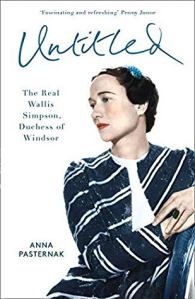
#BookReview Untitled: The Real Wallis Simpson by Anna Pasternak

UntitledAbout the Book

Who was the real Wallis: an opportunistic American social climber, a master manipulator or the true love of Edward’s life? Amid the cacophony of condemnation her story has become obfuscated. Untitled is an intimate biography of one of the most misunderstood women in British royal history.

His charisma and glamour ensured him the status of a rock star prince. Yet Edward gave up the British throne, the British Empire and his position as Emperor of India, to marry his true love, American divorcee Wallis Simpson.

So much gossip and innuendo has been levelled at Wallis Simpson that it has become nearly impossible to discern the real woman. Many have wondered why, when Edward could have had anyone he desired, he was smitten with this unusual American woman. As her friend Herman Rogers said to her in 1936 when news of her affair with Edward broke: ‘Much of what is being said concerns a woman who does not exist and never did exist.’

History is mostly perceived from the perspective of his-story. But what about her story? Anna Pasternak’s new book is the first ever to give Wallis a chance and a voice to show that she was a warm, loyal, intelligent woman adored by her friends, who was written off by cunning, influential Establishment men seeking to diminish her and destroy her reputation. As the author argues, far from being the villain of the abdication, she was the victim.

Anna Pasternak is appearing at Henley Literary Festival 2019

Format: e-book (369 pp.)    Publisher: William Collins
Published: 7th March 2019   Genre: Biography, History, Nonfiction

Purchase Links*
Amazon.co.uk  ǀ Hive.co.uk (supporting UK bookshops)
*links provided for convenience, not as part of any affiliate programme

Find Untitled: The Real Wallis Simpson, Duchess of Windsor on Goodreads


My Review

Anna Pasternak nails her colours pretty unashamedly to the mast when she talks about the book being fuelled by a desire to rehabilitate Wallis in history. Untitled paints the Duchess of Windsor in a positive light, putting forward her side of the story and attempting to quash some, if not all, of the accusations that have been levelled at her. The list of sources and references at the back of the book demonstrate the detailed research undertaken by the author.

I was surprised to learn of the extremes to which the government went in their opposition to the relationship between Edward and Wallis Simpson, including listening in to their private telephone conversations.

However, I was left with a picture of two people so wrapped up in each other that the impact of their actions on others ceased to matter or just simply did not occur to them. At times, the behaviour of Wallis and Edward was either naive or bordered on the crass and their lavish lifestyle was far removed from the experience of the majority of Edward’s subjects. However, no-one with any feelings would surely wish for them the sadness of their final years – declining health, exile and manipulation by others.

Untitled is also the story of a family torn apart by a decision regarded variously as an act of selfishness, betrayal and a failure of duty. The author depicts how the refusal by his mother, Queen Mary, to receive Wallis or even acknowledge her and the decision not to grant the Duchess HRH status became totemic issues for Edward, creating a rift in the Royal Family that was never repaired in his lifetime.

In the Afterword, the author observes that she found herself warming to Edward during the process of researching and writing the book. I’m afraid this reader had the opposite experience. If anything, Edward comes out diminished to my mind. His blind devotion to Wallis is touching but tainted by his seemingly single-minded belief that he should have whatever he wanted in life, regardless of the consequences. As the author observes, ‘His love for Wallis was as selfish and as crucial to his survival as a child’s; it would have been the more loving act to have relinquished her‘.

As for Wallis? I think the author sums it up when she comments, ‘She [Wallis] was powerful – in her effect on Edward – but powerless, in her inability to prevent events from spiralling out of control’.

I received a review copy courtesy of William Collins via NetGalley.

Follow my blog with Bloglovin

In three words: Fascinating, detailed, intimate

Try something similarChanel’s Riviera: The Cote d’Azur in Peace and War, 1930 – 1944 by Anne de Courcy


About the Author

Anna Pasternak is an author, columnist and journalist. She writes regularly for Sunday Times Style, Conde Nast Traveller, Harper’s Bazaar, and others. She lives in Oxfordshire with her husband and daughter.

Book Review: In My Life – A Music Memoir by Alan Johnson

In My Life SignedAbout the Book

From being transported by the sound of ‘True Love’ by Bing Crosby and Grace Kelly on the radio, as a small child living in condemned housing in ungentrified West London in the late 1950s, to going out to work as a postman humming ‘Watching the Detectives’ by Elvis Costello in 1977, Alan Johnson’s life has always had a musical soundtrack. In fact music hasn’t just accompanied his life, it’s been an integral part of it.

In the bestselling and award-winning tradition of This Boy, In My Life vividly transports us to a world that is no longer with us – a world of Dansettes and jukeboxes, of heartfelt love songs and heart-broken ballads, of smoky coffee shops and dingy dance halls. From Bob Dylan to David Bowie, from Lonnie Donnegan to Bruce Springsteen, all of Alan’s favourites are here. As are, of course, his beloved Beatles, whom he has worshipped with undying admiration since 1963.

But this isn’t just a book about music. In My Life adds a fourth dimension to the story of Alan Johnson the man.

Format: Hardcover (272 pp.)    Publisher: Bantam Press
Published: 20th September 2018   Genre: Non-Fiction, Memoir

Find In My Life: A Music Memoir on Goodreads

Purchase Links*
Amazon.co.uk  ǀ  Amazon.com  ǀ Hive.co.uk (supporting UK bookshops)
*links provided for convenience, not as part of any affiliate programme


My Review

As the reader quickly discovers, music has always been an integral part of Alan Johnson’s life. The book covers the period from 1957 to 1982 (he was born in 1950) so overlaps with the first two volumes of his memoirs, This Boy and Please Mr. Postman. Those who’ve read either of those books may feel there’s some repetition. I’ve only read the third volume, The Long and Winding Road (although you can read my husband’s review of Please Mr. Postman here) but reading the early chapters of In My Life with its poignant picture of Alan’s deprived childhood has only increased my interest in reading This Boy.

Each chapter of the book is linked to a song. As Alan explains, they’re not necessarily his favourite pieces of music but are songs that evoke particular memories of his life at that time. For example, listening to Two-Way Family Favourites on the family’s Bakelite wireless, playing 78’s on his sister’s Dansette record player, acquiring his first guitar or hearing about the death of John Lennon. As I said, the early chapters demonstrate how for Alan, and his sister, Linda, music was a distraction from the day to day difficulties of growing up in poverty, with a mother who suffered serious ill-health, domestic violence and eventually abandonment at the hands of their loser of a father.

Starting with ‘True Love’ by Bing Crosby and Grace Kelly, the book charts the evolution of popular music as experienced by Alan and other members of his generation.  He observes that before Lonnie Donnegan and Tommy Steele came on the scene there was no real youth music culture in Britain.  Their arrival signalled a huge change as singer/songwriters such as Lennon & McCartney replaced artists who sang songs written by other people.

The book charts another huge change, namely in how people listen to music.  Previously, it was largely on the radio, more likely than not the Light Programme on the BBC.  Gradually there became a ‘materiality’ about how people experienced music. Alan recalls polishing shellac 78s, reading record labels and playing records at the wrong speed on the Dansette. Later in the book, acquiring his first audio cassette, he reflects:

There is a connection between the music and the object on which it is stored. Just as those shellac 78s, and the Bachelors’ album bought for Lily [his mother] which she didn’t live to hear, had a significance of their own, so did the humble cassette. The physical shape and feel of it, the ritual of taking it out of its plastic case and snapping it into the cassette-player, peering myopically at the tiny type of the “sleeve notes” …’

The book is also an account of Alan’s own musical career which, it has to be said, seems to have had more than its fair share of setbacks such as having musical gear stolen on multiple occasions, including his treasured Hӧfner Verithin guitar. Alan joined his first band The Vampires in the hope (largely unsuccessful) of impressing girls before being invited to join The In Between, a multi-racial group with a (rare at the time) female lead singer. With his trademark self-deprecating humour, Alan recalls his unrequited passion for Carmen, the lead singer, with whom he duetted on their cover version of The Troggs’ Wild Thing:

Carmen and I were born to duet on that song, destined to be together in the centre of that stage. It should have forged the deepest, most volcanic passion since Cathy met Heathcliff. There was only one problem. Carmen was totally and absolutely uninterested in me. She was completely immune to what I was convinced was a magnetic and irresistible charm.’

Although Lonnie Donnegan retains a special place as the musical hero of Alan’s childhood, the Beatles and David Bowie as the heroes of his teen years and twenties respectively, he reserves his ‘lifetime achievement award’ for Elvis Costello. Fittingly therefore, and in another example of that self-deprecating humour, it is Elvis Costello who marks the end of Alan’s ambition to make it as a rock star. Alan decides to send Elvis ‘the creme de la creme’ of his ‘song-writing genius’. As he recalls, ‘I wrote a nice letter to Elvis, listing the song titles along with my name and address, and sent it off by first-class post in November 1982. I’m still waiting to hear back.’

As with Alan Johnson’s other memoirs, In My Life is immensely readable, honest, warm and witty. Alan appeared at Henley Literary Festival 2018. You can read my review of the event here.

In My Life is book number 6 of my 20 Books of Summer.


Alan JohnsonAbout the Author

Alan Johnson was born in May 1950.  He was General Secretary of the Communication Workers Union before entering Parliament as Labour MP for Hull West and Hessle in 1997.  He served as Home Secretary from June 2009 to May 2010.  Before that, he filled a wide variety of cabinet positions in both the Blair and Brown governments, including Education and Health.  His first memoir, This Boy, was published in May 2013 and won the RSL Ondaatje Prize and the Orwell Prize.  Alan’s latest book, In My Life: A Music Memoir, was published in September 2018.  (Photo credit: Goodreads author page)

20 Books of Summer 2019