
Book Review – The Wager: A Tale of Shipwreck, Mutiny and Murder by David Grann

About the Book

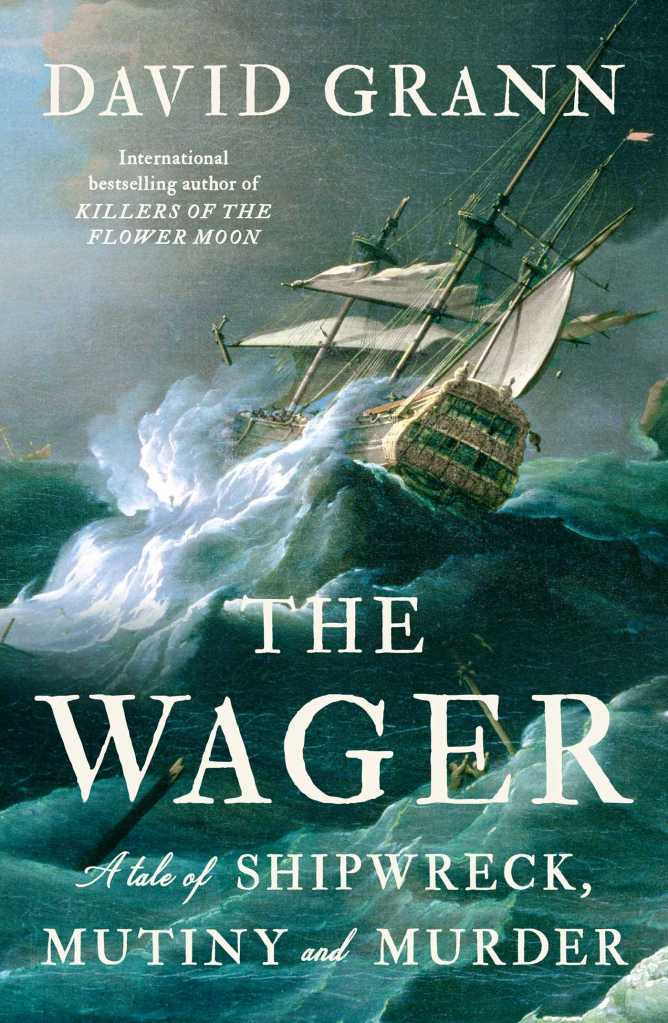
Book cover of The Wager by David Grann

1742: A ramshackle vessel of patched-together wood and cloth washes up on the coast of Brazil. Inside are thirty emaciated men, barely alive. Survivors from the Wager, a British vessel wrecked while on a secret mission to raid a Spanish treasure-filled galleon, they have an extraordinary tale to tell.

Six months later, an even more decrepit boat comes ashore on the coast of Chile, containing just three castaways with their own, very different account of what happened. The thirty sailors who landed in Brazil, they maintain, were not heroes – they were mutineers.

As accusations of treachery and murder fly, who is telling the truth? The stakes are life-and-death – for whoever is guilty could hang.

Format: Paperback (368 pages) Publisher: Simon & Schuster
Publication date: 18th April 2023 Genre: Nonfiction, History

Find The Wager on Goodreads

Purchase The Wager from Bookshop.org [Disclosure: If you buy books linked to our site, we may earn a commission from Bookshop.org, whose fees support independent bookshops.]


My Review

This was a book club pick and a rare non-fiction read for me. I really enjoyed it, as did the majority of my fellow readers. It’s a thrilling story of endurance and the will to survive with, it has to be said, some harrowing scenes in parts. It’s also a thought-provoking exploration of human behaviour under extreme circumstances.

The author’s meticulous research is obvious; you only have to look at the extensive notes and bibliography which make up nearly one hundred pages of the book to see that. Although the book is overflowing with maritime facts, including the origin of some commonly used phrases, it’s not a dry read. For example, this description of the toll on the Wager‘s structure of the rough seas they encounter: ‘Every day she was being devoured… She was pelted and gouged. She pitched, she heaved, she groaned, she splintered.’ Or this, when the ship is finally pitched onto the rocks of what will come to be known as Wager Island: ‘The bowsprit cleaved, windows burst, treenails popped, planks shattered, cabins collapsed, decks caved in.’

It has to be said that on the voyage the Wager’s crew experienced just about everything nature could throw at them as well as outbreaks of typhus and scurvy that cut a deadly swathe over the ship’s crew. I actually found it surprising that anyone survived the voyage, let along the shipwreck and the period as castaways on an island that provided very little in the way of food or shelter. Only salvaging items from the Wager ensured their survival and, at a crucial moment, assistance from an indigenous tribe much better suited to their environment than the crew.

One other thing that surprised me was the extent of the contemporaneous documents that survived, including the journals kept by sixteen year old midshipman John Byron (grandfather of the poet Lord Byron) and gunner, John Bulkeley.

The Wager is a story based on fact. If it wasn’t the author might have been tempted to create a more exciting ending but he stuck rigidly to the actual events which reveal something of a cover-up by those in power who didn’t care to advertise the breakdown of naval discipline or the parlous state of the country’s fleet.

By way of an afterword, Martin Scorcese (who brought to the screen David Grann’s previous book, Killers of the Flower Moon) and Leonard DiCaprio have acquired the screen rights to The Wager.

In three words: Well-researched, detailed, authentic
Try something similar: Erebus: The Story of a Ship by Michael Palin


About the Author

David Grann is the author of the international bestsellers Killers of the Flower Moon and The Lost City of ZKillers of the Flower Moon was a finalist for The National Book Award and won an Edgar Allan Poe Award. He is also the author of The White Darkness and the collection The Devil and Sherlock Holmes. Grann’s investigative reporting has garnered several honours, including a George Polk Award. He lives with his wife and children in New York. (Photo: Goodreads author page)


#ThrowbackThursday #BookReview The Book of Forgotten Authors by Christopher Fowler

Christopher FowlerIt wasn’t just the authors included in this book I’d forgotten about but the book itself until another user on Goodreads liked my review of it recently. Reading my thoughts on it again, I was reminded how much I enjoyed it so I thought I’d share my review again, especially once I found out that its author, Christopher Fowler, sadly died earlier this year.
You can read his own version of his obituary and others by friends and fellow authors here. Gone but definitely not forgotten.


TheBookofForgottenAuthorsAbout the Book

Absence doesn’t make the heart grow fonder. It makes people think you’re dead.

So begins Christopher Fowler’s foray into the back catalogues and back stories of 99 authors who, once hugely popular, have all but disappeared from our shelves. Whether male or female, domestic or international, flash-in-the-pan or prolific, mega-seller or prize-winner – no author, it seems, can ever be fully immune from the fate of being forgotten. And Fowler, as well as remembering their careers, lifts the lid on their lives, and why they often stopped writing or disappeared from the public eye.

These 99 journeys are punctuated by 12 short essays about faded once-favourites: including the now-vanished novels Walt Disney brought to the screen, the contemporary rivals of Sherlock Holmes and Agatha Christie who did not stand the test of time, and the women who introduced us to psychological suspense many decades before it conquered the world.

This is a book about books and their authors. It is for book lovers, and is written by one who could not be a more enthusiastic, enlightening and entertaining guide.

Format: Hardcover (352 pp.)        Publisher: riverrun
Published: 5th October 2017          Genre: Non-Fiction

Purchase links
Amazon.co.uk ǀ Waterstones
Links provided for convenience, not as part of any affiliate programme

Find The Book of Forgotten Authors on Goodreads


My Review

Reading The Book of Forgotten Authors is like browsing in the best second-hand bookshop in the world. That’s second-hand bookshop, mind – not antiquarian bookshop – because the works of the authors featured in Christopher Fowler’s hugely entertaining book are the sort you’d most likely find on the bargain shelf or in a cupboard box near the door.

From (too) much time spent in said second-hand bookshops over the years, I pride myself on having a good knowledge of authors and confidently expected to recognise most of the names mentioned. I was wrong. Over 80% were completely unknown to me and of the rest, some only sparked recognition once I’d read their entry and the titles of some of their books.  I confess to feeling a little thrill of pride on the few occasions a book was mentioned that resides somewhere on the many bookshelves in our house.  Yes, I’m talking about you Richard Hughes (In Hazard, A High Wind in Jamaica).

There were some authors whose inclusion frankly surprised me: Denis Wheatley, Barbara Pym, Marjory Allingham, Georgette Heyer, Winifred Watson. However, when I thought about it further, they may have name recognition but does anyone still buy, borrow or read their books? Which, surely, is Christopher Fowler’s main argument. And, am I the best person to judge? After all, I’m lucky enough to be part of the book blogging community containing some of the best read people on the planet.

The author clearly has an eclectic and esoteric taste in books and, despite his best efforts, some of the authors seem justifiably forgotten to me. I only jotted down a handful of titles to look out for during my next foray into a second-hand bookshop. However, even if the books don’t sound appealing (and, on occasions, the authors likewise), the joy of this book is the wit and humour of each bookish vignette.  For those of us who occasionally struggle to write reviews, the author provides an object lesson in conciseness, managing to summarise books in a single sentence and an author’s life story in a few pages.

So why do authors become forgotten? If I may attempt to emulate the author’s brevity, here are my thoughts in 9.9 (rounded up to 10) bullet points:

  • They wrote too much
  • They wrote too little
  • They wrote in an unpopular genre or format
  • They died
  • Their books went out of print
  • They were usurped by the fame of their character
  • Their book became a more famous film, play, musical
  • They were overshadowed by another contemporaneous author
  • They wrote under many pseudonyms
  • They wrote ‘challenging’ books

To some extent, The Book of Forgotten Authors looks back to an age of traditional publishing when there were few alternative avenues for authors to publicise their books. Today, with the advent of independently published and self-published books, the appearance of new genres (Young Adult, New Adult, etc) and the sheer explosion in the number of titles available, it’s interesting to wonder who the ‘forgotten authors’ of tomorrow will be.

The Book of Forgotten Authors is a treat for bibliophiles and would make a fantastic addition to any book lover’s Christmas present list. It’s ideal for dipping in and out of, using as a reference guide or as a source of inspiration for the bookish equivalent of the jaded palate. I can imagine it triggering many conversations starting with, “Listen to this….” and attracting curious glances at the reader due to its laugh out loud moments. Speaking of the latter, here are a few of my favourites:

  • [On Dan Brown] ‘He makes readers turn pages, and he’s fun to read, albeit in the same way that you’d watch a viral video of a drunk Russian falling over a railing.’
  • [On R. M. Ballantyne] ‘What drew the Scots to literary Tropicana? Did they just enjoy reading books where nobody wore a jumper?’
  • [On The Swiss Family Robinson] ‘This chronicle of survival against pirates, wild animals and the elements went on to become a beloved classic and the most memorable thing about Switzerland except Toblerones and euthanasia…’
  • [On Baroness Orczy, author of The Scarlet Pimpernel] ‘More than a dozen sequels followed, and with the proceeds the Baroness was able to buy an estate in Monte Carlo. As you would.’

In three words: Quirky, engrossing, bookish

Try something similar: Portable Magic by Emma Smith or Bookworm: A Memoir of Childhood Reading by Lucy Mangan