
 About the Book
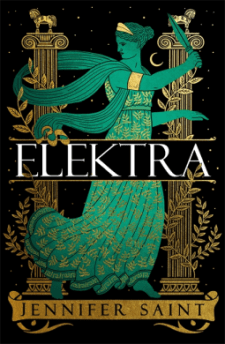
The House of Atreus is cursed. A bloodline tainted by a generational cycle of violence and vengeance. This is the story of three women, their fates inextricably tied to this curse, and the fickle nature of men and gods.
Clytemnestra – The sister of Helen, wife of Agamemnon, her hopes of averting the curse are dashed when her sister is taken to Troy by the feckless Paris. Her husband raises a great army against them, and determines to win, whatever the cost.
Cassandra – Princess of Troy, and cursed by Apollo to see the future but never to be believed when she speaks of it. She is powerless in her knowledge that the city will fall.
Elektra – The youngest daughter of Clytemnestra and Agamemnon, Elektra is horrified by the bloodletting of her kin. But, can she escape the curse, or is her own destiny also bound by violence?
Format: Hardcover (352 pages) Publisher: Wildfire
Publication date: 28th April 2022 Genre: Historical Fiction, Mythology
Find Elektra on Goodreads
Purchase links
Bookshop.org
Disclosure: If you buy a book via the above link, I may earn a commission from Bookshop.org, whose fees support independent bookshops
Hive | Amazon UK
Links provided for convenience only, not as part of an affiliate programme
My Review
I have a rather chequered history when it comes to retellings of Greek myths. I enjoyed Colm Toibin’s House of Names, which also focuses on Clytemnestra, Elektra and Orestes – but wasn’t blown away by it. Again, I found a lot to like about The Silence of the Girls by Pat Barker but didn’t think she completely succeeded in giving a voice to the ‘silenced’ women. It was pretty much the same story with Jennifer Saint’s previous novel, Ariadne, which, whilst admiring the quality of the writing, I couldn’t get as enthusuastic about as other readers. I guess it’s partly because there are only so many ways you can retell a story that has been set down many times before. The author’s challenge is that, if they want to remain true to the original myth, they can’t change the outcome of events only try to explore the characters’ motivations.
To be rather simplistic, Greek tragedy seems to basically consist of people killing other people because they killed other people. ‘Blood must be repaid in blood.’ The story of the House of Atreus is one of patricide, matricide, matiricide and filicide. (I confess I had to look up the last two.)
Based on the book’s title, you’d be forgiven for thinking that Elektra’s story is the main focus. In fact, Elektra is a background figure for much of the book and it is Clytemnestra’s story that is most prominent. It’s also the one I found the most compelling. Her grief at the murder of her eldest daughter, Iphigenia, is raw, heartrending and completely understandable. Her unwavering detemination to exact revenge on her husband borders on madness but the prospect of it, of planning it down to the last detail, is perhaps the only thing that keeps her from ending her own life. Never was the phrase ‘Revenge is a dish best served cold’ so apposite.
The sections from the point of view of Cassandra convey her anguish that she is unable to prevent the downfall of the city of Troy because her prophecies are destined never to be believed. She also provides a Trojan perspective which would otherwise be missing from the book.
I think the author set herself a challenge in making Elektra a character we can either understand or feel some sympathy for (assuming that was her intention). Elektra seems too accepting of her father’s actions – he did murder her sister after all. When she says, ‘Iphigenia was a sacrifice. The gods demand a heavy price sometimes, and it is an honour to pay it’ my immediate thought was, that’s easy for you to say. She is also dismissive of her mother’s grief at Iphigenia’s death. ‘But my mother was not dead, so I didn’t understand why she was behaving as though she was’. Like a stroppy teenager, she seems to resent her mother’s lack of attention to her.
Ironically the character I most warmed to was Georgios, the farmer who proves a steadfast friend to Elektra, and later to her brother Orestes. I found myself feeling quite sorry for him when Elektra abandons him. And I think he hits the nail on the head when he observes, ‘There’s a terrible crime, unbearable pain and then the lashing out of vengeance, and then it all begins again.’
Although the author puts the three women front and centre from a narrative point of view, I’m not sure a sense of female empowerment comes across that strongly, except perhaps when Clytemnestra takes over as ruler of Mycenae in Agamemnon’s absence. Ultimately, the fates of all three women are the consequence of the actions of men.
If you love Greek mythology I’m sure you will enjoy Elektra but I’m afraid – and I appreciate I’m in a minority here – I found the book rather slow. Although it’s beautifully written, the story only really came alive for me at certain points.
I received an advance reader copy courtesy of Wildfire Books via NetGalley.
Try something similar: House of Names by Colm Tóibín
Follow this blog via Bloglovin
 About the Author
Jennifer Saint is a Sunday Times bestselling author. Her debut novel, Ariadne, was shortlisted for Waterstones Book of the Year 2021 and was a finalist in the Goodreads Choice Awards Fantasy category in 2021. Her second novel, Elektra, is another retelling of Greek mythology told in the voices of the women at the heart of the ancient legends.
Connect with Jennifer
Website | Twitter

 About the Book
 About the Author
 What Cathy Read Next...