
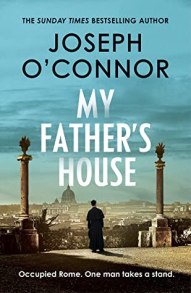
 About the Book
September 1943: German forces occupy Rome. Gestapo boss Obersturmbannführer Paul Hauptmann rules with terror. Hunger is widespread. Rumours fester. The war’s outcome is far from certain.
Diplomats, refugees, and escaped Allied prisoners flee for protection into Vatican City, at one fifth of a square mile the world’s smallest state, a neutral, independent country within Rome. A small band of unlikely friends led by a courageous Irish priest is drawn into deadly danger as they seek to help those seeking refuge.
Format: Hardback (288 pages) Publisher: Vintage
Publication date: 26th January 2023 Genre: Historical Fiction
Find My Father’s House on Goodreads
Purchase links
Bookshop.org
Disclosure: If you buy a book via the above link, I may earn a commission from Bookshop.org, whose fees support independent bookshops
Hive | Amazon UK
Links provided for convenience only, not as part of an affiliate programme
My Review
My only previous experience of Joseph O’Connor’s work is his novel Shadowplay, a fictionalized account of the life of Bram Stoker which was shortlisted for the Walter Scott Prize for Fiction 2020. That book utilised a number of structural techniques including diary entries, letters and transcripts of conversations as well as more traditional third person narration, and the same is true of this latest novel. My Father’s House is set in Rome, more precisely in the Vatican, during the Nazi occupation and is described by the publishers as a ‘WWII-era “great escape” novel’. The book is based on the true story of Monsignor Hugh O’Flaherty who, along with others, risked his life to smuggle thousands of Jews and escaped Allied prisoners out of Italy. The cover for the operations is a choir, with musical or literary terms used as code words.
Although Hugh O’Flaherty is the key character I loved the way the author brought to life the other members of the group. They recount their experiences by means of transcripts of interviews recorded twenty years after the events in question allowing the reader to hear the distinctive voices the author has created for them. For example, the acerbic wit and Irish lilt of displomat’s wife, Delia Kiernan – ‘Some little jack-in-office of a penpusher thinks he’ll lord it over yours truly? Take the back of my arse and boil it’. Or the Italian-American slang of Enzo Angeluccio or the Cockney accent and sardonic asides of John May. Describing his first encounter with his future employer and fellow member of the choir, Sir D’Arcy Osborne, in a Soho nightclub frequented by gay men: ‘So Sir D’Arcy’s in one midnight with a couple of his old school muckers and they’re larking about with the drag boys. It’s coming on a bit fairyland and hark-at-her, Gladys, and they’re calling Sir D’Arcy ‘Francesca’, just good clean fun…’
There are also brilliant little details about life in neutral Vatican City such as the fact it was necessary for residents to apply for a haircut pass the leave its boundaries.
A thriller wouldn’t be thrilling if there wasn’t a formidable opponent. In this case it’s the utterly ruthless Gestapo boss Obersturmbannführer Paul Hauptmann. One of the standout parts of the book for me was a section entitled ‘The Hunstman’ in which the author gives us a chilling insight into Hauptmann’s domestic life in his heavily fortified home in a former museum that is almost like a prison, and to the motivation for his vile actions. Driven by a deluded patriotism, he dreams of delivering to Hitler a conquest that will strengthen his career and bring prosperity to his family. ‘An example to the whole Fatherland. The Hauptmanns.’
All the while the members of the choir are working on the plans for forthcoming missions they are mindful of the risks they are running. ‘What was being rehearsed would have got us tortured to death by Hauptmann.’ Judging by what we learn about him, he’d have enjoyed that.
The description of My Father’s House as a ‘literary’ thriller is spot on because, alongside the gripping story, the narrative has some brilliant stylistic flourishes. I loved the way the author includes passages made up of short, sharp bursts of descriptive prose that are almost like poetry. ‘On the fourth floor, breathless, he unlocks the scriptorium and enters. The vast shutters of his workplace half-closed. Bowed bookshelves. Onyx inkwells. Stacks of mouldering files. Mousegnawed dissertations on Christology. Quills and their sharpeners. Letter-openers. Ledgers. Spiderwebbed portraits of virginal martyrs. A knot of tangled scapulars dangling from a doorknob, near a trinity of rickety candlesticks. Relics and rat traps. A skull doing duty as memento mori. Tomes. Bones. Combed texts of encyclicals. Leaded windows left unwashed for a long as anyone can remember.’
My Father’s House is a thrilling story of heroism, intrigue and ingenuity told with great panache.
In three words: Compelling, atmospheric, stylish
 About the Author
Joseph O’Connor was born in Dublin. His books include Cowboys and Indians, Inishowen, Star of the Sea (American Library Association Award, Irish Post Award for Fiction, France’s Prix Millepages, Italy’s Premio Acerbi, Prix Madeleine Zepter for European novel of the year), Redemption Falls, Ghost Light (Dublin One City One Book Novel 2011) and Shadowplay (Irish Book Awards Novel of the Year, Costa Novel of the Year shortlist). His fiction has been translated into forty languages.
He received the 2012 Irish PEN Award for Outstanding Contribution to Literature and in 2014 he was appointed Frank McCourt Professor of Creative Writing at the University of Limerick. (Photo/bio: Publisher author page)
Connect with Joseph
Website

 About The Witches of Vardø
 About the Author
 What Cathy Read Next...