
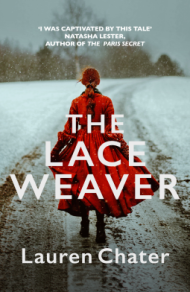
 About the Book
1941, Estonia. As Stalin’s brutal Red Army crushes everything in its path, Katarina and her family survive only because their precious farm produce is needed to feed the occupying forces.
Fiercely partisan, Katarina battles to protect her grandmother’s precious legacy – the weaving of gossamer lace shawls stitched with intricate patterns that tell the stories passed down through generations.
While Katarina struggles to survive the daily oppression, another young woman is suffocating in her prison of privilege in Moscow. Yearning for freedom and to discover her beloved mother’s Baltic heritage, Lydia escapes to Estonia.
Facing the threat of invasion by Hitler’s encroaching Third Reich, Katarina and Lydia and two idealistic young soldiers, insurgents in the battle for their homeland, find themselves in a fight for life, liberty and love.
Format: eARC (352 pages) Publisher: Allison & Busby
Publication date: 19th January 2023 [2018] Genre: Historical Fiction, Romance
Find The Lace Weaver on Goodreads
Purchase links
Bookshop.org
Disclosure: If you buy a book via the above link, I may earn a commission from Bookshop.org, whose fees support independent bookshops
Hive | Amazon UK
Links provided for convenience only, not as part of an affiliate programme
My Review
Being an avid reader of historical fiction set during World War Two, I was attracted to The Lace Weaver by the fact it is set in Estonia. Although I’ve visited Tallinn, I knew very little about Estonia’s history and certainly not about the period covered by the book during which the country was occupied by the Soviet Union and then by the Nazis with Germany initially being looked upon as Estonia’s saviour. As we learn, it didn’t work out like that.
First published in 2018, I doubt if Lauren Chater could have imagined at the time how the situation facing Estonia described in the novel – a small country threatened by a much more powerful neighbour whose stated aim is to bring it within its orbit – would have such similarities with the situation facing Ukraine today. Indeed, if applied to Ukraine, President Putin might well agree with Russian officer Lieutenant Lubov when he insists, ‘The Baltics have always belonged to Russia. She has just welcomed them back to the fold’.
Ostensibly Katarina and Lydia represent different sides of the conflict. Katarina, born and brought up in Estonia, is determined to ensure her country’s culture, such as the making of traditional lace shawls, survives for the day when Estonia is restored to independence. It also acts as a silent form of resistance when more active resistance brings only death. Lydia seemingly represents everything Estonia is fighting against, innocently absorbing the propaganda that Estonia is prospering under Soviet rule when, as we witness, the opposite is the case. Much of the population are starving having been robbed of their property as part of Stalin’s policy of collectivisation. Lydia has her own personal link to Estonia through her mother and her own reasons for wanting to flee Russia when she discovers the truth about her parentage. However, being a Russian in Estonia at that time brings its risks.
The author brings us moments of high drama as the worst excesses of both the Soviet and German occupations of Estonia play out. It starts with confiscation of property, travel restrictions and attempts to destroy the culture of the country, such as outlawing its language, and progresses to forced deportation, the persecution of Jews and other minorities, and eventually to mass murder and the horror of the concentration camps. There are scenes of brutality and cruelty that are hard to stomach, even more so because they are based on historical fact.
In time of war, it’s perhaps understandable that people will snatch at any chance of happiness. After all, who knows what tomorrow will bring or even if there will be a tomorrow? Katarina and Lydia both become involved in romantic relationships. I found Katarina’s more believable given that it developed from a childhood friendship into something more. Lydia’s was less credible being the product of a convenient chance encounter.
The book’s title is a bit of a misnomer as Estonian shawls of the kind featured in the book are knitted from wool not woven. Indeed, Kati and the other women themselves refer to their gatherings as ‘knitting circles’. Maybe ‘The Lace Knitter’ didn’t sound as good as a title? I found it difficult to visualise the lace patterns mentioned, which also form the chapter headings. It would have been helpful to have illustrations of them and while I’m at it perhaps a map of Estonia and a glossary too? This might have helped me appreciate the extent of the forest in which those displaced took shelter and which acted as the base for the Estonian partisans known as the Forest Brothers.
The Lace Weaver shines a light on events in a little known theatre of war. Those who like to be immersed in actual historical events will find much to appreciate in the book. And those who love an element of romance in their historical fiction won’t be disappointed either.
My thanks to Allison & Busby for my review copy received via NetGalley.
In three words: Romantic, powerful, moving
Try something similar: Daughters of War by Dinah Jeffries
 About the Author
After working in the media sector for many years, Lauren Chater turned her passion for reading and research into a professional pursuit. The Lace Weaver was her debut, and her most recent novel is The Winter Dress. She is currently completing her Masters of Cultural Heritage through Deakin University in Victoria, Australia. (Photo: Twitter profile)
Connect with Lauren
Website | Twitter | Facebook | Instagram

 About the Book
 About the Author
 What Cathy Read Next...