About the Book
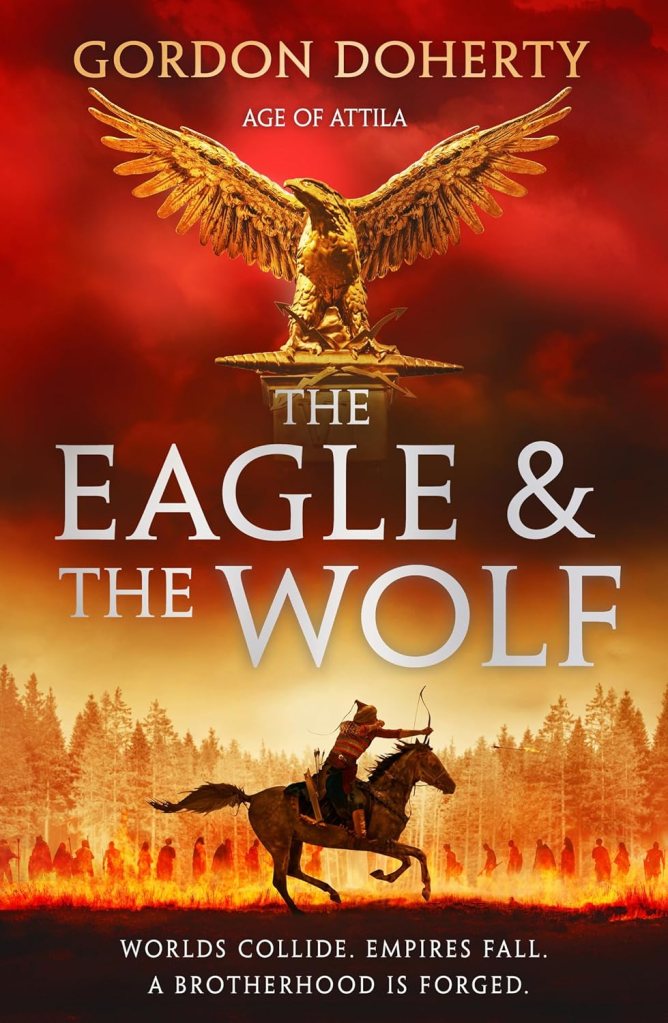
As Hun hordes and Germanic tribes maraud through Imperial lands, two legendary men – Attila the Hun and the “Last of the Romans” General Flavius Aetius find their fortunes entangled with the chaos.
Flavius Aetius, a noble Roman son, is an outsider in a savage land. He has been banished, given as hostage to the barbaric Huns and sent to the edge of the world.
What the Huns do not know, however, is that his father and mother have been murdered in a coup. He is an orphan, with no value at all. His life hangs on a lie.
In this new harsh world, he manages to find one grudging ally, a young boy named Attila.
A brotherhood is formed. One that, the shamans foretell, will shatter the world.
Format: Hardcover (448 pages) Publisher: HarperCollins
Publication date: 13th August 2026 Genre: Historical Fiction
Find The Eagle & the Wolf on Goodreads
Preorder/Purchase The Eagle & the Wolf from Bookshop.org [Disclosure: If you buy books linked to our site, we may earn a commission from Bookshop.org, whose fees support independent bookshops]
My Review
Gordon Doherty has become one of my go-to authors for exciting historical fiction set in the Roman age. I’ve read a number of the books in his ‘Legionary’ series, including the most recent and, sadly, the final instalment Devotio – as well as the ‘Rise of Emperors’ trilogy co-written with Simon Turney. What I’ve come to expect is action-packed stories rich in authentic historical detail. I’m happy to say The Eagle & the Wolf, the first in the new ‘Age of Attila’ series, delivers in all those respects.
I’m probably not alone in having learned about the Huns in history lessons without actually knowing much detail about how they lived. The author sets that right by piecing together the scant information that exists to provide the reader with fascinating detail about their culture, religous beliefs and lifestyle. For example, that at this time the Huns were not a homogeneous group but a collection of nomadic tribes each ruled by their own king.
In the first few weeks following his capture and arrival in the Hun camp, Flavius Aetius is a young man who feels alone in the world. He does not understand the Hun language, finds the food unpalatable, is alarmed at the strange physical appearance of the spiritual leaders of the tribe and is fearful there are some in the camp who know his secret, that he is not the valuable hostage they believe. He plans an escape only to realise the harsh landscape make that impossible. Gradually he is introduced to the ways of the tribe by a young man, Attila, who himself carries a burden. Cleverly, the author has Flavius discover some of the more lurid myths about the Huns are just that, myths. He develops a growing appreciation for their superb horsemanship and skill with bow, spear and lasso. Under Attila’s tutelage he starts to acquire these skills himself whilst also demonstrating his own gift for quick thinking.
Suddenly everything changes and it is now Attila who is uprooted from the tribe and sent to Rome while Flavius is forced to remain, the result of a betrayal by the last person he would have expected.
When they are renuited years later both Flavius and Attila have things they are prepared to risk everything to protect. Unfortunately, there are others who know that too. And although both men have gained valuable military knowledge, they’ve also learned neither the Huns nor the Romans has a monopoly on treachery. There are men on either side who are prepared to do anything to gain power and who will be utterly ruthless when it comes to dispatching their enemies, often in the most gruesome manner imaginable.
The book is set in a turbulent period in the history of the Roman Empire when it could no longer be regarded as a single entity, its decline very much apparent and the signs of its fall there to see. The author guides the reader through the complexities of the shifts of power and the forming and reforming of allegiances, some between former enemies.
The climax of the book takes place at the strategically important city of Arelate, under siege by the Visigoths for many months. Lifting the siege becomes both a military objective and a very personal mission for Flavius. He may have been brought up on Homer’s epic poem the Iliad rather than the Odyssey, but Flavius proves himself just as wily as the latter’s eponymous hero. Sometimes what looks to be the case really isn’t.
If you long for descriptions of the cut and thrust of battle this is one of the points in the book where you won’t be disappointed. Prepare yourself for the ‘thunderclap’ of shields clashing together and the ‘shriek’ of iron weapons meeting while arrows rain down and the Hun forces come together in their ‘whirling cyclone’ formation.
As always, there’s much to be learned from the Historical Notes and the Glossary. I can also recommend checking out the author’s Instagram reels.
Gordon describes The Eagle & the Wolf as ‘the first volume of what promises to be an epic saga’ and hopes we’ll stick around for volume two. I know I will.
I received an advance review copy courtesy of HarperCollins via NetGalley. The Eagle & the Wolf is book 14 of my 20 Books of Summer.
In three words: Epic, action-packed, authentic
Try something similar: Sword of the War God by Tim Hodkinson
About the Author

Gordon Doherty is a Scottish writer, addicted to reading and writing historical fiction. His love of history was first kindled by visits to the misty Roman ruins of Britain and the sun-baked antiquities of Turkey and Greece. His expeditions since have taken him all over the world and back and forth through time (metaphorically, at least), allowing him to write tales of the later Roman Empire, Byzantium, Classical Greece and even the distant Bronze Age. (Photo: Goodreads author page)
Connect with Gordon
Website | X | Instagram | Bluesky | Facebook | TikTok | YouTube