#BookReview Adama by Lavie Tidhar @HoZ_Books

About the Book

Front cover of book Adama by Lavie Tidhar

There is no land without blood , and I water this land with the blood of my men.

Ruth’s family were in Budapest when the Nazis came.

Now Ruth is in Palestine, amid the bare hills inland from Haifa, breaking the rocky soil of an unyielding land before it breaks her.

With her comrades, her fellow kibbutzniks, she will build a better world. There will be green grass, orange trees and pomegranates, a land that is their own and no one else’s.

So they till their fields, dig their wells, build their homes and forge a new way of living, fiercely proud of their shared pursuit of a dream.

But as one generation begets another, the dream unravels, twisted into a dark tapestry of secrets and lies; sacrificed for revenge, forbidden love and murder.

Format: Hardback (400 pages) Publisher: Head of Zeus
Publication date: 14th September 2023 Genre: Historical Fiction

Find Adama on Goodreads

Purchase links 
Bookshop.org 
Disclosure: If you buy a book via the above link, I may earn a commission from Bookshop.org, whose fees support independent bookshops

Hive | Amazon UK 
Links provided for convenience only, not as part of an affiliate programme


My Review

Until I read other reviews of the book, I didn’t realise Adama was the second in a trilogy, the follow-up to Maror. However, I don’t think it’s essential to have read the earlier book although it would probably be helpful to fill in any gaps in your knowledge about the foundation of the state of Israel. Big gaps, in my case.

Having read the chapter that opens part one of the book, you might be forgiven for thinking – as I did – that Adama was a thriller not a work of historical fiction. In fact, you’d be partially right because throughout the book there is intrigue, betrayal and drama as well as a moving story charting the experiences of generations of one family. It made it a page-turner for me.

Following the death of her mother, Hanna finds a box containing old photographs and documents that sees her embark on a search for information about Esther’s past and her family history. It also provides a distraction from the recent breakdown of a relationship. Thereafter the book moves back and forth over the decades recounting events in the life of Ruth, her family, her lovers and other members of her kibbutz with the full picture only gradually emerging.

At times, Ruth’s utter commitment to preserving the kibbutz seems to border on obsession, especially as it becomes clear what she has been prepared to do to in order to protect it. She’s courageous but also single-minded, even ruthless. For her, the end justifies the means. At one point Ruth says, ‘I gave up everything for this land… I sacrificed’. But others’ sacrifice is giving up their lives. Their stories are dramatic, powerful and sometimes harrowing.

The book depicts Israel’s often violent struggle for survival including the brutality of British occupation during which refugees attempting to cross to Palestine from Europe in small boats were intercepted and sent to camps in Cyprus. (Plus ça change, plus c’est la même chose.)

I had a vague concept of what a kibbutz was but had no idea of the extent of their collective nature when they were first established. ‘They believed in sharing – land, crops, property and love. The kibbutz was going to be a new way of life… No more jealousy and no more ownership of things, but somewhere where things could be finally different.’ One example of that difference is that children lived separately from their parents (who had no financial responsibility for them) and were raised and educated communally. The book explores the conflict between the natural instincts of motherhood and commitment to the principles of the kibbutz. Ruth’s sister, Shosana, provides a counterpoint to Ruth’s unwavering beliefs. Initially a place of refuge for Shosana after her experiences during the Second World War, the kibbutz becomes a source of savagery.

By the end of the book, Hanna may not have learned everything she hoped but author leaves the reader with a striking image of the characters they have come to know.

The publisher’s description of Adama as a ‘sweeping historical epic’ is spot on. At the moment, it looks a dead cert to be among my books of the year and it has made me keen to explore the author’s backlist, including reading Maror.

I received a digital review copy courtesy of Head of Zeus via NetGalley.

In three words: Powerful, gripping, moving


About the Author

Lavie Tidhar was born just ten miles from Armageddon and grew up on a kibbutz in northern Israel. He has since made his home in London, where he is currently a Visiting Professor and Writer in Residence at Richmond University. He won the Jerwood Fiction Uncovered Prize for Best British Fiction, was twice longlisted for the International Dublin Literary Award and was shortlisted for the CWA Dagger Award and the Rome Prize. He co-wrote Art and War: Poetry, Pulp and Politics in Israeli Fiction, and is a columnist for the Washington Post. (Photo: Goodreads author page)

Connect with Lavie
Website | Twitter

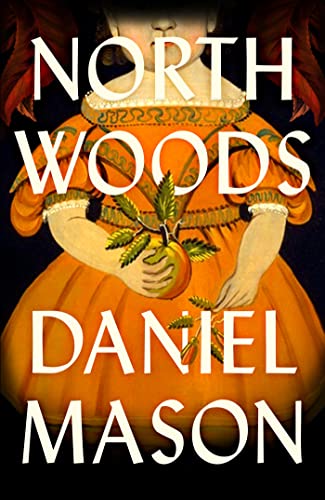
#BookReview North Woods by Daniel Mason @johnmurrays

About the Book

FOUR CENTURIES. A SINGLE HOUSE DEEP IN THE WOODS OF NEW ENGLAND.

A young Puritan couple on the run. An English soldier with a fantastic vision. Inseparable twin sisters. A lovelorn painter and a lusty beetle. A desperate mother and her haunted son. A ruthless con man and a stalking panther. Buried secrets. Madness, dreams and hope.

All are connected. The dark, raucous, beautiful past is very much alive.

Format: eARC (384 pages) Publisher: John Murray Press
Publication date: 19th September 2023 Genre: Historical Fiction, Literary Fiction

Find North Woods on Goodreads

Purchase links 
Bookshop.org 
Disclosure: If you buy a book via the above link, I may earn a commission from Bookshop.org, whose fees support independent bookshops

Hive | Amazon UK 
Links provided for convenience only, not as part of an affiliate programme


My Review

I loved the first book by Daniel Mason I read, The Winter Soldier, an emotional and beautifully written novel set in the First World War that I had no hesitation in awarding five stars. The same was true of his next book, A Registry of My Passage Upon the Earth, a collection of short stories whose subtle links and recurring themes become more apparent as you read the book. In my review, I described it as ‘a tour de force of imagination’ and I have no hesitation in applying the same description to North Woods.

Starting in the 17th century and centred around a remote house and the surrounding north woods, events unfold in a series of episodes told in a variety of styles including a testimony, a newspaper report, a lecture, an exchange of correspondence, a poem, a song. Over time, the house is a place of passion, violence, refuge, contentment, simmering resentment, mental distress and trickery. It’s extended, damaged by storms, left to become derelict, abandoned and then rediscovered. The people that have inhabited it have each left a mark on it, sometimes incorporeal in nature, adding an intriguing supernatural element.

The connections the author weaves between the episodes and the various characters are immensely clever and skilfully done. Some of the links are obvious, some less so, meaning it might only be the mention of an object – an old hat of felted beaver – or a name – Osgood – that makes you recall an earlier story. The book is akin to a patchwork quilt made up of squares created by people of different generations and different skill levels, sewn together in random fashion but with some recurring motifs. As I was reading the book, my constant thought was ‘this is my favourite’, only for it to be replaced by another almost immediately afterwards.

The events in the lives of the characters are often intensely moving but there are also elements of humour, eccentricity and melodrama. And the book doesn’t just feature human characters but also animal and insect life – that ‘lusty beetle’ mentioned in the blurb – even fungal diseases.

The writing is beautiful with the author adopting a variety of styles that wonderfully bring to life the events of each episode. I’m a great fan of a list and there are some brilliantly quirky ones in the book, often almost poetic in style, such as this description of the items making up the ballast of a ship bound for America, demonstrating it’s not only humans who migrate.

There are stones and loam and sand, insects and earthworms, bird bones and crushed snail shells, roly-polies, and tuffs of grass that wilt within the darkness of the hold. There is a half-decayed mole, and a live one, broken jugs, a Roman coin that will be rediscovered by a young boy walking on the shoreline 317 years later, and another, a “crown of the double rose” bearing an image of Edward VI on horseback, that will sift down into the silty depths of Massachusetts Bay and disappear forever. There is a beaded necklace dropped by a longshoreman’s wife during a moment of indiscretion, a splintered lens from a bookkeeper’s spectacles, stray curls blown from the barber’s market stall by an offshore breeze, peach pits, rotting broadsheets of forgotten songs. And there are seeds, uncountable, scattered in the humid load: red clover, groundsel, spurrey, trefoil, meadow fescue, dandelion, hedge parsley, nonesuch, plantains.’

The depiction of nature is mesmerising charting the changing of the seasons and the transformation of the woods over time. In fact, the woods are a character in themselves acting amongst other things as a sanctuary, a meeting place, a source of inspiration, a habitation, a hiding place and a harbinger of environmental change.

I thought North Woods was absolutely brilliant. It’s definitely one of the best books I’ve read this year.

I received a digital review copy courtesy of John Murray Press via NetGalley.

In three words: Magical, imaginative, moving


About the Author

Daniel Mason is the author of The Piano Tuner (2002), A Far Country (2007), The Winter Soldier  (2018), A Registry of My Passage Upon the Earth (2020), which was a finalist for the Pulitzer Prize.  His work has been translated into 28 languages, adapted for opera and stage, and awarded a 2021 Guggenheim Fellowship, the Joyce Carol Oates Prize, the California Book Award, the Northern California Book Award, and a Fellowship from the National Endowment for the Arts.  His short stories and essays have been awarded two Pushcart Prizes, a National Magazine Award, and an O. Henry Prize. He is an assistant professor in the Stanford University Department of Psychiatry. (Photo: Goodreads author page)

Connect with Daniel
Website