Book Review – The Small Museum by Jody Cooksley @AllisonandBusby

Welcome to today’s stop on the blog tour for The Small Museum by Jody Cooksley. My thanks to Helen at Helen Richardson PR for inviting me to take part in the tour and to Allison & Busby for my review copy via NetGalley. Do check out the posts by my tour buddies today, Clare at The Fallen Librarian, and Sara at Intensive Gassing About Books.


About the Book
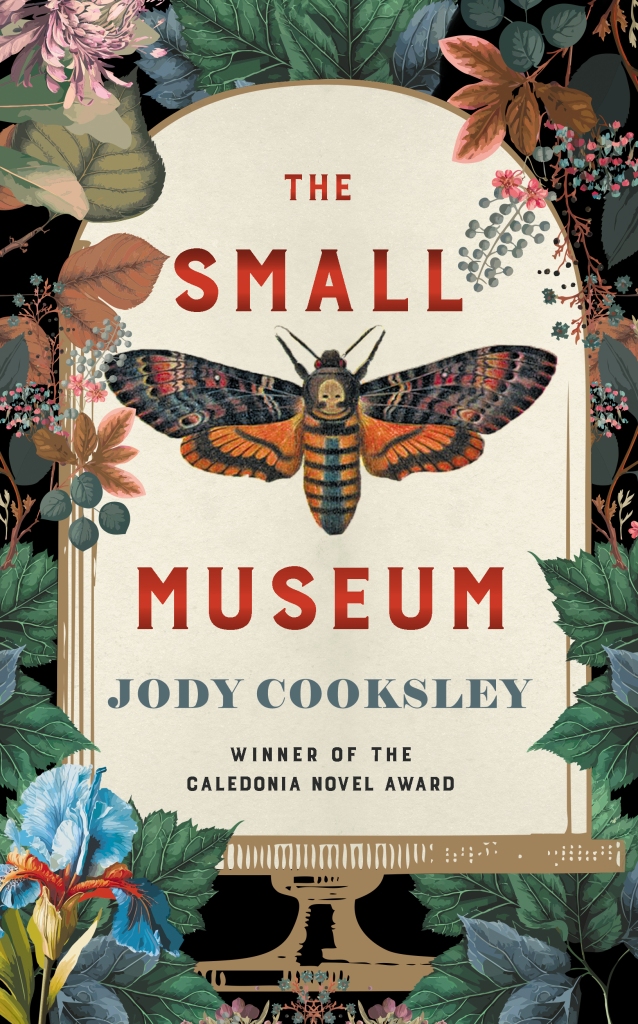
Book cover of The Small Museum by Jody Cooksley

London, 1873. Madeleine Brewster’s marriage to Dr Lucius Everley was meant to be the solution to her family’s sullied reputation. After all, Lucius is a well-respected collector of natural curiosities, his ‘Small Museum’ of bones and things in jars is his pride and joy, although kept under lock and key. His sister Grace’s philanthropic work with fallen women is also highly laudable. However, Maddie is confused by and excluded from what happens in what is meant to be her new home.

Maddie’s skill at drawing promises a role for her though when Lucius agrees to let her help him in making a breakthrough in evolutionary science, a discovery of the first ‘fish with feet’. But the more Maddie learns about both Lucius and Grace, the more she suspects that unimaginable horrors lie behind their polished reputations. Framed for a crime that would take her to the gallows and leave the Everleys unencumbered, Maddie’s only hope is her friend Caroline Fairly. But will she be able to put the pieces together before the trial reaches its fatal conclusion?

Format: Hardcover (320 pages) Publisher: Allison & Busby
Publication date: 16th May 2024 Genre: Historical Fiction

Find The Small Museum on Goodreads

Purchase The Small Museum from Bookshop.org [Disclosure: If you buy books linked to our site, we may earn a commission from Bookshop.org, whose fees support independent bookshops]


My Review

The author has created a ‘small museum’ of her own, in this case a literary one, by bringing together all the elements you could wish for in a Victorian age historical mystery. In particular, it incorporates the macabre interest in the collection and display of anatomical curiosities as well as more outlandish theories about the evolution of species circulating at the time.

Poor Maddie, married off to Lucius in order to try to restore her family’s social standing following the ‘disgrace of her sister Rebecca, is pretty much a lamb to the slaughter. She cannot understand Lucius’ coldness towards her nor the fact that she is kept pretty much a prisoner in her new home which is run with ruthless efficiency by housekeeper, Mrs Barker. Lucius is invariably absent, either visiting patients or attending scientific meetings, so Maddie’s is a lonely existence, made worse by unsettling little things, such as the unexplained rearrangement of objects or the strange sounds she hears in the night. Could it be her imagination? Everyone seems anxious to convince her it is. Have a cup of cocoa and an early night, dear…

Maddie makes touching attempts to show interest in Lucius’s work in the hope of gaining his attention but it’s only when her artistic skill seems likely to assist his work that she gains a modicum of value in his eyes. Unfortunately, it will be a long time until she discovers what her real value to him is, and when she – and the reader – does, it’s positively shocking. Maddie badly needs a friend and Caroline Fairly proves a particularly steadfast one, along with Maddie’s maid, Tizzy, who risks her own wellbeing if she is discovered.

The book has a generous role call of villains. I’d single out Lucius’s sister, Grace, whose knack for gliding into rooms unexpectedly reminded me of Mrs Danvers in Daphne du Maurier’s Rebecca. She willingly goes along with the gaslighting of Maddie whilst at the same time cultivating an air of philanthropy through her involvement in a home for fallen women (reminiscent of the establishment in Stacey Halls’s The Household). Then there are the Barkers, the Eversleys’ loyal retainers, a persistent malign prescence and whom, one suspects, know all the family’s dirty secrets. And, of course, there’s Lucius himself who for a long time seems to be just a coldly obsessive man determined to prove a theory he has developed. But what lengths will he go to in pursuit of that proof?

I particularly liked the use of chapter headings that describe some of the often quite macabre ‘curiosities’ in Lucius’s collection and the way the author subtly insinuated some of these into the story. I was fascinated to learn that some were inspired by actual exhibits in the Hunterian Museum in London.

The Small Museum is a chilling and immersive historical mystery generously infused with elements of Gothic fiction.

In three words: Creepy, dramatic, atmospheric
Try something similar: Things in Jars by Jess Kidd


About the Author

Author Jody Cooksley
Photo credit: Lillian Spibey

Jody Cooksley studied literature at Oxford Brookes University and has a Masters in Victorian Poetry. Her debut novel The Glass House was a fictional account of the life of nineteenth-century photographer, Julia Margaret Cameron. The Small Museum, Jody’s third novel, won the 2023 Caledonia Novel Award.

Jody is originally from Norwich and now lives in Cranleigh, Surrey.

Connect with Jody
Website | X | Instagram

Book Review – A Plague of Serpents by K. J. Maitland

About the Book

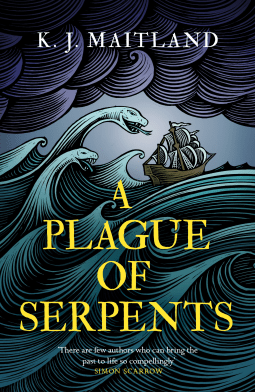
Book cover of A Plague of Serpents by K. J. Maitland

London, 1608. Three years after the Gunpowder Treason, the King’s enemies prepare to strike again.

Daniel Pursglove is tasked by royal command with one final mission: he must infiltrate the Serpents – a secret group of Catholics plotting to kill the King – or risk his own execution. But other conspirators are circling, men who would blackmail Daniel for their own dark ends.

In the Serpents’ den, nothing is quite as it seems. And when Daniel spies a familiar face among their number, the game takes a dangerous turn.

As plague returns to London, tensions reach breaking point. Can Daniel escape the web of treason in which he finds himself ensnared – or has his luck finally run out?

Format: eARC (432 pages) Publisher: Headline
Publication date: 25th April 2024 Genre: Historical Fiction, Mystery

Find A Plague of Serpents on Goodreads

Purchase A Plague of Serpents from Bookshop.org [Disclosure: If you buy books linked to our site, we may earn a commission from Bookshop.org, whose fees support independent bookshop]


My Review

A Plague of Serpents is the fourth and final book in the author’s Daniel Pursglove series comprising The Drowned City, Traitor in the Ice and Rivers of Treason. (Links from each title will take you to my reviews.) The author is renowned for constructing complex plots and this book is no exception. In addition there are many characters to get to know, not all of whom may be what they profess to be, and the true identity of others remains shrouded in mystery. For these reasons I think it would be a struggle to fully enjoy the book without having read the previous three. To be honest, I struggled a bit for a time and I have read all three! (If you don’t have the time or inclination to read the series from the beginning but would like to experience the author’s work then I’d suggest trying one of her standalone historical novels such as The Plague Charmer set in the time of the Black Death.)

The thread that runs through all the Daniel Pursglove books is the search for Spero Pettingar, the only conspirator involved in the Gunpowder Plot who is still at large. As I mentioned in my review of the first book in the series, it wasn’t until I read the historical notes at the end of the book that I realised Spero Pettingar was a real historical figure. For much of the book, I was convinced his name was an anagram! Although having said that, perhaps there is some significance to his peculiar name after all…

King James remains conscious of the continued threat to his life, taking elaborate precautions to prevent being poisioned. He’s right to be vigilant because there are at least two groups who would like to see him dead, either to put their own choice of successor on the throne or to have no monarch at all. And if one group does the job for the other, all well and good.

It’s not just in the Royal court that there exists an atmosphere of mistrust. It’s the same in wider society as well, especially if you’re secretly practising the Catholic faith. ‘Friends, neighbours, brothers, servants, even your own children were not to be trusted. Anyone could be bribed or threatened.’

Daniel makes a spirited hero who’s handy with a dagger, able to blend into the shadows and an expert at ‘charming’ locks. Although the master of narrow escapes, even he makes the odd mistake with the result that he finds himself in some dangerous situations. There are lots of people who want to find out exactly what he knows and don’t have any compunction in using force to do so.

Natural phenomena have provided the background to all the books. In The Drowned City it was a devastating wave in the Bristol Channel, in Traitor in the Ice it was the Great Frost of 1607 and in Rivers of Treason it was the impact of the previous two on the livelihoods of the population: farmland ruined by salt from the flood, cattle and sheep drowned or frozen and winter wheat wiped out by frost. This time the Black Death is making a stealthy return and no-one is safe from that.

As always, the author conjures up the sights, sounds and smells of London – the latter being invariably unpleasant. We’re taken to familiar places like taverns and markets, but also introduced to occupations such as palterer, gong farmer and clank napper. If you’ve no idea what the last three are, check out the Glossary in which you’ll find the answers along with definitions of things such as ‘stool ducketts’, ‘muggets’ and ‘furuncles’. Oh, and whether you should take offence if you’re called a ‘snoutband’ or a ‘princock’.

As the book moves towards its close, we finally learn more about the events in Daniel’s past that have haunted his dreams and left him with an overwhelming sense of guilt for so long. There is also a final reckoning involving two key figures in Daniel’s life. However, the author resists the temptation to tie everything up leaving the reader to imagine for themselves what the future holds for some of the characters we’ve got to know.

I received a review copy courtesy of Headline via NetGalley.

In three words: Intricate, immersive, suspenseful
Try something similar: The Sinner’s Mark by S. W. Perry


About the Author

Author Karen Maitland aka K. J. Maitland

Karen Maitland is an historical novelist, lecturer and teacher of Creative Writing, with over twenty books to her name. She grew up in Malta, which inspired her passion for history, and travelled and worked all over the world before settling in the United Kingdom. She has a doctorate in psycholinguistics, and now lives on the edge of Dartmoor in Devon. (Photo/bio credit: Author website)

Connect with Karen
Website | Facebook