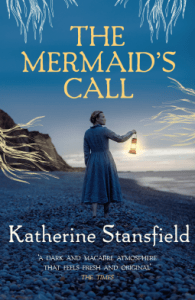
#BookReview The Mermaid’s Call by Katherine Stansfield @allisonandbusby @K_Stansfield

The Mermaid's CallAbout the Book

Cornwall, 1845. Shilly has always felt a connection to happenings that are not of this world, a talent that has proved invaluable when investigating dark deeds with master of disguise, Anna Drake. The women opened a detective agency with help from their newest member and investor, Mathilda, but six long months have passed without a single case to solve and tensions are growing.

It is almost a relief when a man is found dead along the Morwenstow coast and the agency is sought out to investigate. There are suspicions that wreckers plague the shores, luring ships to their ruin with false lights – though nothing has ever been proved. Yet with the local talk of sirens calling victims to the sea to meet their end, could something other-worldly be responsible for the man’s death?

Format: ebook, hardcover (288 pp.)         Publisher: Allison & Busby
Publication date: 19th September 2019  Genre: Historical Fiction

Purchase Links*
Amazon.co.uk | Amazon.com | Hive (supporting UK bookshops)
*links provided for convenience, not as part of any affiliate programme

Find The Mermaid’s Call on Goodreads


My Review

The Mermaid’s Call is the third book in Katherine Stansfield’s ‘Cornish Mystery’ series, following on from Falling Creatures (which I’ve still to read) and The Magpie Tree, my review of which you can read here.   The Mermaid’s Call can definitely be enjoyed as a standalone, although it does contain brief references to events in the earlier two books.  However, there are still plenty of secrets to be learned – especially about Anna Drake – and even the book’s narrator, Shilly, doesn’t know everything about Anna’s past meaning the reader doesn’t feel at a disadvantage or, even if they do, it’s a position they share with Shilly!  Personally, I love that there are hints of things still to be discovered about both characters – I hope in future books in the series.   Incidentally, in her guest post on my blog last year, Katherine Stansfield addressed the challenge of a writing a sequel and whether they should look back or forward.

I mentioned that Shilly is the book’s narrator and she fulfils this duty in her own distinctive style. Shilly has experienced traumatic events in her life and battled demons of her own but Anna is the real woman of mystery with secrets not only in her past but also, it appears, in the present.    Shilly and Anna make an unconventional detective partnership to which each bring their own strengths, although Anna is very much in charge.

Anna’s approach is all about collecting facts and evidence, establishing alibis and questioning suspects, helped by her expertise at adopting disguises in which she invariably poses as a man, an opportunity she seems to relish. As Shilly notes, ‘Men’s clothes gave her something else.  Something I wished I could give her’.  What Shilly describes as her ability to ‘look askance’ means her approach is more founded on impressions, instinct and even visions bordering on the supernatural.  The relationship between Anna and Shilly goes beyond just a partnership in detecting crime though – at least, that’s definitely what Shilly desires.  And, for both of them, the detective agency is also a way, as women, to exert their independence and identity in a world controlled by men.

The case they are engaged to investigate takes them to Morwenstow and the curious household of Parson Hawker which is not only filled with cats and dogs and a rampaging pig but also a secret locked room – surely a requirement of any mystery novel! I was delighted to learn from the author’s historical note that the Parson Hawker in the book is based on a real life character which certainly goes to support the statement that ‘truth is stranger than fiction’.

In my review of The Magpie Tree I wrote that the book ‘ticked all the boxes for me as a historical mystery: intriguing story line, interesting and engaging central characters, great period detail and atmospheric location’.  I had the same feeling on turning the last page of The Mermaid’s Call.   A story of love, secrets, betrayal and revenge, sprinkled with a hint of the supernatural and full of twists and turns, The Mermaid’s Call (and indeed the whole ‘Cornish Mystery’ series) is highly recommended for fans of historical crime mysteries.

I received an advance review copy courtesy of Allison & Busby via NetGalley.

In three words: Compelling, atmospheric, mystery

Try something similar: Wrecker by Noel O’Reilly

Follow my blog via Bloglovin


Katherine Stansfield 2About the Author

Katherine Stansfield is a multi-genre novelist and poet who grew up on Bodmin Moor and now lives in Cardiff.  Her ‘Cornish Mysteries’ crime series is set in the 1840s and features unorthodox detective duo Anna Drake and Shilly Williams. The pair investigate crimes based on real events in Cornish history and involve a good dash of local folklore. Think ‘Sherlock Holmes meets the X Files meets Daphne du Maurier’.

Katherine is also one half of the writing partnership DK Fields, with her partner David Towsey. Head of Zeus will publish their political fantasy novel Widow’s Welcome, the first in ‘The Tales of Fenest’ trilogy, in August 2019. (Photo credit: Goodreads author page)

Connect with Katherine

Website | Twitter | Goodreads

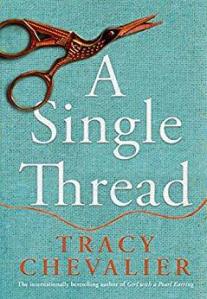
#BookReview A Single Thread by Tracy Chevalier @boroughpress

A Single ThreadAbout the Book

It is 1932, and the losses of the First World War are still keenly felt. Violet Speedwell, mourning for both her fiancé and her brother and regarded by society as a ‘surplus woman’ unlikely to marry, resolves to escape her suffocating mother and strike out alone.

A new life awaits her in Winchester. Yes, it is one of draughty boarding-houses and sidelong glances at her naked ring finger from younger colleagues; but it is also a life gleaming with independence and opportunity. Violet falls in with the broderers, a disparate group of women charged with embroidering kneelers for the Cathedral, and is soon entwined in their lives and their secrets. As the almost unthinkable threat of a second Great War appears on the horizon Violet collects a few secrets of her own that could just change everything…

Format: Hardcover, ebook (344 pp.)     Publisher: The Borough Press
Publication date: 5th September 2019 Genre: Historical Fiction

Purchase Links*
Amazon.co.uk | Hive
*links provided for convenience, not as part of any affiliate programme

Find A Single Thread on Goodreads 


My Review

The author convincingly depicts the details of daily life in the 1930s and, in particular, the challenges faced by women like Violet struggling to survive on a meagre income (for example, making a choice between a hot meal, more coal on the fire or a treat such as a trip to the cinema) and facing open prejudice at work because of their gender and unmarried status, whether from necessity or inclination. For example, the unquestioned assumption that they will at some point either give up work to marry or care for elderly relatives.

When Violet Speedwell joins the Winchester Cathedral broderers it introduces her, and I suspect many other readers, to a new vocabulary: long-armed cross, rice, upright gobelin amongst others. It also allows the reader to encounter some fascinating characters such as the impressive Miss Pesel and the rather fearsome Mrs. Biggins. The observation that “a leader comfortable with her authority does not need to be strident” is entirely on point when it comes to the latter. With the author’s customary insight, the relationships between the broderers, their petty prejudices and attitudes to those who, in their view, do not conform to social norms are laid bare.

Outside the circle of the broderers, and in much the same vein, there’s Violet’s budgie-loving landlady, Mrs Harvey, who assiduously guards the coal supply and carefully vets visitors to the boarding house. And there’s Violet’s mother, the domineering Mrs. Speedwell, who always seems to have a put down for her daughter within easy reach but who becomes a more sympathetic figure later in the book, albeit after a little ‘taming’.

I liked the touching relationship that develops between Violet and Winchester Cathedral bell-ringer, Arthur Knight. They are both, in different ways, lonely people who find comfort in each other’s company and conversation but recognize the seeming impossibility of something more. You wouldn’t naturally think that sharing the experience of bell ringing or examining embroidered kneelers could create a sense of intimacy but the author manages it. The impending threat of a second world war, when many are still struggling to cope with the impact of the first one, is cleverly introduced through the media of both embroidery and bell-ringing. I also liked the way the concentration required to execute both skills is presented as a beneficial distraction from other worries.

I warmed to Violet for her efforts to do good, such as the attention she pays to her niece Marjory or her attempts to help her fellow broderers, Gilda and Dorothy, even if her efforts do not always succeed. And I applauded her desire for independence (a ‘life of sorts’, as she puts it) even if that does bring with it a conflict between loyalty to family and personal fulfilment.

There was only one rather melodramatic, albeit minor, element of the storyline that didn’t work for me; it felt misplaced and out of character with the rest of the book. Other than that I really enjoyed immersing myself in the atmosphere of the inter-war period the author so vividly recreates in A Single Thread. And, as a bonus, I now know a lot more than I did before about embroidery and bell-ringing although not enough, I suspect, to demonstrate competence in either. The final chapters of the book left me uplifted and satisfied in equal measure.

I received a review copy courtesy of The Borough Press and NetGalley.

In three words: Engaging, tender, emotional

Try something similar: Stealing Roses by Heather Cooper (read my review here)

Follow my blog via Bloglovin


TracyChevalierAbout the Author

Tracy Chevalier grew up in Washington D.C. She moved to England in 1984 and graduated in 1994 from the MA course in creative writing at the University of East Anglia.

Her first novel, The Virgin Blue, was chosen by W H Smith for its Fresh Talent promotion in 1997. In 2000 HarperCollins published Girl with a Pearl Earring which has gone on to sell over two million copies worldwide. Falling Angels was published to much critical acclaim in 2002. The Lady and the Unicorn followed in 2004 and Burning Bright in 2007, followed by the bestselling Remarkable Creatures in 2009.

The film of Girl with a Pearl Earring starring Colin Firth as Vermeer was released in the UK in 2003. It was nominated for 10 BAFTAs and two Academy Awards.

Tracy Chevalier lives in North London with her husband and son.

Connect with Tracy

Website | Twitter | Facebook | Instagram