

Hosted by Taking on a World of Words, this meme is all about the three Ws:
- What are you currently reading?
- What did you recently finish reading?
- What do you think you’ll read next?
Why not join in too? Leave a comment with your link at Taking on a World of Words and then go blog hopping!
Currently reading
 Hold by Michael Donkor (eARC, NetGalley)
Belinda knows how to follow the rules. As a housegirl, she has learnt the right way to polish water glasses, to wash and fold a hundred handkerchiefs, and to keep a tight lid on memories of the village she left behind when she came to Kumasi.
Mary is still learning the rules. Eleven-years old and irrepressible, the young housegirl-in-training is the little sister Belinda never had.
Amma has had enough of the rules. A straight-A pupil at her exclusive South-London school, she has always been the pride of her Ghanaian parents. Until now. Watching their once-confident teenager grow sullen and wayward, they decide that sensible Belinda might be just the shining example Amma needs.
So Belinda is summoned from Ghana to London, and must leave Mary to befriend a troubled girl who shows no desire for her friendship. She encounters a city as bewildering as it is thrilling, and tries to impose order on her unsettling new world.
As the Brixton summer turns to Autumn, Belinda and Amma are surprised to discover the beginnings of an unexpected kinship. But when the cracks in their defences open up, the secrets they have both been holding tightly threaten to seep out.
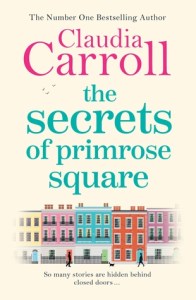 The Secrets of Primrose Square by Claudia Carroll (hardcover, prize courtesy of Readers First)
There are so many stories hidden behind closed doors . . .
It’s late at night and the rain is pouring down on the Dublin city streets. A mother is grieving for her dead child. She stands silently outside the home of the teenage boy she believes responsible. She watches . . .
In a kitchen on the same square, a girl waits anxiously for her mum to come home. She knows exactly where she is, but she knows she cannot reach her.
A few doors down, and a widow sits alone in her room. She has just delivered a bombshell to her family during dinner and her life is about to change forever.
And an aspiring theatre director has just moved in to a flat across the street. Her landlord is absent, but there are already things about him that don’t quite add up . . .
Welcome to Primrose Square.
Recently finished (click on title for review)
 The Lost Letters of William Woolf by Helen Cullen (eARC, NetGalley)
Lost letters have only one hope for survival…
Inside the Dead Letters Depot in East London, William Woolf is one of thirty letter detectives who spend their days solving mysteries: Missing postcodes, illegible handwriting, rain-smudged ink, lost address labels, torn packages, forgotten street names – they are all the culprits of missed birthdays, broken hearts, unheard confessions, pointless accusations, unpaid bills and unanswered prayers.
When William discovers letters addressed simply to ‘My Great Love’ his work takes on new meaning. Written by a woman to a soul mate she hasn’t met yet, the missives stir William in ways he didn’t know were possible. Soon he begins to wonder: Could William be her great love?
William must follow the clues in Winter’s letters to solve his most important mystery yet: the human heart.
 The Road to Newgate by Kate Braithwaite (eARC, courtesy of the author)
What price justice?
London 1678. Titus Oates, an unknown preacher, creates panic with wild stories of a Catholic uprising against Charles II. The murder of a prominent Protestant magistrate appears to confirm that the Popish Plot is real. Only Nathaniel Thompson, writer and Licenser of the Presses, instinctively doubts Oates’s revelations. Even his young wife, Anne, is not so sure. And neither knows that their friend William Smith has personal history with Titus Oates.
When Nathaniel takes a public stand, questioning the plot and Oates’s integrity, the consequences threaten them all.
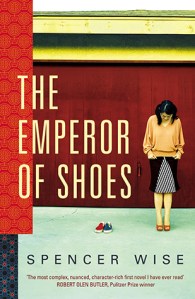 The Emperor of Shoes by Spencer Wise (proof copy courtesy of No Exit Press)
Alex Cohen, a twenty-six-year-old Jewish Bostonian, is living in southern China, where his father runs their family-owned shoe factory. Alex reluctantly assumes the helm of the company, but as he explores the plant’s vast floors and assembly lines, he comes to a grim realization: employees are exploited, regulatory systems are corrupt and Alex’s own father is engaging in bribes to protect the bottom line.
When Alex meets a seamstress named Ivy, his sympathies begin to shift. She is an embedded organizer of a pro-democratic Chinese party, secretly sowing dissonance among her fellow laborers. Will Alex remain loyal to his father and his heritage? Or will the sparks of revolution ignite? Deftly plotted and vibrantly drawn, The Emperor of Shoes is a timely meditation on idealism, ambition, father-son rivalry and cultural revolution set against a vivid backdrop of social and technological change.
 Betty Church and the Suffolk Vampire by M. R. C. Kasasian (hardcover, review copy courtesy of Head of Zeus)
September 1939. A new day dawns in Sackwater, not that this sleepy backwater is taking much notice…
Inspector Betty Church – one of the few female officers on the force – has arrived from London to fill a vacancy at Sackwater police station. But Betty isn’t new here. This is the place she grew up. The place she thought she’d left behind for good.
Time ticks slowly in Sackwater, and crime is of a decidedly lighter shade. Having solved the case of the missing buttons, Betty’s called to the train station to investigate a missing bench. But though there’s no bench, there is a body. A smartly dressed man, murdered in broad daylight, with two distinctive puncture wounds in his throat.
While the locals gossip about the Suffolk Vampire, Betty Church readies herself to hunt a dangerous killer.
What Cathy (will) Read Next
 The Vanished Child (Jayne Sinclair Genealogical Mystery#4) by M. J. Lee (ebook, review copy courtesy of Rachel’s Random Resources)
Every childhood lasts a lifetime.
On her deathbed, Freda Duckworth confesses to giving birth to an illegitimate child in 1944 and placing him in a children’s home. Seven years later she went back but he had vanished. What happened to the child? Why did he disappear? Where did he go?
Jayne Sinclair, genealogical investigator, is faced with lies, secrets and one of the most shameful episodes in recent British history. Can she find the vanished child?
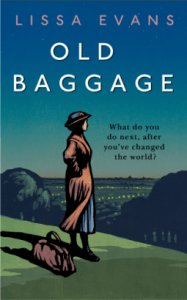 Old Baggage by Lissa Evans (eARC, NetGalley)
What do you do next, after you’ve changed the world?
It is 1928. Matilda Simpkin, rooting through a cupboard, comes across a small wooden club – an old possession of hers, unseen for more than a decade. Mattie is a woman with a thrilling past and a chafingly uneventful present. During the Women’s Suffrage Campaign she was a militant. Jailed five times, she marched, sang, gave speeches, smashed windows and heckled Winston Churchill, and nothing – nothing – since then has had the same depth, the same excitement.
Now in middle age, she is still looking for a fresh mould into which to pour her energies. Giving the wooden club a thoughtful twirl, she is struck by an idea – but what starts as a brilliantly idealistic plan is derailed by a connection with Mattie’s militant past, one which begins to threaten every principle that she stands for.


