Hosted by Taking on a World of Words, this meme is all about the three Ws:
- What are you currently reading?
- What did you recently finish reading?
- What do you think you’ll read next?
Why not join in too? Leave a comment with your link at Taking on a World of Words and then go blog hopping!
Currently reading
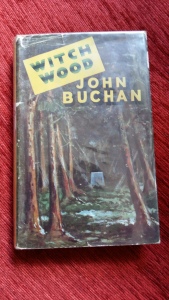 Witch Wood by John Buchan (hardcover)
Set against the religious struggles and civil wars of seventeenth century Scotland, John Buchan’s Witch Wood is a gripping atmospheric tale.
As a moderate presbyterian minister, young David Sempill disputes with the extremists of his faith, as all around, the defeated remnants of Montrose’s men are being harried and slaughtered. There are still older conflicts to be faced however, symbolised by the presence of the Melanudrigall Wood, a last remnant of the ancient Caledonian forest. Here there is black magic to be uncovered, but also the more positive pre-Christian
 Gothic Tales by Elizabeth Gaskell (ebook)
‘Such whispered tales, such old temptations and hauntings, and devilish terrors’
Elizabeth Gaskell’s chilling Gothic tales blend the real and the supernatural to eerie, compelling effect. ‘Disappearances’, inspired by local legends of mysterious vanishings, mixes gossip and fact; ‘Lois the Witch’, a novella based on an account of the Salem witch hunts, shows how sexual desire and jealousy lead to hysteria; while in ‘The Old Nurse’s Story’ a mysterious child roams the freezing Northumberland moors. Whether darkly surreal, such as ‘The Poor Clare’, where an evil doppelganger is formed by a woman’s bitter curse, or mischievous like ‘Curious, if True’, a playful reworking of fairy tales, all the pieces in this volume form a start contrast to the social realism of Gaskell’s novels, revealing a darker and more unsettling style of writing.
 The Senator’s Assignment by Joan E. Histon (eARC, courtesy of Random Things Tours)
Being trusted by a Caesar makes him an enemy of the Roman who crucified Jesus Christ, and puts him under threat from Rome itself…
Rome 30 AD – A Senator is plunged into the dark heart of the Roman Empire, sent to investigate the corrupt practices of Pontius Pilate in Jerusalem by Caesar Tiberius.
In this tense historical thriller can Senator Vivius Marcianus outmanoeuvre charges of treason, devastating secrets resurfaced from his own troubled past, and the political snake pit of Rome to save himself and the woman he loves?
Pre-order The Senator’s Assignment from Amazon UK
Recently finished (click on title for review)
 False Lights by K. J. Whittaker (ebook)
Cornwall, 1817. What if your worst mistake changed the course of history?
Napoleon has crushed the Duke of Wellington at the Battle of Waterloo, and his ex-wife Josephine presides over French-occupied England.
Cornwall erupts into open rebellion, and young heiress Hester escapes with Crow, Wellington’s former intelligence officer, a half-French aristocrat haunted by his part in the catastrophic defeat. Together, they become embroiled in a web of treachery and espionage as plans are laid to free Wellington from secret captivity in the Scilly Isles and lead an uprising against the French occupation. In a country rife with traitors, Hester and Crow know it is impossible to play such a game as this for long… (Review to follow)
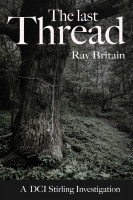 The Last Thread by Ray Britain (ebook, review copy courtesy of the author)
Accused of pushing a boy to his death in a failed suicide intervention, DCI Doug Stirling is suspended from duty. Attacked in the media and haunted by the boy’s smile as he let go of Stirling’s hand, he must look on helplessly as the incompetent Chief Inspector Ballard who is intent on destroying him investigates the boy’s death, supported by the vindictive Deputy Chief Constable, McDonald.
Weeks later, an anonymous call leads the police to a remote location and the discovery of a burnt-out car containing the body of an unidentified man who has been savagely murdered. Short of experienced senior investigators, ACC Steph Tanner has no choice but to take a professional risk. Throwing Stirling the lifeline he needs to restore his reputation, Tanner appoints him as SIO to lead the investigation.
But with no witnesses, no forensic evidence and more theories than investigators, Stirling’s investigation has far too many ‘loose threads’ as he uncovers a complex, interwoven history of deception, betrayal and sadistic relationships. Was the victim connected to the crime scene? Is the murder as complex as it appears? Or is there a simpler explanation? Still traumatised by the boy’s death and with time the enemy, does Stirling still have what it takes to bring the killer, or killers, to justice before McDonald intervenes?
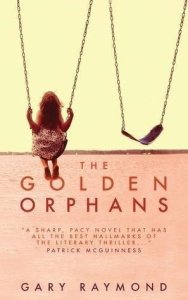 The Golden Orphans by Gary Raymond (ARC, courtesy of Damp Pebbles Blog Tours)
Within the dark heart of an abandoned city, on an island once torn by betrayal and war, lies a terrible secret…
Francis Benthem is a successful artist; he’s created a new life on an island in the sun. He works all night, painting the dreams of his mysterious Russian benefactor, Illy Prostakov. He writes letters to old friends and students back in cold, far away London. But now Francis Benthem is found dead. The funeral is planned and his old friend from art school arrives to finish what Benthem had started. The painting of dreams on a faraway island. But you can also paint nightmares and Illy has secrets of his own that are not ready for the light. Of promises made and broken, betrayal and murder…
What Cathy (will) Read Next
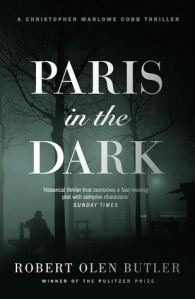 Paris in the Dark by Robert Olen Butler (paperback, review copy courtesy of No Exit Press and Random Things Tours)
Autumn 1915 – The First World War is raging across Europe. Woodrow Wilson has kept Americans out of the trenches, although that hasn’t stopped young men and women from crossing the Atlantic to volunteer at the front.
Christopher Marlowe ‘Kit’ Cobb, a Chicago reporter and undercover agent for the US government is in Paris when he meets an enigmatic nurse called Louise. Officially in the city for a story about American ambulance drivers, Cobb is grateful for the opportunity to get to know her but soon his intelligence handler, James Polk Trask, extends his mission. Parisians are meeting ‘death by dynamite’ in a new campaign of bombings, and the German-speaking Kit seems just the man to discover who is behind this – possibly a German operative who has infiltrated with the waves of refugees?
And so begins a pursuit that will test Kit Cobb, in all his roles, to the very limits of his principles, wits and talents for survival.
Pre-order Paris in the Dark from Amazon UK
 The Magick of Master Lilly by Tobsha Learner (ebook, NetGalley)
In 1641, the country of England stands divided. London has become a wasps’ nest of spies, and under the eyes of the Roundheads those who practice magic are routinely sent to hang.
Living in exile in the Surrey countryside is the Master Astrologer and learned magician William Lilly. Since rumours of occult practice lost him the favour of Parliament, he has not returned to the city. But his talents are well-known, and soon he is called up to London once more, to read the fate of His Majesty the King.
What he sees in the stars will change the course of history.
Only Lilly and a circle of learned astrologers – Cunning Folk – know that London is destined to suffer plague and fire before the decade is through, and must summon angel and demon to sway the political powers from the war the country is heading toward. In doing so, Lilly will influence far greater destinies than his own and encounter great danger. But there will be worse to come . . .
An epic telling of the role of magic in the English Civil War, The Magick of Master Lilly is the story of the most influential astrologer in English history.