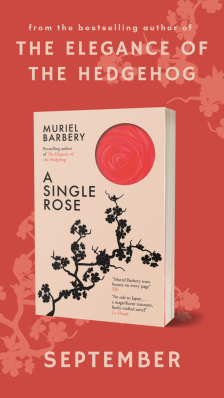
#BlogTour #BookReview A Single Rose by Muriel Barbery, translated by Alison Anderson @BelgraviaB

Welcome to today’s stop on the blog tour for A Single Rose by Muriel Barbery, translated from French by Alison Anderson. My thanks to Isabelle at Gallic Books for inviting me to take part in the tour and for my review copy.


A Single Rose Blog Tour CoverAbout the Book

Rose has turned 40, but has barely begun to live. When the Japanese father she never knew dies and she finds herself an orphan, she leaves France for Kyoto to hear the reading of his will.

In the days before Haru’s last wishes are revealed, Rose is led around the city of temples by his former assistant, Paul. Initially a reluctant tourist, Rose gradually comes to discover her father’s legacy through the itinerary he set for her, finding gifts greater than she had ever imagined.

Format: Paperback (144 pages)               Publisher: Gallic Books
Publication date: 23rd September 2021 Genre: Contemporary Fiction, Literature in Translation

Find A Single Rose on Goodreads

Purchase links
Bookshop.org
Disclosure: If you buy a book via the above link, I may earn a commission from Bookshop.org, whose fees support independent bookshops

Publisher | Hive | Amazon UK
Links provided for convenience only, not as part of an affiliate programme


My Review

From the start of the book the reader, like Rose, is immersed in the culture of Japan: its food, its customs and traditions, even its weather. Each chapter of the book is preceded by a Japanese folk tale or legend which subtly, often obliquely, informs the content of the chapter that follows. There are trees and flowers everywhere – carnations, peonies, magnolia, azaleas – often in hues of red. You would expect their presence to excite Rose’s interest, being a botanist by profession, but her reaction is more ambivalent.  She is seemingly unmoved by their beauty but drawn to their shapes and symbolism. This is reflected in the story of Issa, a famous Japanese poet, who, when asked why he only visited a plum orchard famed for its blossom when the trees were bare replied, ‘I have waited a long time in a state of deprivation; now the plum blossom is inside me’.

To some extent this also describes Rose’s mood when she arrives in Kyoto for the reading of her father’s will; the father she never met. She is full of repressed anger towards her father. ‘What can he give me now?’ she asked. ‘What can absence and death give me? Money? An apology? Lacquered tables?’ Much of her angst is experienced by Paul, her father’s assistant, charged with accompanying Rose on an intinerary compiled by her father shortly before his death.  Poor Paul, who has known loss of his own, puts up with this out of loyalty to Rose’s father.  For a long time, Rose actively resists being drawn to any aspect of her father’s life, resenting rather than appreciating the evidence that emerges of his interest in her life, even if from afar.  Gradually she starts to soften as she absorbs the atmosphere of the temples and gardens she and Paul visit.  The sake helps a little too and soon self-deprecating humour replaces her previous abrasive and petulant nature.

Muriel Barbery’s writing has an etheral, almost dreamlike quality, carefully preserved in Alison Anderson’s translation. I especially liked the evocative descriptions of the temples and gardens Rose visits, the landscape in and around Kyoto, and the weather. Waking up to heavy rain one morning, Rose observes ‘The mountains of the East steamed with mist rising into a diaphonous sky; the river was silenced by the downpour.’ On another morning, the view from her window is of mountain slopes ‘bathed in thick mist that rose in successive exhalations towards a transparent sky’.

By the end of her stay, Rose finds she has become a different person, able to put past disappointments behind her and look to a future that offers so much more than she might have imagined.

A Single Rose is the sort of book you need to linger over, much as you might a cup of fragrant Japanese tea, gradually taking in and appreciating its delicate, subtle features.

In three words: Profound, lyrical, sensuous

Follow this blog via Bloglovin


Muriel-Barbery-©-Catherine-Hélie-Editions-GallimardAbout the Author

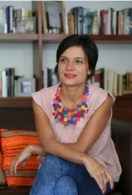
Muriel Barbery is the author of four previous novels, including the IMPAC-shortlisted multimillion-copy bestseller The Elegance of the Hedgehog. She has lived in Kyoto, Amsterdam and Paris, and now lives in the French countryside. (Photo credit: Publisher author page)

About the Translator

Alison Anderson is an author and the translator of around 100 books from French, including Muriel Barbery’s previous novels and works by Amélie Nothomb and J. M. G. Le Clézio.

#BookReview Planet of Clay by Samar Yazbek, translated by Leri Price @WorldEdBooks

Planet of Clay 2About the Book

Rima is a young girl in war-torn Damascus. Her feet seem to work independently, she says. Is this an affliction? Or is she just an inquisitive, adventurous young child? Her exhausted mother keeps her tied with a rope around her wrist to stop her wandering off.

As a young girl, Rima also loses the ability to speak, although she can recite sutras of Qur’an. And she can use her voice to scream – which, tragically, happens more as the story progresses.

Hidden in the library of the school where her mother works as a cleaner, she finds refuge in a fantasy world full of coloured crayons, secret planets, and The Little Prince, reciting passages of the Qur’an like a mantra as everything and everyone around her is blown to bits.

Since Rima hardly ever speaks, people think she’s crazy, but she is no fool – the madness is in the battered city around her. One day while taking a bus through Damascus, a soldier opens fire and her mother is killed. Rima, wounded, is taken to a military hospital before her brother leads her to the besieged area of Ghouta – where, between bombings, she writes her story.

In Planet of Clay, Samar Yazbek offers a surreal depiction of the horrors taking place in Syria, in vivid and poetic language and with a sharp eye for detail and beauty.

Format: Paperback (320 pages)        Publisher: World Editions
Publication date: 26th August 2021 Genre: Literature in Translation, Literary Fiction

Find Planet of Clay on Goodreads

Purchase links
Bookshop.org
Disclosure: If you buy a book via the above link, I may earn a commission from Bookshop.org, whose fees support independent bookshops

Hive | Amazon UK
Links provided for convenience only, not as part of an affiliate programme


My Review

I don’t think Planet of Clay is a book I would have picked up had it not been for Ruth Killick and World Editions kindly sending me an advance review copy.  How glad I am that they did because reading this book was to enter a strange, unsettling world and meet an unforgettable character.

Translated from Arabic by Leri Price, Planet of Clay‘s narrator, Rima, recounts her story in a non-linear fashion, switching back and forth in time between different memories of events she has witnessed.  The stories seem to pour out of her, with many left unfinished as she takes up another story, along with frequent promises that she will return at some point to complete the earlier stories.  As she admits, ‘I’m writing without restraint and without sequence’. This takes some getting used to but I found it best to go with the flow and see where Rima took me.

Through Rima’s eyes the reader experiences the horror of daily life in war-torn Damascus: checkpoints, armed militia and tanks on the street, aeroplanes flying overhead and the sound of bombs falling across the city. ‘We wait, every day, for the bombs to fall on us.’ At one point, she muses, ‘I don’t understand how a giant plane can come and kill small, weak people in such quantities.’ Quite.  Rima witnesses random acts of violence, one of which results in the death of her mother, just one of the people who disappears from Rima’s life. Worse is to come as parts of the city are subjected to attack from lethal weapons. In the words of Rima, ‘the planes and the sky rained smells in August‘.  Rima herself suffers the after-effects of this attack.

Rima’s view of the world is different from those around her, sensed as colours rather than words, and expressed through drawings. For her, ‘every adjective in language is like a painting‘. The writing has moments of intense beauty with some memorable turns of phrase, often influenced by Rima’s beloved The Little Prince by Antoine de Saint-Exupéry. ‘Love is a group of small planets with long thin arms dancing then lacing together into a knot of dazzling light.’

Before long, Rima’s existence has contracted to a tiny cellar room which she cannot leave. She perceives her life as a series of planets, and retreats in her mind to the most secret of them, one which is ‘hard to invade’ and cannot disappear until she disappears too. And as for the book’s title?  As Rima observes, ‘We are toys made out of clay, small toys, quick to break and crumble’.

Towards the end of the book Rima observes, ‘You are starting to know my theory now, about circular stories with intersecting centres which are only completed by retelling and new details’.  The stories Rima tells are heartbreaking and paint a unique picture of a world gone mad. I’m sure I won’t be the only reader to see parallels with the terrible events taking place in Afghanistan.

In three words: Mesmerising, imaginative, moving

Try something similar: The Storyteller by Pierre Jarawan

Follow this blog via Bloglovin


Samar YazbekAbout the Author

Samar Yazbek is a Syrian writer, novelist, and journalist. She was born in Jableh in 1970 and studied literature before beginning her career as a journalist and a scriptwriter for Syrian television and film. Her novels include Cinnamon (2012) and Planet of Clay (2021). Her accounts of the Syrian conflict include A Woman in the Crossfire: Diaries of the Syrian Revolution (2012) and The Crossing: My Journey to the Shattered Heart of Syria (2015). Yazbek’s work has been translated into multiple languages and has been recognized with numerous awards – notably, the French Best Foreign Book Award, the PEN-Oxfam Novib, PEN Tucholsky, and PEN Pinter awards.

Connect with Samar
Goodreads

About the Translator

Leri Price is an award-winning literary translator of contemporary Arabic fiction. Price’s translation of Khaled Khalifa’s Death Is Hard Work was a finalist for the 2019 National Book Award for Translated Literature (US) and winner of the 2020 Saif Ghobash Banipal Prize for Arabic Literary Translation. Her translation of Khaled Khalifa’s No Knives in the Kitchens of This City was shortlisted for the ALTA National Translation Award. Price’s other recent translations include Sarab by award-winning writer Raja Alem.