#BookReview End of Summer by Anders de la Motte @ZaffreBooks

End of SummerAbout the Book

You can always go home. But you can never go back…

Summer 1983: Four-year-old Billy chases a rabbit in the fields behind his house. But when his mother goes to call him in, Billy has disappeared. Never to be seen again.

Today: Veronica is a bereavement counsellor. She’s never fully come to turns with her mother’s suicide after her brother Billy’s disappearance. When a young man walks into her group, he looks familiar and talks about the trauma of his friend’s disappearance in 1983. Could Billy still be alive after all this time?

Needing to know the truth, Veronica goes home – to the place where her life started to fall apart. But is she really prepared for the answers that wait for her there?

Format: Paperback (480 pages)        Publisher: Zaffre
Publication date: 19th August 2021 Genre: Crime, Mystery

Find End of Summer on Goodreads

Purchase links
Bookshop.org
Disclosure: If you buy a book via the above link, I may earn a commission from Bookshop.org, whose fees support independent bookshops

Hive | Amazon UK
Links provided for convenience only, not as part of an affiliate programme


My Review

End of Summer was first published in Sweden in 2016 where it was shortlisted for Novel of the Year in the Swedish Crime Writers’ Academy Awards. Now available in English, it’s the second book in the ‘Seasons Quartet’ with Dead of Winter and Deeds of Autumn due out in January and October 2022 respectively, joining Rites of Spring which was published in April 2021, although each book is a standalone story.

End of Summer unfolds in alternating chapters, moving between past and present – the summer of 1983 and the present day. For me this structure really worked as I was constantly wondering what was going to happen next in the other timeline, although later in the book, one of the timelines predominates. Throughout the book the author’s  ability to deliver a teasing last line adds to the suspense, as does the occasional inclusion of a series of letters from an undisclosed correspondent, the significance of which only becomes evident in the closing chapters.

As the mystery of Billy Nilsson’s disappearance remains unresolved, the reader sees played out the disturbing effect it has on the family, the small community of Reftinge in which they live, and the police officer charged with investigating it, Chief of Police Månsson. Unfamiliar with investigating a crime of this magnitude, Månsson feels out of his depth but deeply conscious of his obligation to provide an answer for the Nilsson family. Månsson can’t help imagining what it would be like if it was one of his own sons who had gone missing. At one point he reflects, “I’m doing my best… I’m trying to be a good husband, a good father. A good police officer.” I found him a very empathetic character. The pressure on Månsson only increases when what evidence there is seems to point to a particular individual.

Moving to the present day, Billy’s sister, Vera, has reinvented herself as Veronica. The reasons for this remain tantalizingly unclear for much of the book; all the reader knows is that she seems to have experienced more than one traumatic event in her life. Ironically, Veronica is now working as a bereavement counsellor running grief therapy sessions at which those attending share the impact of their loss. The author shows a deft touch here, one phrase in particular sticking in my mind: the description of the tears shed by a member of the group as being ‘tiny, translucent pearls of grief’. An unxpected arrival at one of Veronica’s sessions triggers disturbing memories and sets in motion a chain of events which increasingly spirals out of control, triggering feelings of panic and paranoia.

When Veronica returns home to the family farm at the urging of her brother Mattias, Reftinge seen through her eyes is rather rundown. However, that feeling is soon replaced by the spine-tingling atmosphere the author creates as Veronica pursues her own investigation into the disappearance of her brother, heedless to the risks she runs in doing so. But how much of what she experiences is imagined, how much is real?

The author lays down plenty of false trails that certainly had me foxed. I developed several theories but the answer to the question ‘Where is Billy?’ when it is finally revealed definitely wrong-footed me. The solution was both more complex and more heartrending than anything I could have come up with.

End of Summer is a compelling mystery but also an absorbing and insightful picture of a family coping with the disappearance of a child: the unanswered questions, the dashed hopes, and the sense of absence. I found it absolutely gripping from start to finish and it’s a book I definitely won’t forget in a hurry.  I must also commend the translator, Neil Smith. If I hadn’t known, I certainly wouldn’t have guessed the book was originally written in Swedish.

My thanks to Clare Kelly at Zaffre for my proof copy of End of Summer. I shall certainly be looking out for future books in the series.

In three words: Gripping, moving, masterful

Try something similar: The Missing Girl by Jenny Quintana

Follow this blog via Bloglovin


Anders de la MotteAbout the Author

Anders de la Motte is the bestselling author of the ‘Seasons Quartet’; the first three of which – End of Summer, Deeds of Autumn and Dead of Winter – have all been number one bestsellers in Sweden and have been shortlisted for the Swedish Academy of Crime Writers’ Award for Best Crime Novel of the Year. Anders, a former police officer, has already won a Swedish Academy of Crime Award for his debut, Game, in 2010 and his second standalone, The Silenced, in 2015.
To date, the first three books in the ‘Seasons Quartet’ have sold over half a million copies, with the fourth, Rites of Spring, publishing in Sweden in 2020. Set in Southern Sweden, all four books can be read as standalone novels.
Connect with Anders

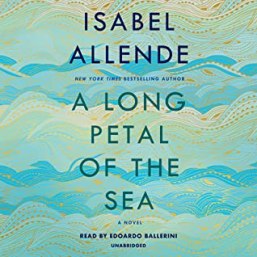
#BookReview A Long Petal of the Sea by Isabelle Allende

A Long Petal of the SeaAbout the Book

Victor Dalmau is a young doctor when he is caught up in the Spanish Civil War, a tragedy that leaves his life – and the fate of his country – forever changed. Together with his sister-in-law, he is forced out of his beloved Barcelona and into exile in Chile. There, they find themselves enmeshed in a rich web of characters who come together in love and tragedy over the course of four generations, destined to witness the battle between freedom and repression as it plays out across the world.

Format: Audiobook (9h 46m)             Publisher: Bloomsbury
Publication date: 21st January 2020  Genre: Historical Fiction, Literary Fiction

Find A Long Petal of the Sea on Goodreads

Purchase links
Bookshop.org
Disclosure: If you buy a book via the above link, I may earn a commission from Bookshop.org, whose fees support independent bookshops

Hive | Amazon UK
Links provided for convenience only, not as part of an affiliate programme


My Review

I’m almost ashamed to admit that this is the first book I’ve read by Isabel Allende mainly because she’s known for her works of magic realism which is a genre I’ve been unable to get along with. However, when I saw the description of this book, especially that it was partly set during the Spanish Civil War and its aftermath, I thought this might be my opportunity to experience her writing. I listened to the audiobook version, skilfully narrated by Edoardo Ballerini.

The book, translated by Amanda Hopkinson and Nick Caistor, vividly recreates the chaos and confusion of the Spanish Civil War and its terrible toll on Spanish citizens, tearing apart families and communities, plunging others into homelessness, poverty and hunger, and forcing many into exile. Mixing historical events with both real and fictional characters, each chapter of the book opens with an excerpt from the works of renowned Chilean poet Pablo Neruda.

The book tells the story of Victor Dalmau, a young doctor who is caught up on the Republican side in the Spanish Civil War and is forced to flee to France with Roser, the wife of his brother who was killed fighting against the forces of Franco. Although I had heard of Pablo Neruda, I had no idea of his role in helping refugees from the conflict to emigrate to Chile, the country whose description as the ‘long petal of the sea’ inspires the book’s title.

There are vivid scenes aboard the SS Winnipeg, as Victor and Roser make the dangerous and uncomfortable voyage across the Atlantic, through the Panama canal, into the Pacific and their eventual arrival in Chile. There Victor pursues his ambition to become a doctor, alongside running a tavern (named Winnipeg in honour of the ship that carried them to safety), and Roser builds a career as a musician. Having entered into a ‘marriage of convenience’ in order to secure their entry into Chile, Victor and Roser pursue separate relationships whilst at the same time finding there remains a strong connection between them. Their past life in Spain is not completely left behind either despite the thousands of miles that divide them from their homeland and from people they believed lost forever.

Alongside the fIctional story of Victor and Roser’s new life in Chile, the book describes the political changes in that country from the end of the Second World War onwards, including the rise to power of Salvador Allende (a distant relative of the author), his subsequent overthrow and assassination, and the coming of the brutal Pinochet regime. I’ll admit that, at times, my attention wandered during this part of the book as it felt more like a history lesson – albeit one influenced by the author’s own heritage – than a story inspired by the characters she had created. However, the book was redeemed for me by the final section which charts, in the most powerful and emotional way possible, the final years of the lives of Victor and Roser.

Spanning decades and a number of generations, A Long Petal of the Sea is an epic family saga that vividly demonstrates the emotional turmoil and suffering caused by war but also serves as an insight into turbulent periods in the history of both Spain and Chile.

In three words: Powerful, eventful, epic

Try something similar: Those I Have Lost by Sharon Maas

Follow this blog via Bloglovin


Isabel AllendeAbout the Author

Born in Peru and raised in Chile, Isabel Allende is the author of The House of the Spirits, Daughter of Fortune, PaulaMy Invented Country and The Japanese Lover. Her books have been translated into more than 35 languages and have sold over 65 million copies worldwide. The Japanese Lover was an international and New York Times bestseller. She lives in California. (Photo credit: Publisher author page)

Connect with Isabel
Website